
Kadant’s Sustainable Industrial Processing: Strategic Leverage, Leadership Transition, and the Next Phase of Value Creation
Kadant Inc. demonstrates robust profitability and a reported balance sheet position as it deepens its focus on sustainable industrial processing. With a new CEO taking the helm in 2027, the company faces both opportunity and uncertainty in leveraging its engineering expertise and global footprint to capture growth in efficiency-driven process industries.
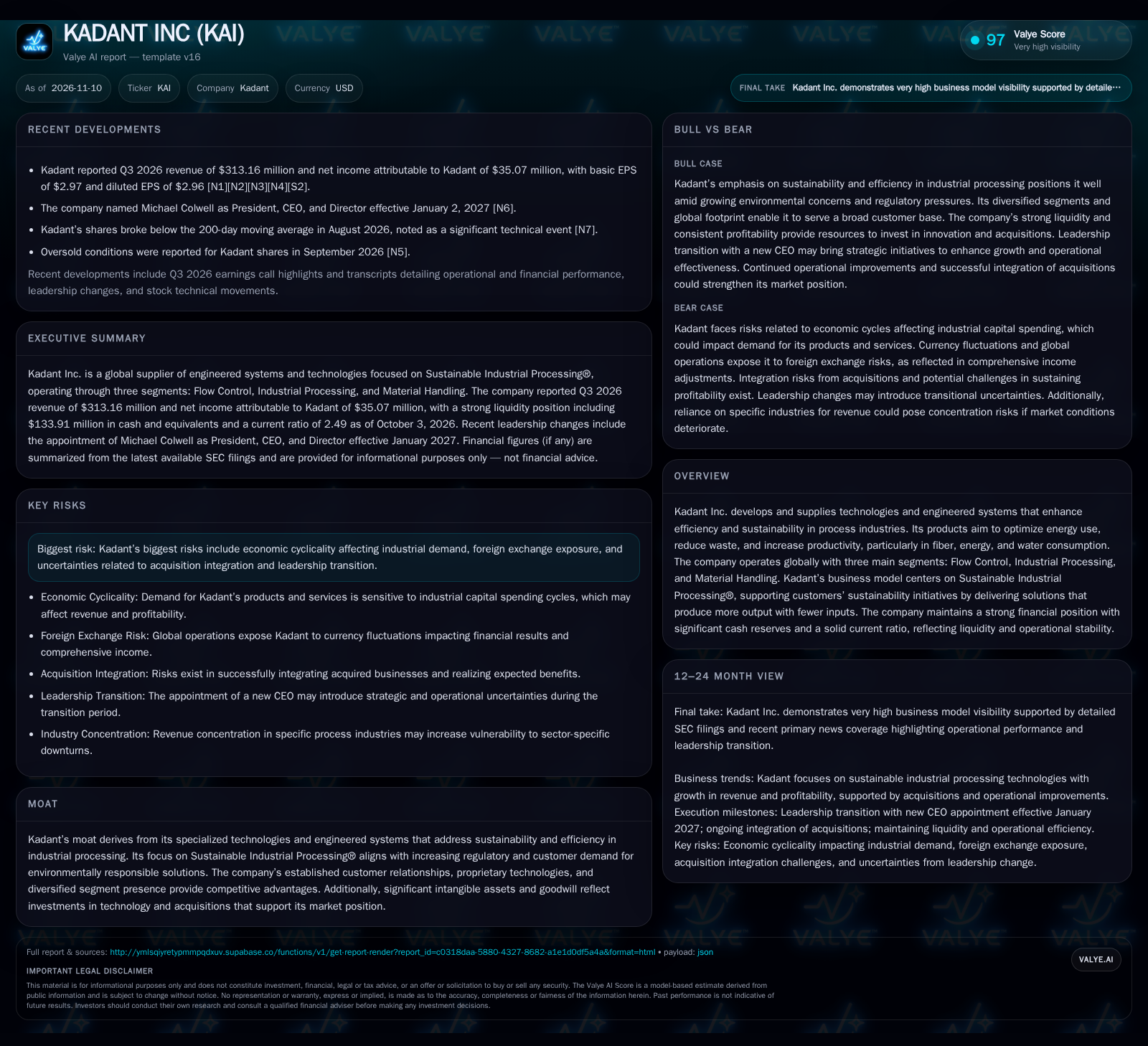
Kadant’s recent quarter saw strong revenue and net income growth, backed by reported liquidity position and a business model centered on sustainability and operational efficiency. The upcoming CEO transition introduces a potential inflection point—future performance will hinge on the company’s ability to integrate acquisitions, navigate cyclical industrial demand, and sustain innovation in engineered systems for process industries. [S2] [N6]
Kadant Inc. stands at a pivotal juncture as it continues to deliver solid financial results and invests in sustainable industrial processing technologies. The company’s Q3 2026 performance underscores resilient demand for efficiency- and sustainability-focused engineered systems, while a substantial cash position and reported current ratio offer operational leeway. However, the imminent CEO transition and ongoing global economic uncertainties present both opportunities and execution risks. How Kadant leverages its technical moat and navigates cyclicality will shape its value trajectory in the coming years. [S2] [N6]
Recent Financial Performance and Impending Leadership Change Set the Stage
Kadant’s Q3 2026 results highlight revenue of $313.16 million and net income attributable to Kadant of $35.07 million, with diluted earnings per share at $2.96. These figures represent clear year-over-year growth and confirm ongoing profitability improvements, suggesting that demand for the company’s engineered systems remains robust. The company’s liquidity profile is underscored by $133.91 million in cash and equivalents and a current ratio of 2.49 as of October 3, 2026. [S2]
A notable strategic development is the appointment of Michael Colwell as President, CEO, and Director, effective January 2, 2027. This leadership transition is likely to influence Kadant’s strategic priorities and operational tempo, introducing both the potential for fresh initiatives and the risk of transitional disruption. [N6]
How Kadant’s Business Model Drives Profitability and Capital Allocation
Kadant generates revenue by supplying engineered systems and technologies that help process industries optimize resource use—fiber, energy, water—while reducing waste. Its three segments—Flow Control, Industrial Processing, and Material Handling—provide a mix of capital equipment and ancillary solutions. This structure typically yields a blend of upfront equipment sales, aftermarket components, and service revenues. If the company’s solutions are deeply embedded in customer production lines, recurring aftermarket and service revenue could help smooth earnings across cycles, though segment-level mechanics are not fully disclosed.
The company’s operating leverage is visible in its recent results: with Q3 2026 operating income of $53.55 million on $313.16 million in revenue, Kadant demonstrated the ability to translate revenue growth into margin expansion. Its cost structure likely combines high fixed R&D and engineering expense with variable manufacturing and installation costs, supporting incremental margin improvement as volumes rise.
Kadant’s capital needs are moderate relative to its scale, with $138.33 million in operating cash flow for the first nine months of 2026 and ongoing investment in acquisitions and capital expenditures. The presence of $658.10 million in goodwill and $345.39 million in intangible assets on the balance sheet reflects a history of M&A, which can augment growth but also introduces integration and impairment risks. [S2]
The interplay between Kadant’s capital allocation strategy and its business model is critical to sustaining profitability and growth. Given the company’s moderate capital intensity, management must balance investment in organic R&D with strategic acquisitions to maintain technological leadership without overextending financial resources. A disciplined capital allocation approach that prioritizes high-return projects and bolt-on acquisitions aligned with core competencies could enhance shareholder value over time. Conversely, excessive reliance on acquisitions without commensurate integration success or innovation could strain cash flow and dilute returns, especially if goodwill impairment risks materialize.
Engineering Differentiation and Sustainability Alignment Shape Competitive Defenses
Kadant’s competitive position hinges on proprietary process technologies designed to help industrial customers meet sustainability and efficiency targets. This focus on Sustainable Industrial Processing® creates a moat where regulatory trends and customer preferences increasingly favor solutions that reduce energy, water, and raw material consumption. The company’s installed base, engineering know-how, and integration with critical process lines may increase switching costs, though the depth and durability of these frictions are not specifically quantified.
Competition comes from large diversified industrial equipment manufacturers, as well as niche engineering firms specializing in flow control or industrial automation. The pace of technology substitution—such as digitalization or alternative process chemistries—could erode differentiation if Kadant’s R&D does not keep pace. Additionally, the company’s global exposure subjects it to currency risk and local market dynamics, which can both help and hinder competitive standing depending on macroeconomic conditions.
Decarbonization Mandates and Operational Integration Unlock Accelerated Value
A favorable scenario for Kadant sees regulatory and customer-driven decarbonization accelerating capital investment in process industries, driving demand for energy- and resource-efficient systems. If Kadant successfully integrates recent acquisitions and leverages its balance sheet for targeted R&D or bolt-on deals, it could expand its addressable market and deepen penetration with existing customers.
Confirmation of this scenario would come from above-trend revenue growth in both legacy and newly acquired segments, sustained operating margin expansion, and disclosures of multi-year customer commitments or recurring aftermarket/service revenue. A visible pipeline of innovation and tangible market share gains in sustainability-driven projects would further validate this trajectory.
Resilient Demand Meets Cyclical Headwinds and Integration Complexity
The most plausible outcome is that Kadant continues to grow modestly above global industrial production rates, with sustainability trends offsetting some cyclical weakness in customer capital spending. Revenue and profit growth may decelerate from recent highs as parts of the process industries delay capex in response to macro uncertainty, but aftermarket and service revenues help buffer volatility.
This scenario would be confirmed by stable or slightly rising revenues across segments, steady operating margins, and limited impairment charges on recent acquisitions. Evidence of successful integration—such as cost synergies or customer cross-selling—would further support this base case. Conversely, abrupt revenue declines in a major segment, margin compression, or acquisition-related write-downs would signal deviation from this path.
Prolonged Industrial Downturn and Integration Missteps Erode Value
A negative scenario unfolds if global process industries enter a sustained downturn, sharply curtailing capital spending and delaying efficiency-oriented upgrades. In this environment, Kadant’s revenue would contract, operating leverage would work in reverse, and fixed costs would pressure margins. If recent acquisitions are poorly integrated or overvalued, goodwill impairments or restructuring charges could follow, eroding both earnings and balance sheet strength.
This scenario would be confirmed by sequential revenue declines, significant margin contraction, rising inventory or receivables, and public acknowledgment of integration challenges or asset impairments. Early warning signs could include missed earnings guidance and negative operating cash flow trends.
Milestones and Metrics That Will Shape Kadant’s Value Creation Thesis
Revenue growth by segment, especially in Industrial Processing and Material Handling, as a gauge of end-market demand and effectiveness of sustainability-aligned offerings (if disclosed).
Operating margin trends and the company’s ability to sustain or expand profitability through the cycle.
Aftermarket and service revenue mix, which would indicate the degree of recurring business versus capital equipment cyclicality (if disclosed).
Acquisition integration progress, including any disclosed synergies, cross-selling, or impairment charges.
R&D investment levels and new product introductions, as signals of ongoing innovation and competitive differentiation.
Impact of foreign currency translation on both reported results and comprehensive income, given global operations.
CEO transition milestones, including communication of strategic priorities and early execution signals under new leadership.
Disclaimer: This is research-only, informational analysis and not investment advice. It may include AI-generated interpretation and general industry context. Always verify important details using primary sources.

Comments