
Palladyne AI: Capitalizing on AI-Driven Autonomy—But Commercialization and Integration Risks Loom
Palladyne AI’s expansion into AI/ML foundational technology, autonomous aerial systems, avionics, and precision manufacturing positions it for a broad addressable market, but persistent operating losses, long sales cycles, and execution risks from recent acquisitions define the stakes. The company’s reported liquidity position offers time, but the path to sustainable growth hinges on converting pipeline into multi-customer revenue and operationalizing its expanded platform.
Palladyne AI is an early-stage infrastructure AI/ML and autonomous systems company with recent manufacturing and avionics acquisitions, a reported cash position, and persistent losses. With only one AI/ML foundational technology customer and long sales cycles, its challenge is converting technical assets into scalable, recurring revenue before capital needs force dilution or operational constraints. Execution on integration, contract conversion, and customer adoption will determine whether its technology platform becomes a durable business.
Palladyne AI Corp finds itself at a crossroads: its ambitious expansion across AI/ML foundational technology, autonomous aerial systems, and defense-related manufacturing creates a compelling platform for future growth, but the company’s persistent operating losses, extended sales cycles, and the formidable challenge of integrating recent acquisitions pose substantial barriers to sustained commercial success. With only one paying AI/ML foundational technology customer and significant capital requirements on the horizon, the next 12–24 months will test whether Palladyne can leverage its reported liquidity position and broadened capabilities into a scalable, defensible business—or whether it will remain mired in the high-burn, low-adoption phase that has characterized many early-stage deep tech ventures.
Recent Acquisitions and Persistent Losses Define the Operating Landscape
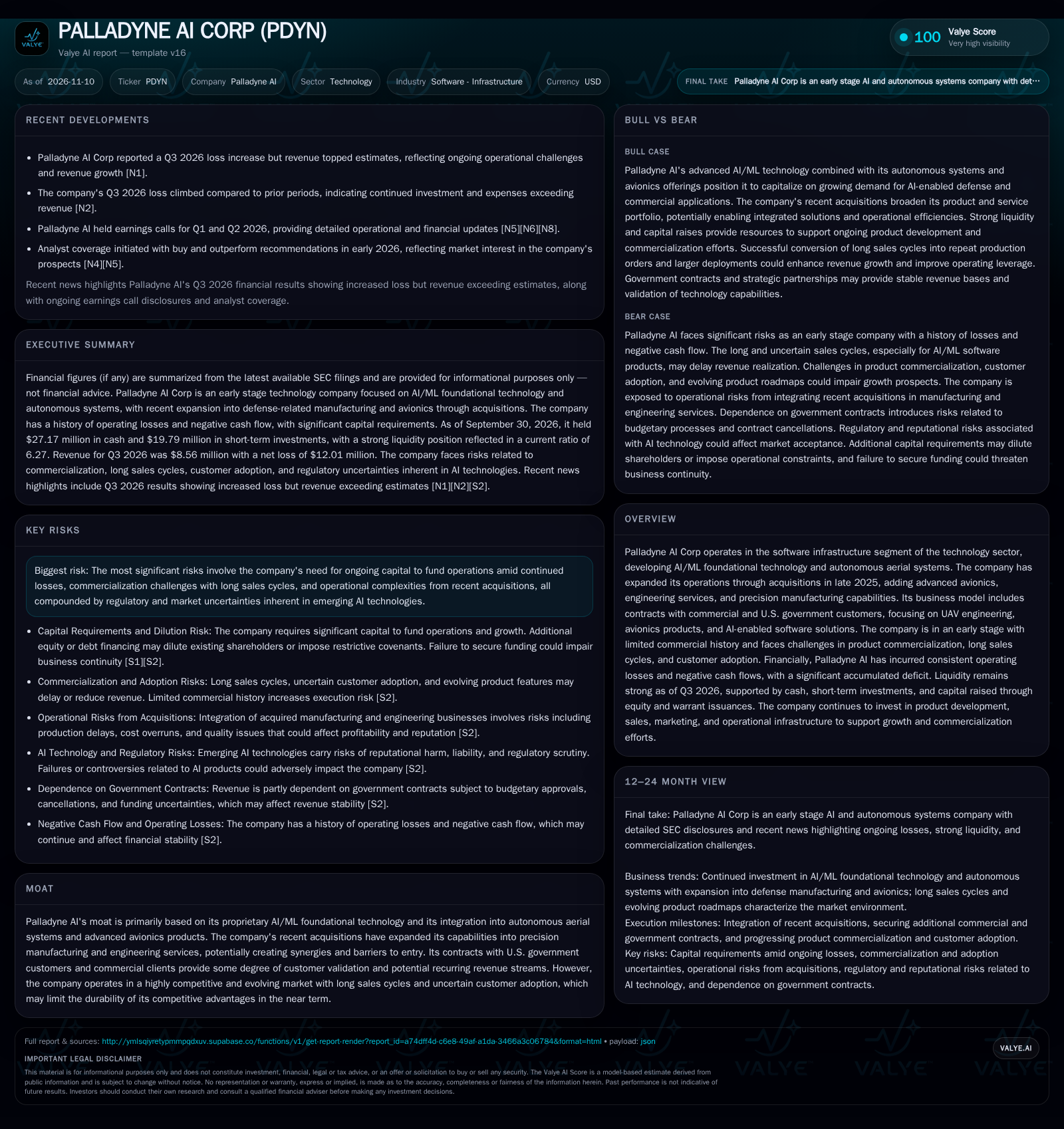
Palladyne AI’s financial and strategic position as of Q3 2026 is shaped by several material developments. The company reported $8.56 million in revenue for the quarter but a net loss of $12.01 million, continuing a trend of negative cash flow and an accumulated deficit of $517.7 million [S2]. The company reported a current ratio of 6.27 for the period. [S2] The company’s November 2025 acquisitions of GuideTech, Warnke Precision Machining, and MKR Fabricators expanded its business from pure AI/ML software into advanced avionics, engineering services, and precision manufacturing [S2]. Despite this broadened portfolio, Palladyne reported only one paying customer for its AI/ML foundational technology as of the latest filing, highlighting the early and unproven stage of its core software commercialization [S2]. The company’s revenue mix now spans commercial and U.S. government contracts, but long sales cycles (12–18 months or more) and uncertain customer adoption remain central challenges [S2].
How Palladyne AI’s Model Could Unlock Operating Leverage—If Commercialization Accelerates
Palladyne AI’s evolving business model is an exercise in high fixed costs and uncertain revenue scale. The company’s core economics depend on its ability to convert R&D-heavy, high-margin AI/ML foundational technology and autonomous systems into repeatable production contracts. The expansion into engineering services and precision manufacturing, via acquisition, introduces a more traditional contract and project-revenue dynamic—often lower margin and with greater variable cost exposure compared to pure software. In theory, successful vertical integration could create a flywheel: proprietary AI/ML algorithms embedded in custom avionics or UAV platforms, bundled with engineering and manufacturing services, could command premium pricing and increase customer stickiness. However, the reality is that with only one AI/ML foundational technology customer and a long sales cycle, the business is still in the early, lumpy revenue phase. Government contracts, while potentially large and multi-year, tend to be milestone- and deliverable-based, with slow ramp and significant risk of delay or cancellation. The company’s persistent operating losses—$38.7 million for the first nine months of 2026—reflect both the capital intensity of ongoing product development and the lack of operating leverage at current volumes [S2]. Until commercialization gains traction, negative operating cash flow will likely continue, and the mix between high-margin software and lower-margin manufacturing will be a key determinant of future profitability.
Competitive Dynamics: Proprietary AI Meets the Realities of Government and Industrial Procurement
Palladyne AI’s competitive ambition lies in integrating proprietary AI/ML technology into autonomous aerial systems and advanced avionics, offering a differentiated product suite relative to traditional defense contractors, pure-play AI startups, and established engineering services firms. Its recent acquisitions theoretically enable it to compete for larger, more integrated contracts—where a customer seeks not just software, but a full stack of AI-enabled UAVs, avionics, and supporting engineering. However, barriers to entry in these markets are high: incumbents have long-standing government relationships, validated manufacturing processes, and the scale to absorb slow procurement cycles. The company’s limited commercial history and single AI/ML foundational technology customer suggest that its technology, while differentiated, has not yet proven itself in the eyes of risk-averse buyers. Switching costs in aerospace and defense are typically substantial, but only after initial adoption and integration—so early-stage vendors face a steep credibility hurdle. Regulatory and reputational risks associated with emerging AI, as well as macro headwinds like tariffs and shifting government budgets, further complicate the competitive landscape. Palladyne’s best hope for durable advantage lies in demonstrating that its integrated solution meaningfully outperforms legacy approaches on cost, reliability, or mission capability, thereby justifying the risk of switching for early adopters.
From Pipeline to Platform: What a Successful Commercialization Inflection Would Look Like
A favorable scenario for Palladyne AI would see the company convert its long sales cycles into multiple, repeatable commercial and government contracts for integrated AI/ML and autonomous systems. This would likely require successful demonstration projects or pilot deployments that validate performance, reliability, and cost-effectiveness in real-world conditions. If the company can leverage its manufacturing and engineering acquisitions to offer turnkey solutions—bundling custom UAVs, avionics, and embedded AI—it could command higher average contract values and create cross-selling opportunities. Confirmation of this scenario would come from a sharp increase in the number of paying customers for its AI/ML foundational technology, a growing backlog of awarded contracts, and a revenue mix shifting toward higher-margin, software-enabled products. Multi-year government contracts, a move toward recurring revenue, and evidence of customer stickiness (e.g., follow-on orders, references) would further validate the thesis. This inflection would likely coincide with improving gross margins, reduced cash burn relative to sales growth, and a slowing pace of dilution as the business approaches breakeven.
Commercial Progress Remains Lumpy as Integration and Adoption Prove Slow
The most plausible near-term trajectory is one of gradual progress but continued volatility. Palladyne AI may secure incremental contract wins, particularly in engineering services or manufacturing, but struggles to drive rapid adoption of its AI/ML foundational technology. Long sales cycles persist, and the company’s revenue base remains concentrated among a handful of government and commercial customers, with limited visibility or predictability. Integration of the 2025 acquisitions adds operational complexity and may introduce execution risk, potentially resulting in higher-than-expected costs or delays in delivering on contracts. Gross margins remain under pressure due to the mix of lower-margin manufacturing and service revenue relative to high-margin software. The company continues to burn cash and requires additional capital within the next 12–24 months, resulting in further dilution or restrictive debt terms. Evidence for this scenario would include a slow increase in customer count, continued negative operating cash flow, and a lack of significant expansion in software-derived revenues relative to total sales.
Capital Constraints and Delayed Adoption Threaten Business Continuity
In a more adverse scenario, Palladyne AI’s long sales cycles and uncertain customer adoption persist, with key contract decisions delayed or lost to larger, more established competitors. Integration of recent acquisitions fails to yield operational synergies, instead introducing cost overruns, quality issues, or production delays that erode customer confidence and strain relationships. Cash burn remains high, and the company is forced to raise capital on unfavorable terms—resulting in significant dilution or operational restrictions that curtail investment in R&D and commercialization. Regulatory or reputational setbacks in the emerging AI/ML space could further impede adoption, especially if an early deployment suffers a publicized failure or controversy. Evidence for this downside would include a shrinking or stagnant customer base, mounting operating losses without a corresponding increase in backlog, and equity or debt financings at punitive terms.
Milestones That Will Define Whether Palladyne AI’s Platform Can Scale
Number of paying customers for AI/ML foundational technology—an increase would indicate traction beyond initial pilots or references. If disclosed, this metric would directly test the thesis of scalable software adoption.
Backlog of awarded commercial and government contracts—a growing backlog would suggest conversion of pipeline into revenue visibility and operational leverage.
Revenue mix by segment, especially the share attributable to high-margin AI/ML software versus lower-margin manufacturing and engineering services. Segment disclosure, if provided, would clarify the company’s path to profitability.
Gross margin trends—improvement would signal success in shifting the business toward higher-value, software-enabled offerings.
Quarterly operating cash flow and capital raise activity—persistent negative cash flow and frequent equity issuance would increase dilution risk and pressure the business model.
Integration milestones for acquired businesses, such as operational synergies, cross-selling between legacy and acquired units, or cost savings. Disclosures on integration progress would help test the company’s execution ability.
Customer concentration and renewal rates—a diversified and recurring customer base would reduce revenue volatility and indicate business maturity.
Regulatory, legal, or reputational events impacting AI/ML adoption—any material development here could quickly alter customer willingness to contract with Palladyne AI.
Disclaimer: This is research-only, informational analysis and not investment advice. It may include AI-generated interpretation and general industry context. Always verify important details using primary sources.

Comments