
KULR Technology Group: Battery Systems Expansion, IP Leverage, and the Post-Bitcoin Pivot
KULR Technology Group’s exit from bitcoin operations marks a decisive refocus on advanced battery systems, proprietary vibration management, and IP licensing. With a fortified balance sheet and new licensing deals, the company’s next phase hinges on scaling its Houston facility, deepening commercial adoption, and translating technical differentiation into recurring revenue.
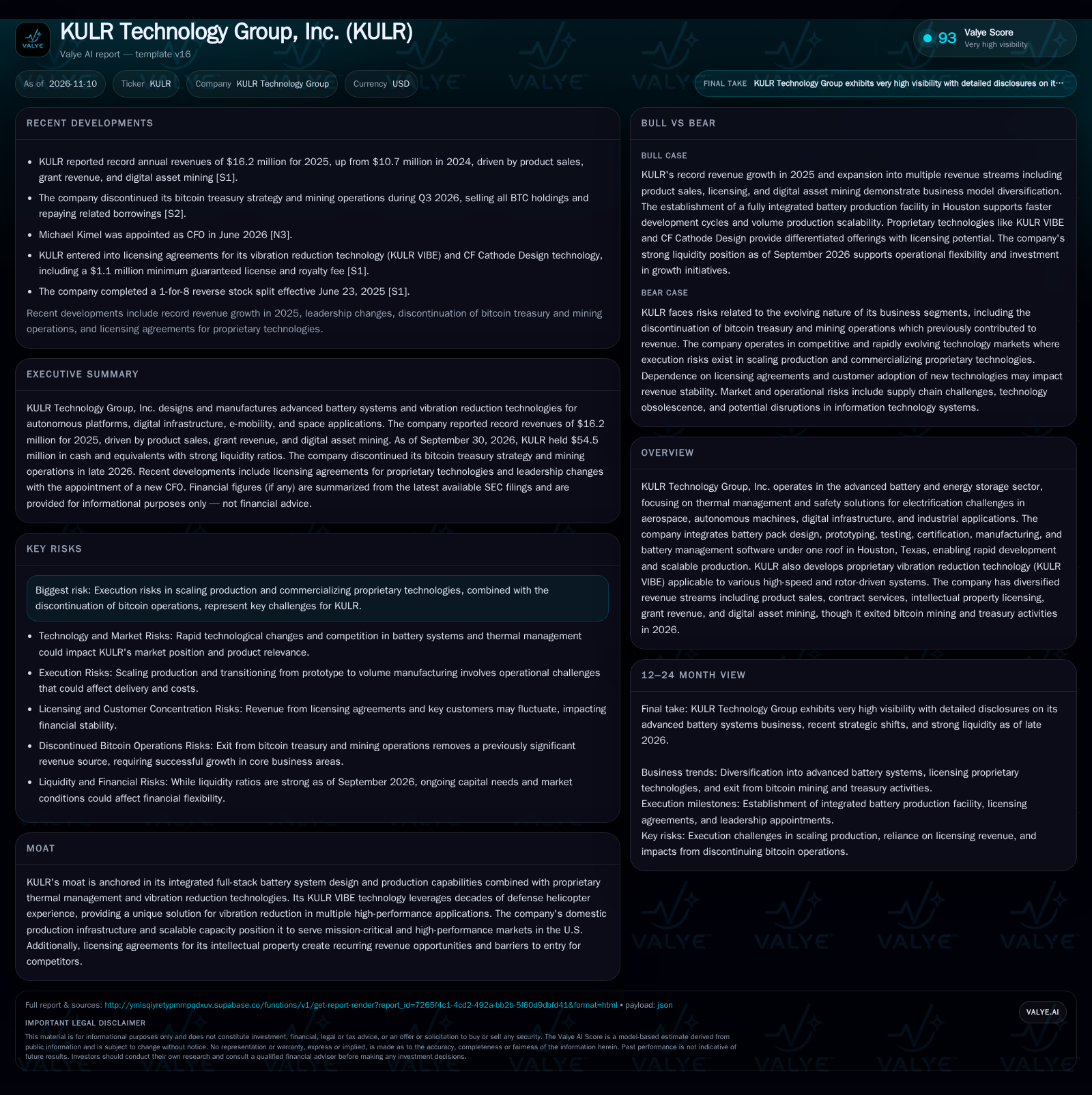
KULR Technology Group reported record 2025 revenues and has exited bitcoin mining to double down on battery system innovation, thermal management, and IP licensing. Its integrated Houston facility and proprietary technologies—especially in vibration reduction—are central to its strategy. [S1] [S2]
KULR Technology Group is at an inflection point after a period of rapid evolution in both its business model and revenue streams. With the wind-down of its bitcoin mining operations in late 2026, the company is pivoting squarely toward its core strengths: advanced battery systems, proprietary vibration reduction technology, and intellectual property licensing.
Strategic Refocus and Financial Reset: KULR’s Latest Milestones
KULR Technology Group reported record annual revenues of $16.2 million for 2025, a substantial increase from $10.7 million in 2024, driven by a mix of product sales, contract services, grant revenue, and digital asset mining. However, the company exited its bitcoin treasury and mining operations during Q3 2026, selling all BTC holdings and repaying related borrowings. This marks a significant pivot back to its core technology and product businesses. As of September 30, 2026, KULR had $54.5 million in cash and equivalents, a current ratio of 11.95, and a cash ratio of 9.26, indicating a strong near-term liquidity position. The company also entered into licensing deals for its proprietary vibration reduction and cathode design technologies, including a $1.1 million minimum guaranteed license for KULR VIBE. Leadership was strengthened with the appointment of Michael Kimel as CFO in June 2026. [S1] [S2] [N3]
Integrated Production and IP Licensing: How KULR Aims to Drive Profitability
KULR’s business model is now centered on advanced battery system production, proprietary vibration reduction technology, and intellectual property licensing. The Houston facility’s integration of design, prototyping, testing, certification, manufacturing, and BMS software development under one roof is designed to accelerate product development cycles and scale production for high-power, high-reliability battery packs. If successful, this could deliver operating leverage by spreading fixed R&D and manufacturing costs over higher volumes, especially as adoption in aerospace, e-mobility, and digital infrastructure grows.
Revenue composition is diversified: product sales, contract services, licensing, and grants. The recent licensing agreements—especially those with minimum guarantees and royalties—could provide higher-margin, recurring revenue with less capital intensity than hardware manufacturing. However, the magnitude and duration of these licensing streams remain to be proven. The exit from bitcoin mining removes a volatile but previously meaningful revenue source, increasing the importance of scaling core battery and IP businesses to sustain growth.
The company reported cash and liquidity metrics for the period; these figures do not by themselves establish operating runway, investment capacity, financial flexibility, or financing capacity. The company’s decision not to pay dividends and instead reinvest in growth signals a focus on scaling and long-term value creation.
A critical aspect of KULR’s integrated production model is its potential to reduce time-to-market, which can be a decisive competitive advantage in fast-evolving battery technology sectors. By consolidating design, prototyping, and manufacturing processes, the company can iterate rapidly on product improvements, respond swiftly to customer feedback, and customize solutions for niche applications. However, this approach also concentrates operational risk; any disruption at the Houston facility could impact multiple stages of the value chain simultaneously. Therefore, operational resilience and capacity flexibility will be key factors influencing the scalability and profitability of this integrated model.
Differentiation in Thermal Management and Vibration Reduction: Competitive Stakes
KULR operates in highly competitive sectors—advanced batteries, thermal management, and vibration mitigation—where established players, new entrants, and substitute technologies vie for customer adoption. The company’s integrated Houston facility and domestic supply chain alignment could appeal to U.S.-based customers with critical reliability and traceability needs, such as aerospace, defense, and high-performance industrials.
KULR’s proprietary technologies—especially KULR VIBE, derived from defense rotorcraft vibration management, and advanced cathode design—may offer differentiated performance in reducing heat and vibration, potentially lowering risk and extending system lifespans. If these claims are validated in customer applications, they could justify premium pricing or licensing fees. However, barriers to adoption remain: customers may require extensive validation cycles, and established competitors may have deeper distribution or broader product portfolios.
The new IP licensing agreements suggest some traction, but the long-term competitive moat will depend on continued innovation, execution in manufacturing scale-up, and the ability to convert technical wins into sticky, recurring commercial relationships. Substitution risk from new battery chemistries, software-only solutions, or integrated competitors remains a persistent threat.
The competitive landscape for thermal and vibration management solutions is characterized by rapid innovation and evolving customer requirements, particularly in sectors such as aerospace and electric vehicles where safety and reliability are paramount. KULR’s ability to demonstrate quantifiable improvements in system longevity and performance could create a defensible niche, but this requires rigorous validation under diverse operational conditions. Additionally, the company must navigate the risk that emerging battery chemistries or integrated thermal management systems from larger incumbents could reduce the relative advantage of standalone vibration reduction technologies. Strategic partnerships or co-development agreements may therefore be instrumental in maintaining market relevance and accelerating adoption.
From Technical Differentiation to Commercial Flywheel: What a Bullish Outcome Looks Like
A favorable trajectory for KULR would see rapid customer adoption of its high-reliability battery packs and vibration reduction solutions across aerospace, e-mobility, and digital infrastructure markets. The Houston facility achieves efficient scale, enabling cost-competitive production and faster design-to-deployment cycles. Licensing revenues from KULR VIBE and cathode technologies grow as OEMs and integrators seek to embed these solutions in their platforms, creating a high-margin, recurring revenue stream.
Confirmation would come from a growing backlog of multi-year product or licensing contracts, positive customer case studies demonstrating measurable reductions in thermal and vibration risk, and margin expansion as fixed costs are leveraged. Disclosures of additional licensing deals, production ramp milestones, or major customer wins would strengthen the case.
Execution-Driven Growth with Revenue Mix Transition: The Most Likely Path Forward
The most plausible scenario is one of continued but measured growth as KULR transitions from bitcoin-driven revenues to a more sustainable mix of product sales, services, and licensing. The Houston facility ramps production, but adoption is gradual due to customer validation cycles and industry inertia. Licensing agreements provide some recurring revenue, but the scale is initially modest relative to product sales.
Evidence supporting this scenario would include steady increases in product shipments, incremental licensing deals, and stable gross margins as scale improves. However, revenue volatility could persist if customer concentration remains high or if licensing revenues are lumpy.
Scaling Friction and Adoption Delays Could Undercut Momentum
The adverse scenario features slow or stalled uptake of KULR’s battery systems and IP due to technical qualification delays, customer conservatism, or stronger-than-expected competition. Production scale-up at the Houston facility encounters operational challenges, driving up costs or affecting product quality. Licensing revenues fail to reach critical mass, and the loss of bitcoin-related income is not offset by core business growth.
Warning signs would include flat or declining product revenue, limited new licensing activity, rising operating expenses without corresponding gross profit, or the need to pursue dilutive financing if cash burn accelerates. Customer attrition, negative validation results, or evidence of competitor displacement would further confirm the downside.
Milestones That Will Define KULR’s Post-Bitcoin Value Creation
Quarterly revenue mix breakdown by segment—product sales, licensing, services, and grants—to assess the pace of transition from bitcoin-driven to core business revenue (if disclosed).
Production capacity utilization and throughput at the Houston facility; meaningful increases would indicate successful scale-up.
Number and value of new licensing agreements signed for KULR VIBE and cathode design technologies, including minimum guarantees and royalties.
Gross and operating margin trends as production scales and licensing revenue grows; margin expansion would support operating leverage.
Customer concentration metrics—reliance on top customers or contracts—would help evaluate revenue durability (if disclosed).
Validation case studies or third-party endorsements demonstrating performance gains or risk reduction from KULR’s solutions.
Cash burn rate and capital expenditure trends; a sustained increase without corresponding revenue growth would be a red flag.
Disclosure of any new strategic partnerships, OEM wins, or integration into major platforms, helping to gauge market penetration.
Disclaimer: This is research-only, informational analysis and not investment advice. It may include AI-generated interpretation and general industry context. Always verify important details using primary sources.

Comments