
Coya Therapeutics: Progressing Treg Modulation in Neurodegenerative Disease at a Clinical and Capital Crossroads
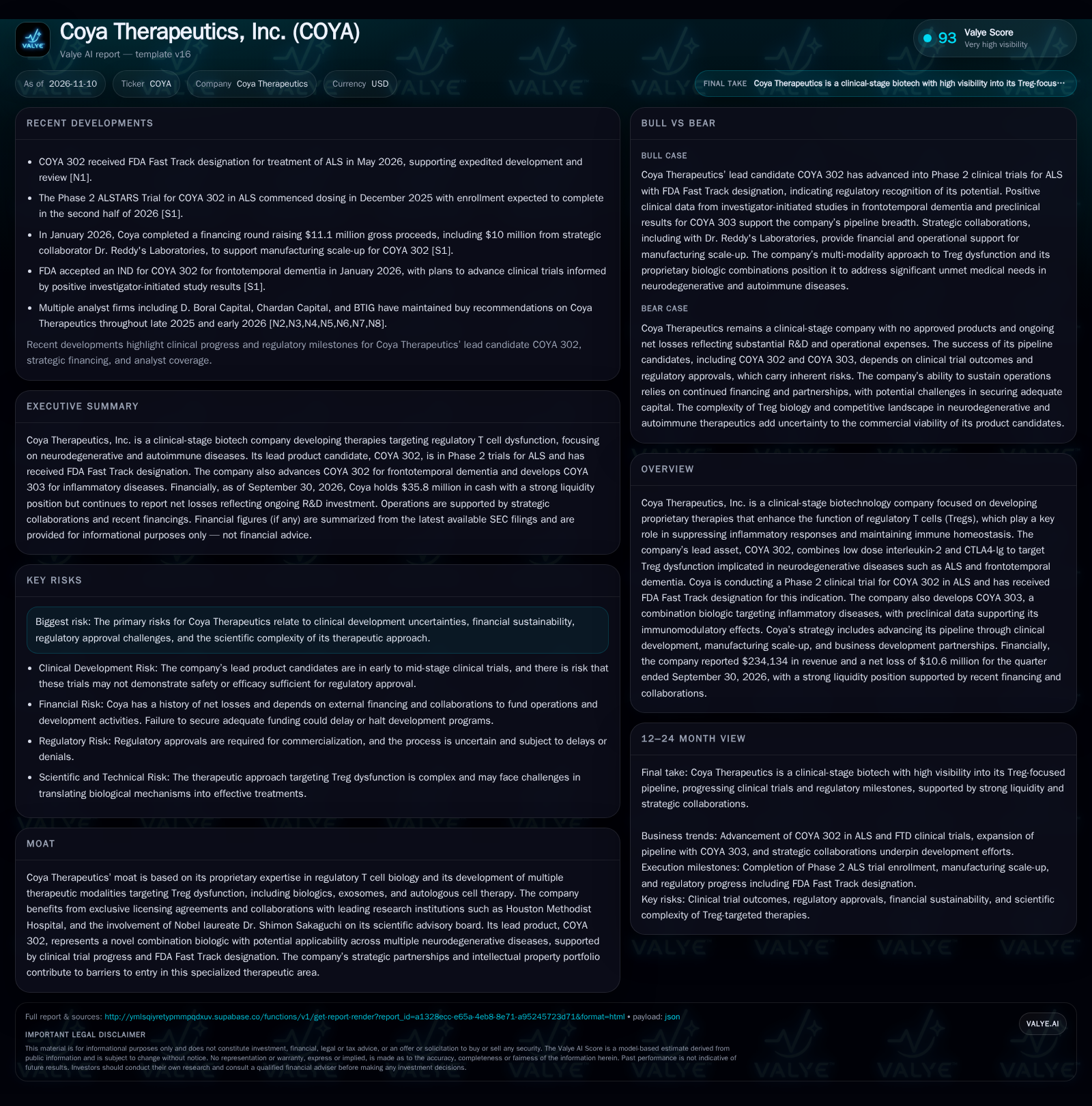
Coya Therapeutics’ lead asset, COYA 302, is now in Phase 2 for ALS with FDA Fast Track designation and a concurrent push into frontotemporal dementia, supported by a major strategic collaboration, but commercial viability still hinges on clinical validation and the scalability of its Treg-targeted approach.
Coya Therapeutics is making visible progress on its Treg-enhancing therapies, with COYA 302 in Phase 2 trials for ALS and regulatory tailwinds from Fast Track status. Recent financing, largely from Dr. Reddy’s, underwrites manufacturing scale-up, but the company remains pre-commercial and dependent on positive clinical outcomes, regulatory approvals, and continued access to capital.
Coya Therapeutics stands at a pivotal juncture as its lead Treg-targeted biologic, COYA 302, advances through Phase 2 trials in ALS, buoyed by FDA Fast Track designation and a strategic capital infusion from Dr. Reddy’s Laboratories. With parallel development in frontotemporal dementia and a preclinical platform extending into broader inflammatory disease, Coya’s ambitions contrast sharply with its pre-commercial status and persistent net losses. The next 12–18 months will test the scalability of its technology, the durability of its partnerships, and its ability to convert scientific promise into clinical and commercial proof.
Clinical Momentum and Strategic Capital Define Near-Term Inflection
Coya’s lead asset, COYA 302, is now in a Phase 2 randomized, multi-center, placebo-controlled trial for ALS, with dosing begun in December 2025 and enrollment slated for completion in the second half of 2026 [S1]. The program has received FDA Fast Track designation as of May 2026, enhancing its potential for expedited regulatory review and heightened visibility [N1].
In January 2026, Coya secured $11.1 million in gross proceeds—$10 million from Dr. The company reported a current ratio of 7.24 for the period. [S1] [S2]
The FDA accepted an IND for COYA 302 in frontotemporal dementia in January 2026, positioning the asset for expansion into a second neurodegenerative indication, and the company’s pipeline now includes both clinical and preclinical Treg-modulating candidates [S1].
Commercialization Hurdles and the Economics of Platform-Stage Biotech
Coya’s business model is typical of clinical-stage biotech: value creation is front-loaded through R&D investment, with future returns contingent on successful clinical outcomes and regulatory approval. Current revenue remains negligible, with $234,134 recognized in the most recent quarter, likely from grants or collaborations rather than product sales [S2]. Operating leverage is negative at this stage, as fixed and variable costs related to clinical development, manufacturing scale-up, and business development outweigh any near-term revenue.
Future revenue potential hinges on successful Phase 2/3 outcomes for COYA 302 in ALS and FTD, eventual approval, and payer adoption. Pricing power in rare neurodegenerative diseases can be significant if a therapy demonstrates clear clinical benefit and addresses high unmet need—a pattern seen in other ALS therapies—but the ultimate economics will depend on efficacy, safety, differentiation, and health system willingness to reimburse.
The capital intensity is high, with substantial cash burns typical through clinical phases. Manufacturing scale-up, a capital-intensive step, is being underwritten in part by Dr. Reddy’s, but the transition to commercial-scale operations remains a major hurdle for value realization.
The pathway from clinical-stage innovation to commercial success in biotech is often nonlinear and fraught with uncertainty, particularly for novel immunomodulatory platforms like Coya’s. The company’s reliance on external capital infusions underscores the importance of managing dilution risk and timing milestones to optimize valuation. Strategic partnerships that provide not only funding but also operational capabilities—such as manufacturing scale-up and regulatory navigation—can materially de-risk the commercialization pathway. However, these collaborations require alignment on long-term value creation, and any shifts in partner priorities or market conditions could impact resource availability and strategic flexibility.
Differentiation Through Treg Modulation and Strategic Partnerships
Coya’s competitive positioning centers on its proprietary Treg-focused platform, with a lead asset that combines low dose IL-2 and CTLA4-Ig to potentially deliver sustained immunomodulatory effects. This multi-modal approach seeks to address both the inflammatory and neurodegenerative components of diseases like ALS and FTD, differentiating it from single-target or symptomatic therapies.
The involvement of Nobel laureate Dr. Shimon Sakaguchi on the scientific advisory board and collaborations with Houston Methodist Hospital bolster Coya’s scientific credibility and provide access to translational expertise. The partnership with Dr. Reddy’s Laboratories not only supplies funding but also manufacturing and potential future commercial infrastructure.
However, the landscape is competitive and rapidly evolving. Other biotech and pharma players are developing both cell-based and biologic approaches to neuroinflammation and neurodegeneration, and the complexity of Treg biology means that clinical translation is uncertain. If Coya’s approach is validated, intellectual property and first-mover advantage could create barriers, but the risk of technological substitution or parallel advances remains high.
Breakthrough Clinical Data Drives Regulatory Acceleration and Pipeline Expansion
The most favorable scenario would see COYA 302 deliver robust efficacy and safety results in the ALSTARS Phase 2 ALS trial, leading to accelerated regulatory review under Fast Track and potentially Breakthrough Therapy designation. Positive readouts could catalyze rapid enrollment completion, early regulatory engagement, and increased interest from larger biopharma partners or acquirers.
Concurrently, successful initiation and early data from FTD trials would validate the platform’s broader applicability, and preclinical advances with COYA 303 would reinforce the company’s claim to a differentiated Treg-modulation franchise.
What would confirm this scenario: clear, statistically significant clinical endpoints in ALS and FTD; favorable safety/tolerability; ongoing analyst upgrades; new strategic partnerships or licensing deals; and evidence of manufacturing scalability without major cost overruns or delays.
Incremental Clinical Progress with Ongoing Cash Burn and Eventual Dilution
In the most plausible middle outcome, COYA 302 advances through Phase 2 in ALS and initiates FTD trials, with data that suggest potential but are not transformative—perhaps showing safety and some biomarker or functional improvements but not clear-cut efficacy. Regulatory engagement continues, but timelines remain extended, and the company must secure additional capital to sustain development.
Manufacturing scale-up proceeds with some execution friction, absorbing more cash than anticipated but not derailing the program. Analyst sentiment remains generally positive, but valuation is capped by uncertainty and the absence of pivotal data.
This scenario would be confirmed by continued clinical progress without major setbacks, ongoing net losses, modest pipeline expansion, and periodic equity or partnership financings to maintain liquidity.
Clinical or Manufacturing Setbacks Trigger Strategic Retrenchment
The adverse scenario would be driven by clinical trial failures—COYA 302 failing to demonstrate efficacy or encountering unexpected safety signals in ALS or FTD. Regulatory timelines would stall or reset, and partnership momentum could fade.
Manufacturing challenges—such as inability to scale cost-effectively or meet regulatory standards—could further increase burn or force delays.
Confirmation would come from negative clinical readouts, halted or delayed trials, major layoffs or operational retrenchments, and analyst downgrades or withdrawal of partner support.
Milestones That Will Determine Coya’s Trajectory in Treg-Targeted Neurodegeneration
Pace of enrollment and completion of the ALSTARS Phase 2 ALS trial—delays or accelerated timelines would materially impact the regulatory and commercial outlook.
Disclosure of interim or top-line clinical data for COYA 302 in ALS and, if initiated, FTD—demonstrated efficacy and safety are the single most important thesis drivers.
Updates on manufacturing scale-up progress and cost—whether Coya can meet quality standards and timelines without unexpected capital outlays.
Cash runway guidance and any new financing events—monitoring whether additional equity raises or partnership deals are needed before the next major clinical inflection.
Initiation and design of COYA 302 FTD clinical trials—scope, endpoints, and regulatory interactions will clarify the platform’s potential breadth.
Preclinical and early clinical progress of COYA 303—advancement or setbacks here would test the extensibility of the Treg-modulation approach.
If disclosed, details on patient retention, trial site expansion, and geographic reach—these would indicate execution strength and trial scalability.
Announcements of new or expanded strategic collaborations, particularly regarding commercialization or late-stage development support.
Disclaimer: This is research-only, informational analysis and not investment advice. It may include AI-generated interpretation and general industry context. Always verify important details using primary sources.

Comments