
Exagen’s Turnaround and Product Concentration: Diagnostic Expansion Versus the Realities of Rheumatology Testing
Exagen Inc. continues to drive operational improvements and margin gains through its AVISE® CTD autoimmune diagnostics franchise, but it remains reliant on a single product line and faces the challenge of broadening its portfolio and reimbursement base amid ongoing investment and market adoption risks.
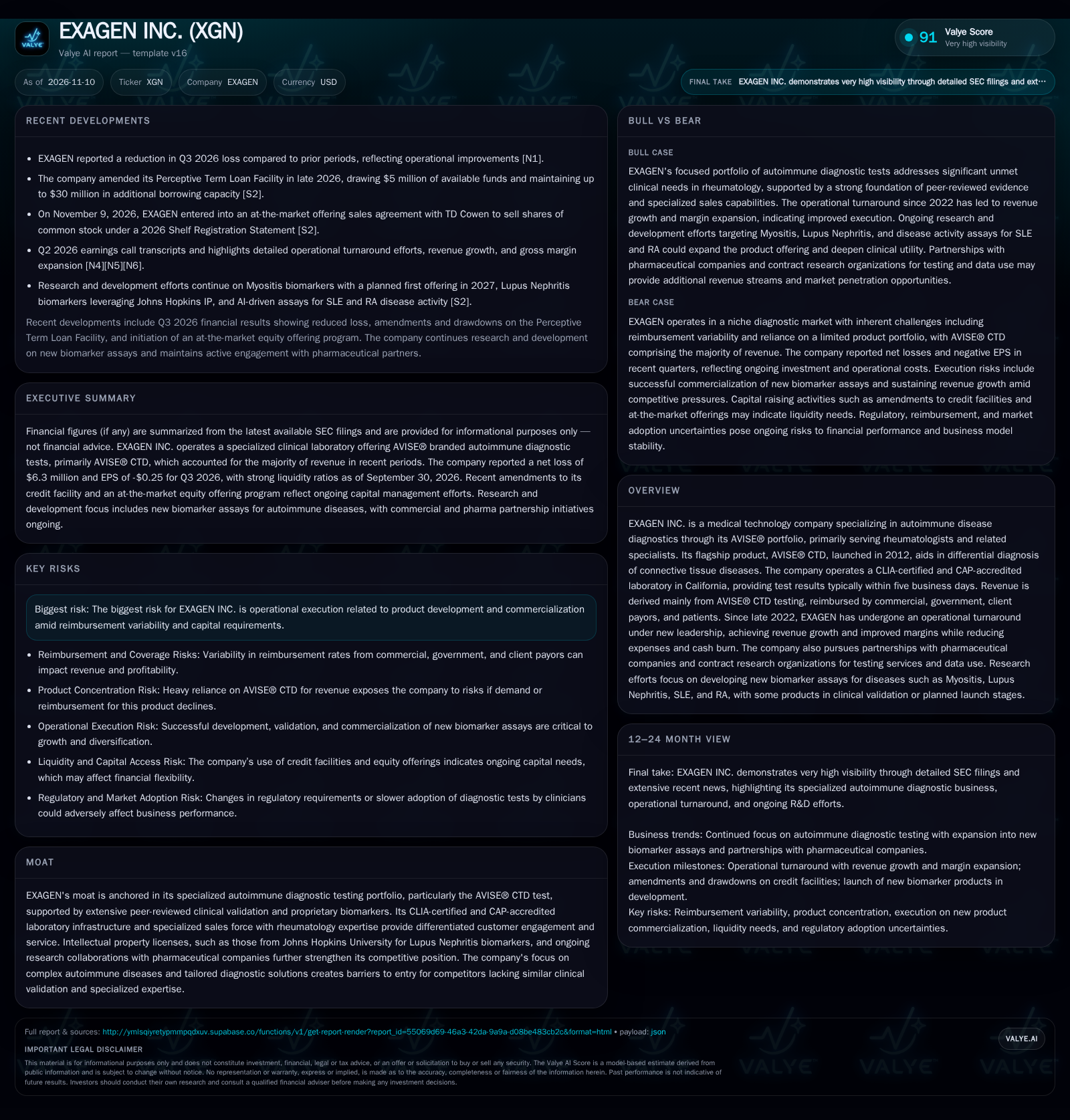
Exagen has reduced its quarterly loss and expanded margins since a 2022 operational overhaul, with AVISE® CTD still representing about 90% of revenue. Ongoing capital management, including a recently amended credit facility and an at-the-market equity program, underscores the importance of successful product and partnership expansion for future growth.[S2] [N1]
Exagen Inc. stands at a pivotal point in its evolution as a specialist in autoimmune diagnostics, having implemented a notable operational turnaround that has reduced losses and improved margins over the past two years. The company’s reliance on the AVISE® CTD test as its primary revenue driver underscores both the strength of its niche and the urgency of expanding its portfolio to mitigate concentration risk. With new biomarker assays in development and capital management initiatives underway, Exagen’s next phase will hinge on its ability to convert R&D into commercial traction while navigating reimbursement and market adoption hurdles.[S2] [N1]
Recent Performance: Margin Gains and the Dominance of AVISE® CTD
The company reported a current ratio of 3.46 for the period. [N1] [S2]
Revenue Mechanics and the Leverage Challenge in Specialty Diagnostics
Exagen’s business model is anchored in the volume and reimbursement of specialized autoimmune diagnostic tests performed in its CLIA-certified laboratory. The AVISE® CTD test—designed for differential diagnosis of connective tissue diseases—drives nearly all revenue, which exposes the company to volatility if reimbursement rates or demand for this test fluctuate.[S2] Test pricing and realized revenue per test depend on a complex mix of commercial, government, and patient payors, with reimbursement variability introducing revenue unpredictability.
Gross margin improvements since 2022 suggest a positive shift in test economics, likely due to higher volumes, improved operational efficiency, and possibly improved reimbursement mix, though the specific drivers are not detailed in current disclosures.[S2] Fixed costs related to laboratory operations and specialized sales force create potential operating leverage, but high R&D and commercialization expenses for new assays require continued investment. The company’s amended credit facility and at-the-market equity program indicate ongoing capital needs, typical for diagnostics firms aiming to expand test menus and penetrate new clinical areas.[S2]
Future economics will hinge on Exagen’s ability to: (1) broaden its test portfolio beyond AVISE® CTD, (2) secure favorable reimbursement for new offerings, and (3) leverage existing laboratory infrastructure for incremental volume without proportionate cost increases. Partnerships with pharmaceutical companies and CROs for testing and de-identified data sales could introduce higher-margin, less volume-dependent revenue streams if commercialized at scale.
Defensible Niche or Vulnerable Franchise? Competitive Pressures in Autoimmune Diagnostics
Exagen’s main competitive advantage lies in the clinical validation and peer-reviewed evidence supporting AVISE® CTD, its proprietary biomarkers, and its specialized salesforce engaging rheumatologists. Its CLIA-certified and CAP-accredited laboratory, along with intellectual property licenses such as those from Johns Hopkins for Lupus Nephritis biomarkers, further reinforce differentiation.[S2]
However, the company faces material counterforces. Larger diagnostics firms and reference labs possess broader test menus, deeper payer relationships, and greater resources for commercialization and reimbursement negotiations. Tech-driven entrants, including those leveraging AI or next-generation sequencing, could offer alternative diagnostic approaches—potentially disrupting traditional autoantibody-based tests if clinical utility and reimbursement are proven. Exagen’s ability to maintain relevance will depend on sustaining clinical evidence, expanding its portfolio, and demonstrating clear advantages in diagnostic accuracy or workflow integration to clinicians.
Switching costs for rheumatologists are moderate: while test interpretation and workflow integration create some inertia, payor-driven changes or the introduction of superior assays by competitors could shift ordering patterns. The company’s salesforce specialization and deep clinical engagement are important, but not insurmountable, barriers for well-resourced competitors.
Portfolio Expansion Unlocks Revenue Streams and Margin Upside
A favorable trajectory for Exagen would see successful clinical validation and commercial launch of new biomarker assays for Myositis (planned for 2027), Lupus Nephritis, SLE, and RA, broadening the portfolio and reducing reliance on AVISE® CTD.[S2] If these new tests achieve clinical adoption and secure reimbursement at attractive rates, incremental revenue could be realized with limited additional fixed cost, driving operating leverage.
Evidence confirming this scenario would include: (1) demonstration of robust clinical utility and peer-reviewed data for new assays, (2) new product launches with initial adoption metrics, (3) expanded payor coverage and positive reimbursement determinations, and (4) partnership announcements with pharmaceutical companies or CROs utilizing Exagen’s tests or de-identified data. Margin expansion and further reduction in net loss would reinforce the narrative of successful portfolio leverage.
A falsification would be delayed product launches, lack of clinical acceptance, or evidence that new assays fail to generate meaningful revenue or reimbursement compared to AVISE® CTD.
Sustained Improvement with Persistent Concentration and Execution Risk
The most plausible outcome is continued operational progress with Exagen maintaining positive revenue and margin trends, but with AVISE® CTD remaining the dominant revenue contributor into 2027. New assay launches may occur, but their ramp could be gradual, with initial revenue contribution modest relative to the flagship product.
Ongoing capital management—drawing on available credit and periodic equity raises—supports R&D and commercialization, but also signals that self-sustaining profitability is not imminent. Reimbursement variability and payer mix may continue to introduce quarterly volatility, even as operational discipline keeps losses manageable.
This scenario would be confirmed by further reductions in quarterly losses, stable or modestly growing revenue, and incremental progress updates on assay development and partnership activity. A reversal—such as flat or declining revenue, stalled product development, or deteriorating margins—would signal a break from this base trajectory.
Product Reliance Exposes Vulnerability to Reimbursement or Market Shocks
The adverse case is defined by a negative inflection in AVISE® CTD demand or reimbursement, which would be difficult to offset given the current lack of revenue diversity. Potential triggers include payor policy changes, loss of key coverage contracts, or clinical guidelines shifting away from Exagen’s core modality. Failure to successfully launch or commercialize new assays would compound this risk, leaving the company exposed to fixed-cost deleveraging and increased cash burn.
This scenario is confirmed by sharp revenue declines, widening quarterly losses, increased drawdowns on credit facilities, and dilutive equity raises. Signs of reimbursement contraction, negative coverage decisions, or loss of key customer relationships would further validate the downside risk.
A partial falsification would be resilience in AVISE® CTD volumes and reimbursement, or evidence that new test launches are gaining traction and diversifying revenue sources.
Milestones That Will Define Exagen’s Next Chapter in Autoimmune Diagnostics
Trends in AVISE® CTD test volumes and realized average reimbursement per test, if disclosed, as indicators of core business health and potential vulnerability to payor shifts.
Progress updates and timelines for the clinical validation and commercial launch of new biomarker assays, particularly for Myositis (planned for 2027), Lupus Nephritis, SLE, and RA.
Frequency and scale of new pharmaceutical and CRO partnerships leveraging Exagen’s testing services or de-identified data, which could signal incremental revenue streams beyond the traditional diagnostics business.
Quarterly gross margin and operating margin trends as evidence of continued operational leverage or emerging cost pressures.
Updates on capital deployment, including draws on the credit facility and sales under the at-the-market equity program, as a barometer of funding needs and dilution risk.
Payor coverage updates, new reimbursement approvals, or adverse reimbursement decisions affecting existing and pipeline tests.
Any signals of clinician adoption and retention for new assays, such as early order volumes, customer testimonials, or peer-reviewed publication of clinical utility data.
R&D expense trends and disclosures regarding the efficiency of assay development and the potential for pipeline attrition or delays.
Disclaimer: This is research-only, informational analysis and not investment advice. It may include AI-generated interpretation and general industry context. Always verify important details using primary sources.

Comments