
Nucor’s 2026 Surge: Margin Expansion, Operating Leverage, and the Next Phase of Steel Market Dynamics
Nucor’s record 2026 earnings reflect not just cyclical tailwinds but also margin expansion from higher steel prices, robust volume growth, and disciplined risk management. The challenge ahead is converting these gains into durable returns as new capacity ramps, input volatility persists, and the company tests its positioning in emerging infrastructure sectors.
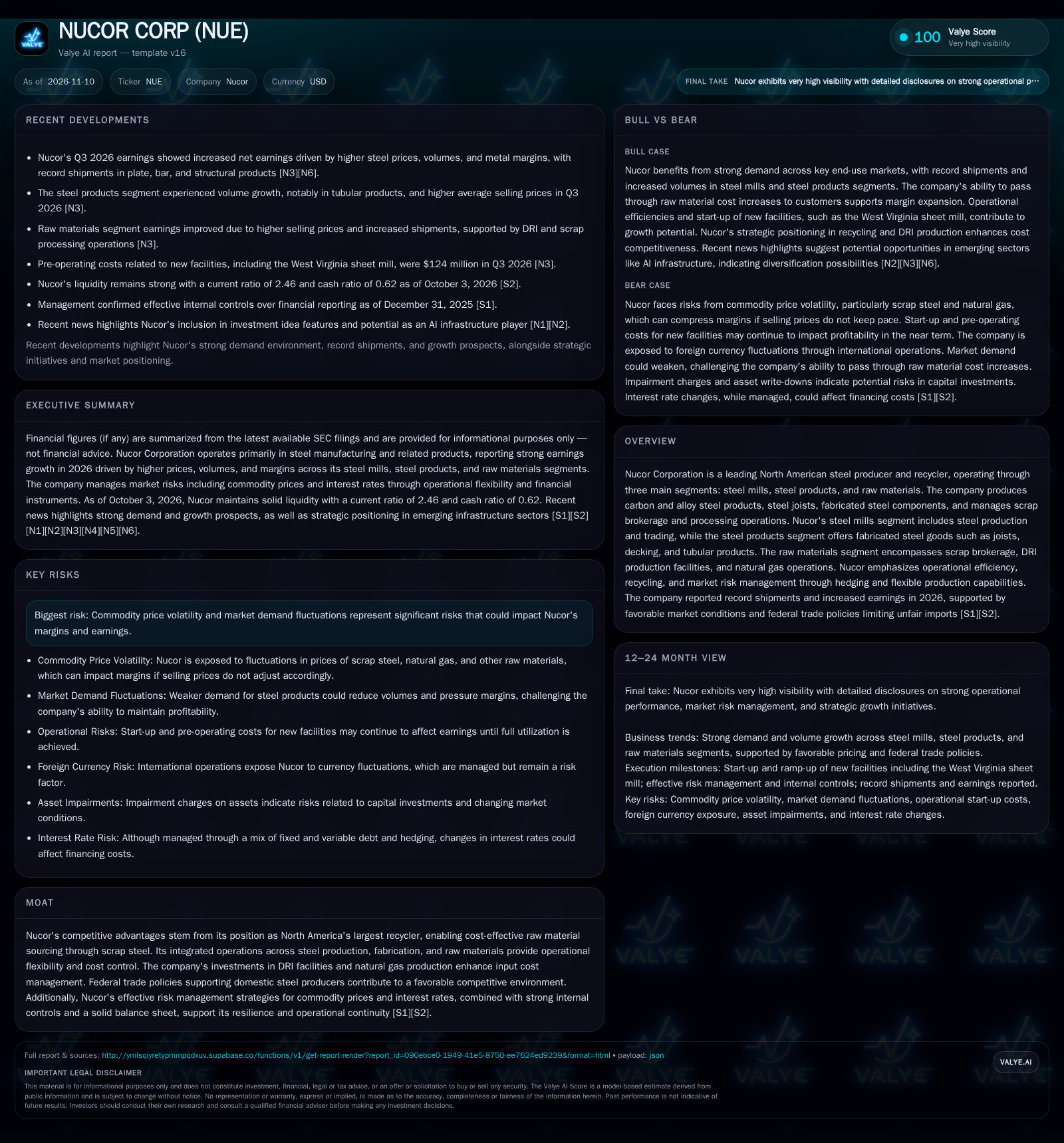
Nucor delivered record net earnings and shipments in 2026, propelled by higher selling prices, strong demand, and improved metal margins, especially in its core steel mills segment. While operating leverage and risk management have enabled significant margin gains, the next test will be sustaining profitability as new plants, like the West Virginia sheet mill, come online and commodity volatility returns. Potential upside lies in Nucor’s ability to leverage its cost structure and recycling leadership for new infrastructure demand—including AI data center builds—while the main risks remain input cost spikes, market demand reversals, and execution on recent investments.[S2] [N2] [N3] [N6]
Nucor’s 2026 performance marks a high point in both profitability and operational scale, as the company capitalizes on robust steel demand, higher prices, and disciplined cost management. With net earnings and margins reaching multi-year highs, Nucor is reaping the benefits of its position as North America’s largest recycler and a leading low-cost producer. However, as the company brings new capacity online and faces the perennial risks of commodity volatility and shifting demand, the real test will be its ability to sustain and compound these gains. Strategic opportunities in infrastructure and emerging verticals like AI-driven construction could reshape the growth profile, but execution and market timing remain key variables.
Record Earnings, Margin Expansion, and the Cost of Growth
Nucor’s Q3 2026 net earnings surged to $1.32 billion—more than double the $607 million reported in Q3 2025—driven primarily by its steel mills segment. Gross margin expanded to 21% from 14% a year prior, as higher average selling prices, increased shipments, and improved metal margins all contributed to the outperformance. The company also achieved record shipments, especially in tubular products and building systems, reflecting both strong end-market demand and effective operational execution.[S2] [N3] [N6]
On the balance sheet, Nucor reported $3.47 billion in cash and equivalents and a current ratio of 2.46 as of October 2026, indicating reported liquidity position. However, pre-operating and start-up costs—particularly $124 million in Q3 tied to the West Virginia sheet mill—signal that new investments are still in the ramp phase and could weigh on margins until utilization improves.[S2]
How Nucor Converts Volatility into Profit: Pricing, Leverage, and Capital Requirements
Nucor’s core economics hinge on its ability to manage input volatility while maximizing operating leverage. The company’s mini-mill model, using scrap steel as the primary feedstock, allows for rapid adjustment of output in response to market demand and scrap prices. In upcycles—such as 2026—higher steel prices can be passed through faster than raw material costs rise, expanding metal margins and driving profitability. This was evident in the 19% year-over-year increase in average sales price per ton and a corresponding 11% increase in total tons shipped in Q3 2026.[S2]
Fixed costs are significant, especially as new mills and fabrication lines come online, but high utilization rates (89% for steel mills in the first nine months of 2026) amplify operating leverage in strong markets. The steel products segment, which includes higher value-added fabrication, offers margin diversification but is more exposed to input cost swings. The raw materials segment, bolstered by DRI and natural gas operations, gives Nucor some insulation from third-party supplier volatility but requires ongoing capital investment.
Capital needs are material, as evidenced by recent pre-operating costs for the West Virginia sheet mill. Over the cycle, Nucor’s profitability is tightly linked to its ability to balance volume, price realization, and input cost management.
Recycling Leadership, Integrated Operations, and the Competitive Chessboard
Nucor’s status as North America’s largest recycler provides a critical cost and sourcing advantage, especially during periods of scrap steel tightness. Its integrated model—spanning steel production, fabrication, and raw materials—allows for operational flexibility and internal hedging against commodity swings. Direct Reduced Iron (DRI) facilities further insulate the company from external raw material price shocks and provide a potential edge over competitors relying more heavily on third-party inputs.
Competitive threats remain, particularly from domestic peers with similar mini-mill models and from global producers if trade protections ease. Substitutes such as aluminum or composite materials could erode certain end-markets, while traditional blast furnace operators may regain share if energy markets or policy environments shift. Nucor’s ability to differentiate through recycling, cost control, and value-added products will determine its resilience.
Emerging infrastructure trends—such as the AI data center buildout—could create new demand layers, but Nucor’s ability to capture these depends on its product mix, customer relationships, and agility relative to both traditional and non-traditional competitors.[N2]
If Demand for Domestic Steel and Infrastructure Accelerates
A favorable scenario sees Nucor benefiting from continued strength in construction, manufacturing, and infrastructure—potentially amplified by federal spending and AI-driven data center demand. If new capacity, such as the West Virginia sheet mill, ramps efficiently and utilization remains high, operating leverage could drive further margin expansion. The company’s recycling leadership and DRI integration may allow it to pass through input cost increases and defend margins even as volatility returns.
Confirmation would come from sustained high utilization rates, rapid improvement in new facility profitability, and evidence that Nucor is capturing share in emerging verticals like tech infrastructure. Accelerating volumes in value-added products and a stable or rising gross margin above 20% would further support this thesis. Disproving evidence would be persistent ramp-up delays, margin compression despite strong demand, or failure to participate in new infrastructure cycles.
Normalization After a Peak: Margins Settle, Growth Moderates, and Execution Becomes Central
The most plausible outcome is a moderation from 2026’s peak conditions. Steel prices may soften as supply and demand rebalance, but Nucor’s flexible operating model and cost discipline should allow it to defend margins better than higher-cost peers. New facilities gradually ramp, offsetting pre-operating drag with incremental volume and cost advantages. Gross margins settle in the mid-to-high teens, and net earnings remain solid but less explosive than the 2026 surge.
This scenario would be confirmed by stable utilization rates in the 80–90% range, a return to normalized steel price growth, and steady—if unspectacular—volume gains. Disconfirming evidence would be a sharp drop in shipments, deteriorating margins despite flat input costs, or significant impairment charges on recent capital projects.
Input Cost Spikes, Demand Contraction, and the Risk of Overcapacity
A bearish chain unfolds if scrap steel or natural gas prices spike while end-market demand softens, compressing metal margins. If Nucor is unable to pass through cost increases or if new capacity ramps into an oversupplied market, profitability could fall sharply. Extended pre-operating and ramp-up costs would further dilute returns, and asset impairments could signal misallocated capital. Weakness in construction or industrial demand—especially if infrastructure spending disappoints—would exacerbate these pressures.
This scenario would be validated by a rapid decline in utilization rates, shrinking gross margins, and a reversal of shipment growth. Additional impairment charges or persistent negative earnings from new facilities would further indicate downside risk.
Tracking Nucor’s Margin Durability, Ramp Execution, and Exposure to Next-Gen Infrastructure
Gross margin percentage by segment—especially in steel mills and steel products—will reveal whether margin gains are cyclical or structural. A useful metric would be segment-level margin disclosure over the next several quarters.
Utilization rates across steel mills, steel products, and raw materials: sustained rates above 80% would support the operating leverage thesis; a drop would flag demand or competitive pressures.
Pre-operating and ramp-up costs for new facilities (notably the West Virginia sheet mill): watch for signs that these are declining and translating into positive segment earnings.
Volume and price trends in value-added products, such as tubular goods and building systems, as a proxy for end-market health and Nucor’s share in higher-margin categories.
Input cost trends for scrap steel and natural gas: if disclosed, tracking Nucor’s realized input costs versus benchmarks would help assess margin risk.
Participation in emerging infrastructure demand, including AI data centers: evidence could include customer wins, contract announcements, or product shipments into these segments, if disclosed.
Impairment charges or write-downs: recurring charges would indicate capital allocation or demand missteps.
Balance sheet discipline: while liquidity is currently strong, watch for changes in net debt, working capital swings, or large capital outlays that could constrain flexibility.
Disclaimer: This is research-only, informational analysis and not investment advice. It may include AI-generated interpretation and general industry context. Always verify important details using primary sources.

Comments