
Tyra Biosciences: Clinical Progress, Capital Strength, and the Stakes of Oncology Pipeline Execution
Tyra Biosciences is advancing two oncology programs, SURF302 and Dabogratinib, with positive recent clinical data and a substantial $400 million capital raise.
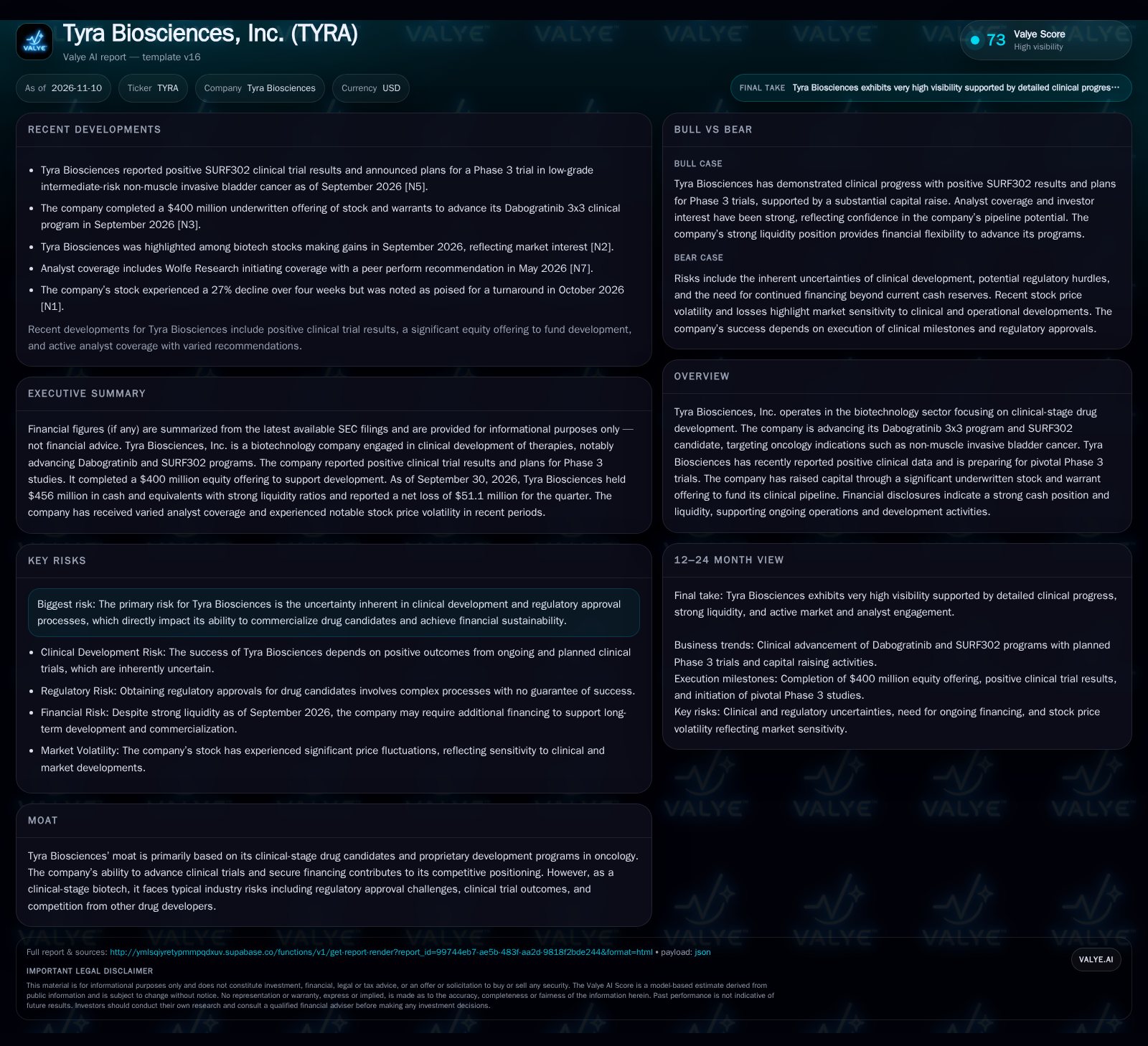
Tyra Biosciences is well-funded after a $400 million equity offering and has reported positive clinical data for its SURF302 candidate, now moving toward Phase 3 trials in non-muscle invasive bladder cancer. The company’s reported cash position and analyst interest highlight its pipeline potential, but success depends on clinical execution and overcoming industry-standard regulatory hurdles. Recent share price volatility underscores the market’s sensitivity to trial outcomes and operational progress. [S2] [N3] [N5]
Tyra Biosciences, a clinical-stage biotech focused on oncology, has recently achieved two pivotal milestones: positive clinical results for its SURF302 candidate and a $400 million capital raise to fuel the next phase of its pipeline. These developments, combined with reported liquidity position and active analyst coverage, position the company as a closely watched player in targeted cancer therapeutics. However, as with all clinical-stage biotechs, Tyra’s future value creation is contingent on successfully converting clinical promise into approved therapies—an inherently uncertain journey marked by regulatory, operational, and commercial inflection points.
Recent Clinical Milestones and Capital Raise Redefine Tyra’s Near-Term Trajectory
Tyra Biosciences reported positive clinical results for its SURF302 program and is planning a pivotal Phase 3 trial targeting low-grade intermediate-risk non-muscle invasive bladder cancer as of September 2026. This marks a significant inflection, as positive Phase 2/early-stage data can drive both internal confidence and external interest in the pipeline. Concurrently, Tyra completed a $400 million underwritten offering of stock and warrants to advance its Dabogratinib 3x3 clinical program, raising its cash and equivalents to $456 million as of September 30, 2026. These events materially extend Tyra’s financial runway and provide the resources to execute on multiple clinical programs. The company’s net loss for the quarter was $51.1 million, reflecting the capital-intensive nature of ongoing development. Market reaction has been volatile, with the stock up 280% year-over-year but down 27% in the last month, highlighting heightened sensitivity to clinical and operational milestones. [S2] [N3] [N5] [N1] [N8]
Clinical Development Drives Value, but Capital Burn and Commercial Uncertainty Remain Core Realities
Tyra Biosciences’ business model is classic clinical-stage biotech: value is created primarily through the advancement and potential approval of proprietary drug candidates. Revenue is not expected until products reach commercialization, so the company’s current economics are defined by R&D spend and capital raises. However, quarterly net losses of $51.1 million underscore the high fixed costs of clinical operations, including trial site fees, regulatory submissions, and manufacturing for trials. Operating leverage is limited until late-stage or commercial inflection, after which successful trials could unlock milestone payments, partnerships, or direct sales. The economics of oncology drugs can be attractive—if approved—due to premium pricing and long duration of therapy, but commercialization typically requires significant investment in sales infrastructure or partnership with larger pharma companies. Should Tyra’s lead programs progress, future capital needs may arise for market launch, post-approval studies, and broader pipeline expansion.
Pipeline Differentiation and Early Clinical Wins Amid a Crowded Oncology Landscape
Tyra’s competitive position depends on its ability to deliver differentiated clinical outcomes in oncology sub-segments where unmet need and competitive intensity are both high. Positive SURF302 results and the advancement of Dabogratinib signal potential for first- or best-in-class positioning, but the company is far from alone: numerous established and emerging biotechs are pursuing similar indications, often with deeper resources or more advanced programs. Switching costs are low for payers and providers until regulatory approval, so clinical data and regulatory progress are the primary sources of potential advantage. Proprietary molecules and the ability to move quickly through clinical milestones could confer some defensibility, but the risk of technological substitution or superior competing therapies remains elevated. If Tyra can generate robust Phase 3 data and secure regulatory approval, it may then face a new set of challenges—commercial execution and payer adoption—where scale and established relationships often dominate.
If Phase 3 Trials Succeed, Tyra Could Transition from Clinical-Stage to Commercial-Stage or Become an Attractive Acquisition Target
The most favorable scenario for Tyra Biosciences involves successful Phase 3 trial outcomes for SURF302 and/or Dabogratinib, leading to regulatory approval for non-muscle invasive bladder cancer or related oncology indications. This would validate both the scientific platform and management’s execution capabilities. Positive pivotal data could unlock value in several ways: enabling Tyra to launch its first commercial product (with potential for premium oncology pricing), attracting lucrative partnership or licensing deals with larger pharmaceutical companies, or positioning the company as an acquisition target at a strategic premium. Confirmation would come from successful completion of Phase 3 enrollment, positive top-line data, regulatory filings, and eventual approval. Early signs of commercial traction—such as payer coverage or guideline inclusion—would further substantiate the upside. Conversely, delays, safety concerns, or inconclusive efficacy would falsify this scenario.
Execution Continues, But Clinical and Regulatory Uncertainties Dominate the Medium Term
The most plausible medium-term path for Tyra is continued advancement of its lead programs through pivotal trials, supported by its robust capital base. Operating losses are likely to persist as the company advances multiple clinical assets, with the earliest possible revenue still several years away. The base case assumes that Tyra completes Phase 3 enrollment and data readouts without major setbacks, but regulatory approval is not guaranteed, and competition from other biotechs or large pharma could erode commercial potential even if approvals are won. Confirmation of this scenario would include steady trial progress, manageable cash burn, and ongoing investor and analyst engagement. Falsification could come from trial discontinuations, negative data, or a rapid decline in available capital.
Adverse Trial Outcomes or Regulatory Setbacks Could Force Strategic Retrenchment or Dilution
The primary risk is that one or more of Tyra’s lead programs fail to achieve target endpoints in Phase 3 trials, or encounter unanticipated safety or regulatory issues. In this scenario, the company would likely face a sharp market repricing, potential loss of investor confidence, and the need to reprioritize pipeline assets or cut costs. With no marketed products, Tyra would be forced to rely on its remaining cash to pivot or extend runway, potentially seeking partnerships on less favorable terms or raising additional capital at dilutive valuations. Confirmation of this scenario would include negative or ambiguous clinical data, regulatory delays, or abrupt changes in trial enrollment or scope. Falsification would require clear, positive data and regulatory momentum.
Factors That Will Shape Tyra’s Value Creation and Risk Profile
Enrollment progress and timeline updates for the Phase 3 SURF302 trial, as timely enrollment is critical for maintaining momentum and market confidence.
Interim and final data readouts from pivotal trials, especially for SURF302 and Dabogratinib, as efficacy and safety outcomes will determine regulatory and commercial potential.
Cash burn rate relative to clinical progress—quarterly financial disclosures will indicate whether Tyra’s capital raise is likely to be sufficient for near- to mid-term milestones.
Regulatory feedback from agencies (e.g., FDA meeting minutes, special protocol assessments), which could accelerate or impede clinical advancement.
Updates on potential partnership, licensing, or M&A activity, as external validation or strategic interest would signal perceived value and could influence resource needs.
Analyst and investor sentiment, tracked through coverage changes, institutional ownership, or large fund disclosures, which often presage shifts in capital access or valuation.
Any changes in competitive landscape or new data from peer companies targeting the same oncology indications, as these could alter both the opportunity and risk profile.
Disclaimer: This is research-only, informational analysis and not investment advice. It may include AI-generated interpretation and general industry context. Always verify important details using primary sources.

Comments