
Alpha Pro Tech: Profitability, Trade Policy Headwinds, and the Stakes of Tariff Litigation
The company’s cost structure and supply chain flexibility will be tested as global trade dynamics evolve and legal outcomes remain uncertain.
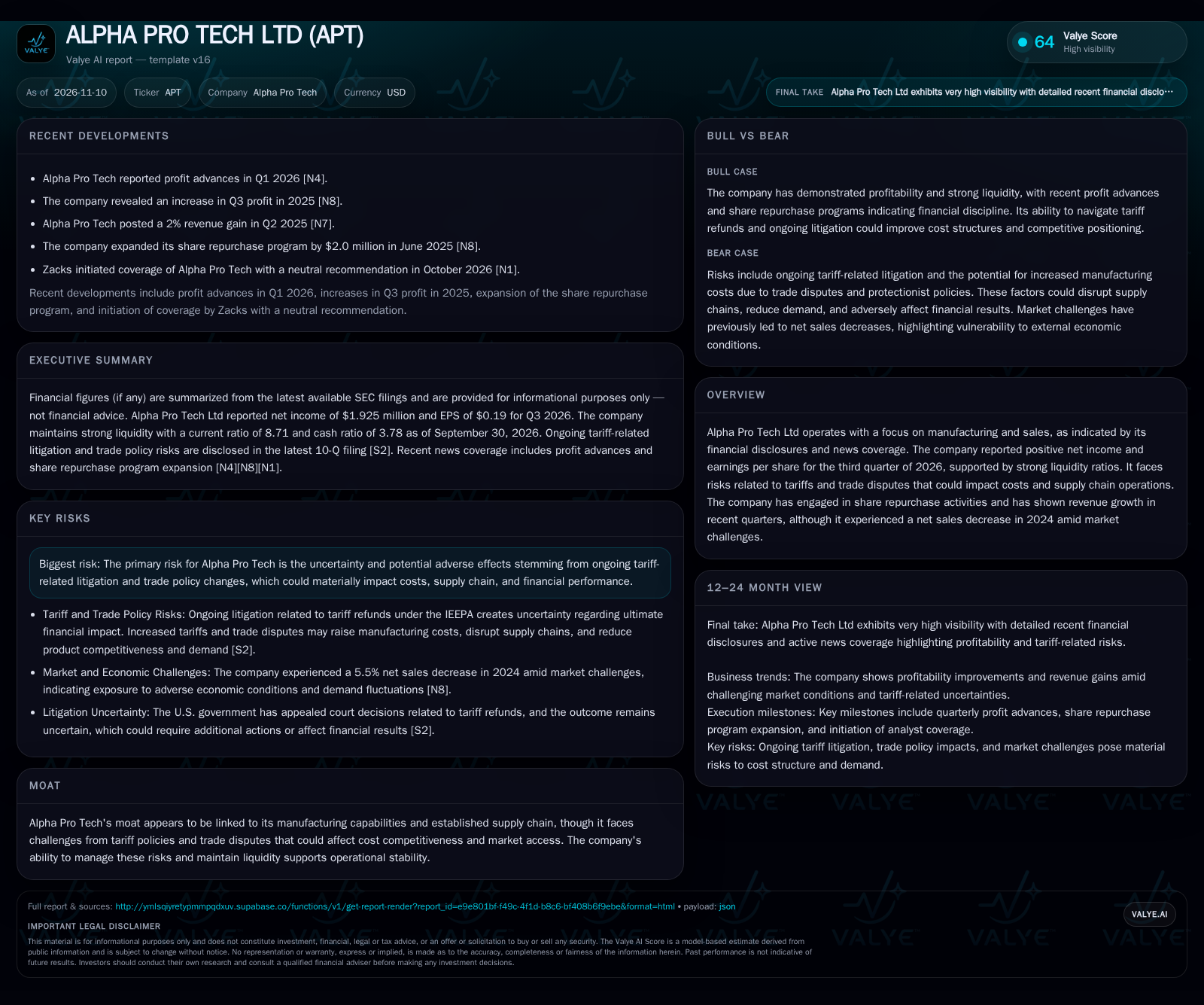
The company’s cost structure and supply chain flexibility will be tested as global trade dynamics evolve and legal outcomes remain uncertain. Future performance hinges on the resolution of tariff disputes and management’s ability to adapt to cost or demand shocks in a volatile market environment. [S2]
Alpha Pro Tech’s recent results underscore a business with reported liquidity position and sustained profitability, even as it faces a challenging trade environment. The company’s $1.925 million net income in Q3 2026 and reported current ratio suggest operational discipline and prudent balance-sheet management. However, unresolved tariff litigation and exposure to unpredictable trade policy shifts pose ongoing threats to its manufacturing cost base and market positioning. The outcome of these external pressures—and management’s ability to navigate them—will likely determine whether Alpha Pro Tech can convert its financial strength into durable competitive advantage or face renewed margin and demand headwinds.
Profitability and Liquidity Stand Out, But Tariff Uncertainty Lingers
Alpha Pro Tech reported a net income of $1.925 million for the quarter ended September 30, 2026, with basic and diluted EPS of $0.19, indicating continued profitability amid ongoing market challenges. The company reported cash and liquidity metrics for the period; these figures do not by themselves establish operating runway, investment capacity, financial flexibility, or financing capacity. Despite these strengths, Alpha Pro Tech remains embroiled in litigation over tariff refunds, with the final outcome still unresolved. The company recognized a refund for certain tariffs, but the prospect of further legal or regulatory action introduces uncertainty around future cost structures. These factors collectively define the near-term context: a financially stable manufacturer facing external risks that could materially affect costs and supply chain resilience. [S2]
Manufacturing Margins, Cost Sensitivities, and the Leverage of Scale
Alpha Pro Tech’s business model is anchored in manufacturing and sales, which typically feature a mix of fixed and variable costs. In such models, gross margins are heavily influenced by raw material input prices, labor costs, and operating efficiencies. Exposure to tariffs and trade policy shifts can directly impact material costs and erode margins, especially if the company is unable to pass increased expenses onto customers through price adjustments. If Alpha Pro Tech operates at scale or benefits from process automation, it may achieve some operating leverage, with incremental sales contributing more directly to profit. However, persistent tariff headwinds or supply chain disruptions could limit the ability to maintain or expand margins.
Further deepening the analysis of Alpha Pro Tech’s cost structure reveals the critical role of fixed versus variable cost composition in determining margin resilience. Fixed costs, including depreciation on manufacturing equipment and salaried personnel, create a baseline expense that must be covered regardless of sales volume, amplifying operational leverage when volumes increase but also posing risk if demand declines. Variable costs, primarily raw materials and hourly labor, are more directly tied to production levels but remain susceptible to tariff-induced price shocks. The interplay between these cost categories means that even modest tariff increases can disproportionately reduce profitability if the company cannot adjust production volumes or input sourcing quickly. Additionally, the degree of vertical integration and reliance on third-party suppliers affects the company’s ability to negotiate prices and absorb cost fluctuations, influencing overall margin stability.
Another dimension to consider is the potential impact of currency fluctuations on cost inputs and export competitiveness. Given the global nature of supply chains and markets, exchange rate volatility can exacerbate or mitigate the effects of tariffs by altering the local currency cost of imported materials or the attractiveness of exported goods. If Alpha Pro Tech sources components internationally or sells into foreign markets, currency movements could either offset tariff costs or compound them, depending on the direction and magnitude of changes. Managing this exposure through hedging strategies or geographic diversification of suppliers and customers would be a critical factor influencing the company’s ability to maintain stable margins in a volatile trade environment.
Tariff Risks Test Cost Competitiveness in a Crowded Market
Alpha Pro Tech’s competitive position appears to rest on its manufacturing capabilities and established supply chain relationships. However, in a global market for protective apparel and materials—where commodity input costs and contract manufacturing are common—tariff and trade policy changes can rapidly alter the cost basis for all players. Competitors based in lower-tariff jurisdictions or those with more diversified supply chains may be able to absorb or bypass cost increases more effectively. Additionally, the commoditized nature of many protective products means that price competition is fierce, and customers may switch suppliers if Alpha Pro Tech passes through higher costs. The company’s ability to maintain operational flexibility, secure alternative sourcing, and defend share against both domestic and international rivals will be determined by how it navigates the ongoing policy and litigation landscape.
Litigation Resolution and Supply Chain Adaptation Unlock Margin Recovery
If Alpha Pro Tech achieves a favorable resolution in its ongoing tariff litigation—securing additional refunds or permanent relief from elevated tariffs—the company could see a meaningful reduction in its cost base. This would directly boost gross margins and potentially enable more aggressive pricing or reinvestment in product development. Coupled with proactive supply chain adjustments—such as diversifying suppliers, nearshoring production, or leveraging automation—Alpha Pro Tech could improve resilience to future trade shocks. Evidence for this scenario would include positive legal outcomes, a reduction in reported manufacturing costs, improved margin trends, and management commentary on cost mitigation strategies. Confirmation would also come from stable or growing sales volumes despite external disruptions, indicating effective customer retention and competitive positioning.
Sustained Profitability Amid Policy Volatility and Incremental Cost Pressures
The most plausible case is that Alpha Pro Tech continues to operate profitably, but with periodic margin volatility driven by unresolved tariff litigation and ongoing trade policy uncertainty. Over time, Alpha Pro Tech may need to accept lower margins or invest in supply chain flexibility to remain competitive. Evidence for this scenario would include continued positive net income, stable but not expanding margins, and management disclosures reflecting cautious optimism paired with ongoing risk disclosures. Falsification would come from a sustained deterioration in profitability, a spike in cost of goods sold, or loss of major customer relationships due to uncompetitive pricing.
Adverse Legal Rulings and Escalating Trade Tensions Squeeze Margins and Demand
A negative outcome in the tariff litigation—such as repayment requirements or denial of further refunds—could sharply increase Alpha Pro Tech’s cost structure. If trade tensions escalate, resulting in new or higher tariffs on key inputs, the company could face rapidly rising manufacturing expenses with limited ability to pass costs to customers. In a worst-case scenario, supply chain disruptions coincide with margin compression and demand erosion, especially if customers seek cheaper or more reliable alternatives. Indicators for this scenario include adverse legal outcomes, a material increase in reported costs, declining sales volumes, or negative analyst revisions. Falsification would be evidence that Alpha Pro Tech has successfully offset cost increases through operational changes or that demand remains resilient despite external shocks.
Signals That Will Clarify Alpha Pro Tech’s Resilience and Competitive Trajectory
The resolution and financial impact of ongoing tariff litigation, including any additional refunds or liabilities recognized in future filings.
Trends in gross margin and cost of goods sold, which would reflect the effectiveness of cost mitigation efforts and supply chain adaptation.
Management commentary or disclosures regarding supply chain diversification, sourcing strategies, or automation investments, if disclosed.
Quarterly sales volumes and customer retention rates, which would indicate the company’s ability to maintain demand amid cost pressures.
Evidence of new or renewed customer contracts or expansion into less tariff-sensitive markets, if disclosed in future reports.
Changes in trade policy or tariff regimes relevant to Alpha Pro Tech’s key input materials or export markets.
Any announced restructuring charges, cost-cutting initiatives, or capital allocation shifts in response to evolving trade or legal risks.
Disclaimer: This is research-only, informational analysis and not investment advice. It may include AI-generated interpretation and general industry context. Always verify important details using primary sources.

Comments