
Oculus Inc.: Product Ambition Meets the Realities of Liquidity and Market Entry in Data Privacy SaaS
The company’s future hinges on its ability to convert product innovation into customer adoption before potential financial flexibility is exhausted.
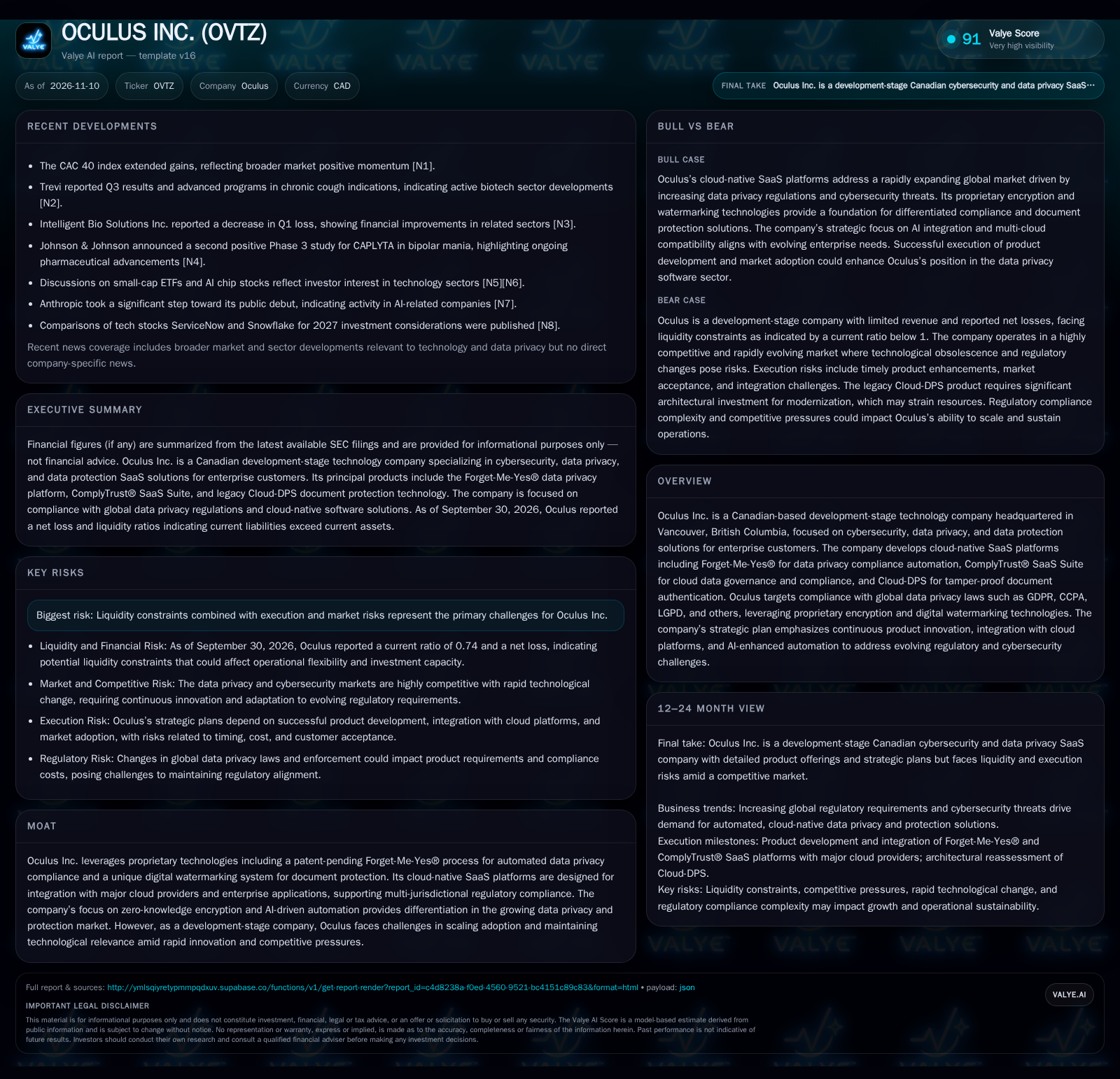
Oculus Inc. is a Canadian development-stage technology company building SaaS solutions for enterprise data privacy and cybersecurity compliance.Its core products leverage proprietary encryption and digital watermarking for regulatory alignment, but as of September 2026, the company faces a reported current ratio and ongoing net losses. The path to commercial validation and financial sustainability remains uncertain amid fierce competition and urgent funding needs. [S1] [S2]
Oculus Inc. is positioning itself as a solution provider at the intersection of enterprise cybersecurity and global data privacy regulation. With a suite of proprietary SaaS platforms targeting compliance automation and document protection, the company is attempting to ride the wave of increasing regulatory complexity and cyber threats.
Liquidity Pressures and Product Ambition Define Oculus’s Current Inflection
Oculus Inc. is a Canadian development-stage technology company focused on SaaS platforms for data privacy, cybersecurity, and regulatory compliance. Net loss for the quarter was $66,610 USD, with no reported revenue for the quarter ending March 2023. Meanwhile, Oculus is investing in expanding its Forget-Me-Yes® platform and ComplyTrust® SaaS Suite to address the growing demand for data privacy and compliance automation among enterprises, especially as regulatory requirements intensify worldwide. [S1] [S2]
How Oculus’s SaaS Model Could Generate Value—And Where the Margins Are at Risk
Oculus’s business model is predicated on recurring SaaS revenues from enterprise clients seeking automation in data privacy compliance and document protection. In theory, successful multi-tenant SaaS platforms can deliver high gross margins, especially after reaching critical scale, due to the low variable costs of serving additional customers. The Forget-Me-Yes® platform, for example, is designed as a cloud-native solution, which could allow for rapid deployment and low customer onboarding friction if the integrations with major platforms (Salesforce, AWS RDS, Hubspot, etc.) come to fruition.
However, the economics of this model are highly sensitive to customer acquisition costs, time-to-adoption, and integration complexity. As a development-stage company, Oculus is likely incurring high R&D and integration costs upfront, with little revenue to offset these investments. The lack of disclosed customer contracts or recurring revenue suggests that the company has not yet proven its ability to convert product features into paying relationships. Additionally, the capital-light nature of SaaS is offset by the need for ongoing product updates, compliance monitoring, and support—especially in a regulatory environment that is both fragmented and rapidly changing. Until Oculus demonstrates commercial uptake and retention, the pathway to positive operating leverage remains hypothetical.
A critical factor in Oculus’s ability to generate sustainable value lies in its capacity to manage the balance between upfront investment and long-term customer lifetime value (LTV). Given the competitive SaaS landscape, customer acquisition cost (CAC) efficiency will be pivotal. If Oculus can demonstrate a CAC-to-LTV ratio that supports profitable scaling, it would validate the economics of its model. However, this depends heavily on reducing onboarding friction through seamless integrations and delivering measurable compliance ROI to clients, which in turn supports pricing power. Without clear visibility into these unit economics, the risk remains that high churn or slow adoption could erode gross margins and delay profitability.
Moreover, the regulatory environment’s fragmentation imposes ongoing product development costs that may compress margins. Each jurisdiction’s unique compliance requirements necessitate continuous platform updates, which can increase operational complexity and technical debt. Oculus’s ability to modularize its architecture and leverage automation to minimize manual intervention will be key to controlling these costs. Failure to do so could result in rising support expenses and slower feature rollouts, undermining the value proposition. Thus, scalability is not only a function of customer growth but also of efficient product maintenance and adaptability to evolving regulations.
Navigating a Crowded Field: Differentiation Versus Scale in Data Privacy and Cybersecurity
Oculus operates in a global data privacy and cybersecurity software market characterized by rapid growth but intense competition. The company’s claim to differentiation rests on proprietary technologies such as its hybrid polymorphic encryption, digital watermarking, and AI-driven automation for compliance alerts and reporting. These features could provide an edge over generic compliance solutions, particularly for enterprises facing complex, multi-jurisdictional regulatory burdens.
However, the competitive landscape includes both established software vendors (with deep integration into enterprise IT stacks) and nimble startups targeting similar compliance pain points. Key competitor categories include large cloud providers offering native compliance tools, specialized privacy SaaS platforms, and cybersecurity vendors expanding into data governance. The question is whether Oculus’s technical differentiation is sufficient to overcome the entrenched relationships and integration advantages of larger players. Without commercial proof points or marquee customer wins, Oculus remains at risk of being outpaced by better-capitalized or more deeply embedded competitors.
If Product Integration and Regulatory Tailwinds Accelerate Adoption
A favorable outcome for Oculus would require rapid validation of its SaaS platforms by enterprise customers, driven by urgent regulatory deadlines and the complexity of compliance across multiple jurisdictions. If the company succeeds in completing integrations with major platforms (such as Salesforce, AWS, and Shopify), it could lower adoption barriers and tap into existing enterprise workflows. The AI-driven automation and proprietary encryption could become differentiators valued by compliance officers and IT decision-makers, especially if regulatory enforcement actions increase the perceived cost of non-compliance.
Evidence that would confirm this scenario includes announcements of paying customers, recurring revenue streams, or multi-year contracts, as well as successful product launches or integrations with leading cloud ecosystems. Conversely, if Oculus fails to convert its product roadmap into commercial deployments within the next several quarters, the upside scenario becomes increasingly implausible given its current liquidity position.
Commercial Uncertainty Persists as Oculus Balances Product Development and Funding Needs
The most plausible outcome, based on current evidence, is that Oculus continues to advance its product suite and integration efforts but struggles to achieve meaningful commercial traction before liquidity constraints become acute. The company may pursue further capital raises or strategic partnerships to bridge the gap, but this could come at the cost of dilution or unfavorable terms. In this scenario, Oculus remains a technology-driven but commercially unproven player, with the risk that ongoing R&D and operating expenses outpace any incremental revenue gains.
Confirmation of this scenario would include continued net losses and lack of material revenue growth, alongside incremental product updates or integration announcements without corresponding customer wins. A reversal—evidence of successful customer onboarding, recurring SaaS revenue, or improved balance-sheet flexibility—would be necessary to shift the outlook toward sustainable growth.
Liquidity Exhaustion and Execution Shortfalls Could Force Strategic Retrenchment
The principal risk for Oculus is that it fails to secure new funding or generate commercial revenue quickly enough to sustain operations. If liquidity continues to deteriorate and product adoption remains limited, the company could be forced into emergency cost-cutting, asset sales, or a distressed transaction. The legacy Cloud-DPS product, which requires significant architectural investment for modernization, could become a stranded asset if resources are diverted to survival rather than innovation.
Evidence supporting the downside scenario would include further declines in cash reserves, rising current liabilities, layoffs or restructuring announcements, or disclosures of going concern risks. The absence of customer validation or delays in product integration would further amplify the likelihood of adverse outcomes.
Milestones That Will Determine Whether Oculus Can Bridge Innovation and Adoption
Any reported customer wins, signed contracts, or recurring SaaS revenue—if disclosed—would be critical to validate product-market fit.
Progress on integrations with major platforms (e.g., Salesforce, AWS, Hubspot, Shopify) would signal execution against the stated product roadmap.
Updates on capital raising, partnership formation, or strategic investments would provide insight into Oculus’s financial runway and bargaining power.
Disclosures on customer retention, renewal rates, or churn—if disclosed—would help test the durability and scalability of the SaaS model.
Announcements of architectural refresh or successful integration of Cloud-DPS into the ComplyTrust® Suite would indicate ability to modernize legacy assets.
Any regulatory changes or enforcement actions that increase demand for automated compliance could serve as external tailwinds.
Trends in net loss, cash burn, and current ratio in subsequent quarters will reveal whether financial pressures are abating or intensifying.
Disclaimer: This is research-only, informational analysis and not investment advice. It may include AI-generated interpretation and general industry context. Always verify important details using primary sources.

Comments