
CPS Technologies: Expansion, Customer Concentration, and the Leverage of Advanced Composites in Specialized Markets
CPS Technologies is expanding operational capacity while navigating customer concentration and the complexities of high-performance material markets. Its proprietary metal matrix composites enable differentiated solutions for demanding commercial and defense applications, but growth hinges on broadening its customer base and translating technical leadership into scalable, recurring revenue streams.
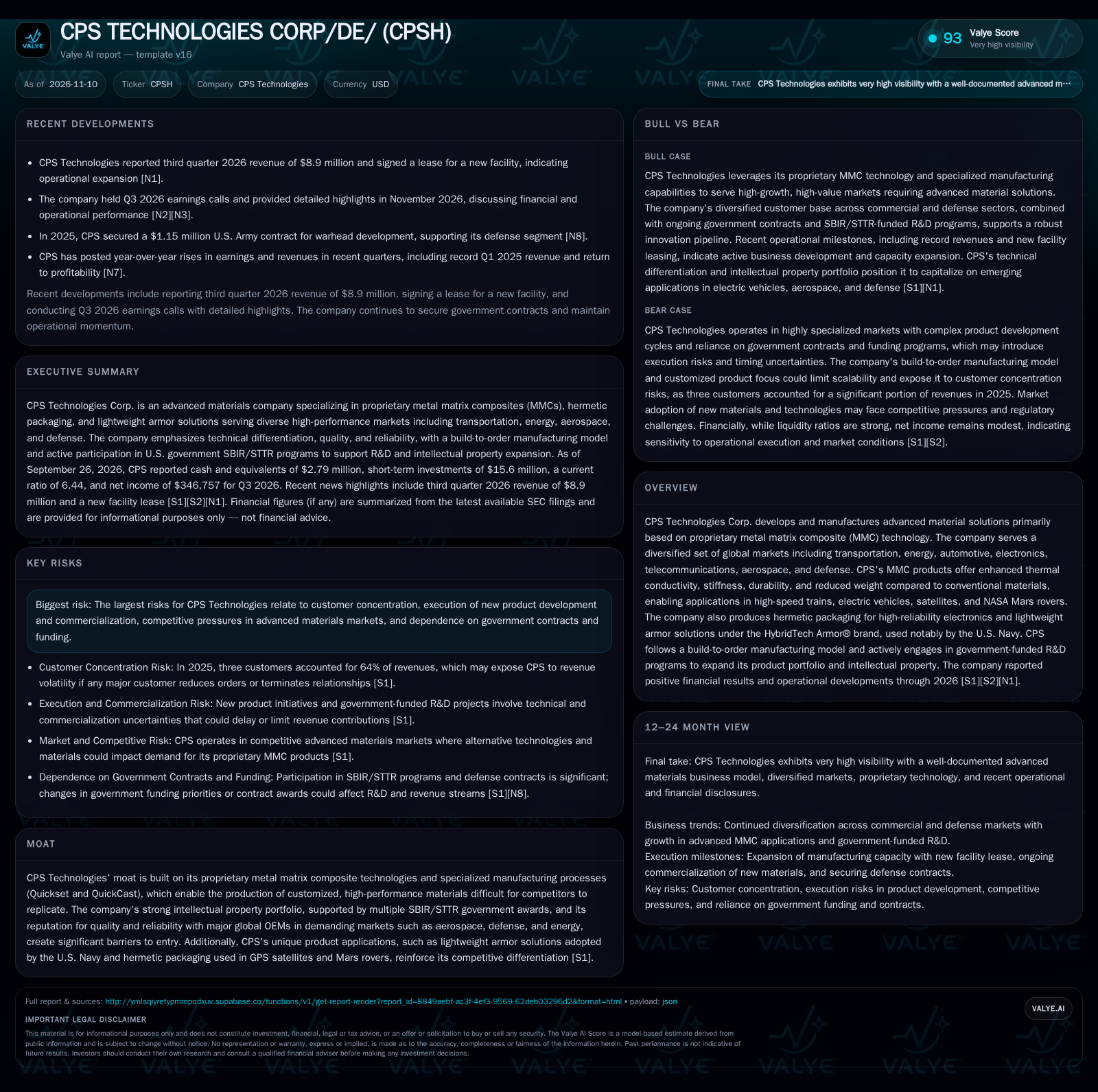
CPS Technologies reported Q3 2026 revenue of $8.9 million and signed a lease for a new facility, signaling operational expansion. The company’s proprietary metal matrix composite technology underpins its offerings in transportation, energy, aerospace, and defense, with notable customer concentration as three customers accounted for 64% of 2025 revenues. [S1] [S2] [N1] [N8]
CPS Technologies finds itself at an inflection point: expanding its operational footprint with a new facility lease and posting steady revenue growth, yet still heavily reliant on a small set of customers and the vagaries of government contracts. The company’s proprietary metal matrix composite (MMC) expertise has carved out a niche in high-performance markets—from electric vehicles to defense applications—where material reliability and customization command premium pricing. But as CPS seeks to scale, its ability to diversify its customer base, maintain technical differentiation, and convert innovation into recurring, profitable growth will determine whether its recent momentum is sustainable or vulnerable to disruption.
Facility Expansion and Revenue Growth: Recent Developments Shape Near-Term Trajectory
CPS Technologies reported Q3 2026 revenue of $8.9 million and signed a lease for a new facility, marking a tangible step in scaling operational capacity. This expansion follows a period of year-over-year revenue and earnings growth, including record Q1 2025 revenue and a return to profitability.[N1] [N7] This momentum is underpinned by continued contract wins in both commercial and defense sectors, such as a $1.15 million U.S. Army contract for warhead development awarded in 2025.[N8] However, customer concentration remains acute: in 2025, the three largest customers accounted for 64% of revenue, amplifying exposure to order volatility.[S1] These facts together frame the company's current position—a blend of operational progress and underlying structural risk.
How Proprietary MMCs Could Unlock Margin Leverage—If Commercialization Expands
CPS’s business model revolves around the design and manufacture of advanced material solutions, primarily leveraging its proprietary metal matrix composite (MMC) technology. MMCs command premium pricing due to their superior thermal, mechanical, and weight properties, which are essential in mission-critical applications such as satellites, electric vehicles, and defense platforms. The build-to-order, highly customized manufacturing approach allows CPS to capture higher gross margins on specialized products, but also limits scale economies compared to standardized volume manufacturing.
Fixed costs are elevated by ongoing investments in R&D, process automation, and employee training—expenses that may be partially offset by SBIR/STTR government grants and defense contracts. Variable costs are closely tied to project complexity and raw material volatility. The recent lease of a new facility suggests an intention to increase throughput or pursue new product lines, which could introduce operating leverage if incremental volumes are realized. However, the highly engineered nature of CPS’s products means that revenue visibility is often tied to project-based orders rather than recurring contracts, making cash flow lumpy and dependent on successful commercialization and renewal cycles.
Capital needs remain moderate given the company's asset-light, IP-driven orientation, but expansion into new applications or sustained growth would require further investment in equipment and technical talent. If CPS can broaden its customer base or secure multi-year contracts, it could shift its revenue mix toward more predictable, higher-margin streams.
Technical Differentiation Versus Customer Concentration: The Double-Edged Sword
CPS Technologies’ moat is rooted in its proprietary MMC processes (Quickset and QuickCast) and its ability to deliver highly customized solutions for applications where thermal management, durability, and weight are mission-critical. This specialization has enabled penetration into demanding markets such as aerospace, defense, and high-end electronics, where switching costs are elevated due to qualification cycles and reliability requirements.
However, the same factors that drive technical differentiation also constrain market breadth. The advanced materials sector features entrenched competitors—ranging from large specialty chemical conglomerates to niche composites manufacturers—often with deeper distribution, broader product portfolios, or vertically integrated supply chains. Emerging substitute technologies, such as advanced polymers or new ceramic composites, could erode CPS’s market share if they offer comparable performance at lower cost or greater scalability.
Customer concentration is a structural vulnerability. The loss of a major customer or a delay in project adoption could materially impact revenue, particularly given the long sales cycles and qualification hurdles typical of the industries CPS serves. The company’s reputation for quality and reliability is an asset, but without a more diversified customer roster or recurring revenue model, competitive pressure remains a persistent risk.
If End Markets Broaden and Recurring Orders Take Hold, Margin and Growth Could Accelerate
A favorable trajectory for CPS would involve successful expansion into new commercial and defense applications, leveraging its new facility to boost capacity and reduce lead times. If the company can convert pilot projects or initial contracts into recurring, multi-year supply agreements—particularly in electric vehicles, renewable energy, or next-generation defense platforms—operating leverage would rise as fixed costs are absorbed over a larger revenue base.
Further SBIR/STTR awards or large-scale government contracts could both de-risk the R&D pipeline and provide near-term revenue catalysts. Validation from marquee customers in emerging sectors may also accelerate adoption by additional OEMs, reducing customer concentration and enhancing pricing power.
Evidence that would confirm this scenario includes a rising number of multi-year contracts, increased customer diversification in revenue disclosures, and sustained margin expansion as new facility utilization grows. Announcements of new product launches or expanded relationships with top-tier commercial or defense clients would further support the upside case.
Incremental Growth Anchored by Existing Customers and Tactical Contract Wins
The most plausible near-term outcome is that CPS continues to post modest growth, anchored by its core set of customers and periodic success in securing incremental government and commercial contracts. The new facility may enable some capacity expansion or operational efficiencies, but the rate of top-line growth is likely constrained by the pace of adoption in targeted end markets and the inherent project-based nature of the business.
Revenue and earnings remain sensitive to the timing and size of customer orders, with continued reliance on SBIR/STTR and defense contracts to support R&D and offset fixed costs. Customer concentration persists as a structural feature, though gradual diversification may occur if targeted business development efforts yield results.
This scenario would be confirmed by continued single-digit revenue growth, stable or slightly improving gross margins, and revenue disclosures that show incremental progress in customer mix without a transformative broadening of the base. The absence of significant, multi-year contract announcements or dramatic changes in revenue composition would falsify a more bullish scenario.
If Customer Losses or Project Delays Materialize, Revenue Volatility and Margin Compression Loom
The principal risk to CPS is a material reduction in orders from one or more of its largest customers, or delays in the commercialization of new products and government-funded projects. Given that three customers made up 64% of 2025 revenues, any disruption—whether due to competitive displacement, project cancellation, or budgetary shifts in defense programs—could lead to abrupt revenue declines and underutilized capacity.
Because the company’s cost structure includes significant fixed overhead tied to specialized staff and R&D infrastructure, revenue shortfalls could rapidly erode margins and push the business back toward operating losses. If alternative materials or technologies gain traction with CPS’s key customers, switching costs may not be sufficient to prevent attrition.
Evidence supporting the downside case would include sudden drops in disclosed customer revenue concentration, negative surprises in quarterly revenue or earnings, or public disclosures of order cancellations or project deferrals. Failure to win new contracts or extend existing ones would further increase the risk of margin compression and financial stress.
Milestones and Metrics That Will Clarify CPS Technologies’ Path Forward
The degree to which new facility capacity is utilized and whether it translates into meaningful revenue growth.
Changes in customer concentration disclosed in future filings—a declining share from the top three customers would signal progress on diversification.
The frequency and size of new contract announcements, especially multi-year or recurring supply agreements in both commercial and defense markets.
Gross margin trends, particularly as new products are launched or as the mix shifts toward higher-volume, lower-customization offerings (if disclosed).
The pace and outcome of SBIR/STTR program participation and the ability to translate funded R&D into commercial products.
Evidence of expanded penetration in fast-growing end markets such as electric vehicles, renewable energy, or advanced electronics.
Any disclosure of backlog or order pipeline visibility that would improve forecasting of future revenues.
The impact of raw material or labor cost fluctuations on project economics and overall profitability, if detailed in future financial statements.
Disclaimer: This is research-only, informational analysis and not investment advice. It may include AI-generated interpretation and general industry context. Always verify important details using primary sources.

Comments