
Aviat Networks: Wireless Transport Execution, Revenue Volatility, and the Stakes of Technological Transition
Aviat Networks’ Q4 2026 results highlight the operational complexities of the wireless transport sector—marked by long sales cycles, reliance on third parties, and the challenge of sustaining profitability amid rapid industry change. With AI integration on the horizon and a product mix spanning both hardware and services, the company’s ability to manage cost structure and adapt to evolving standards will shape its next phase.
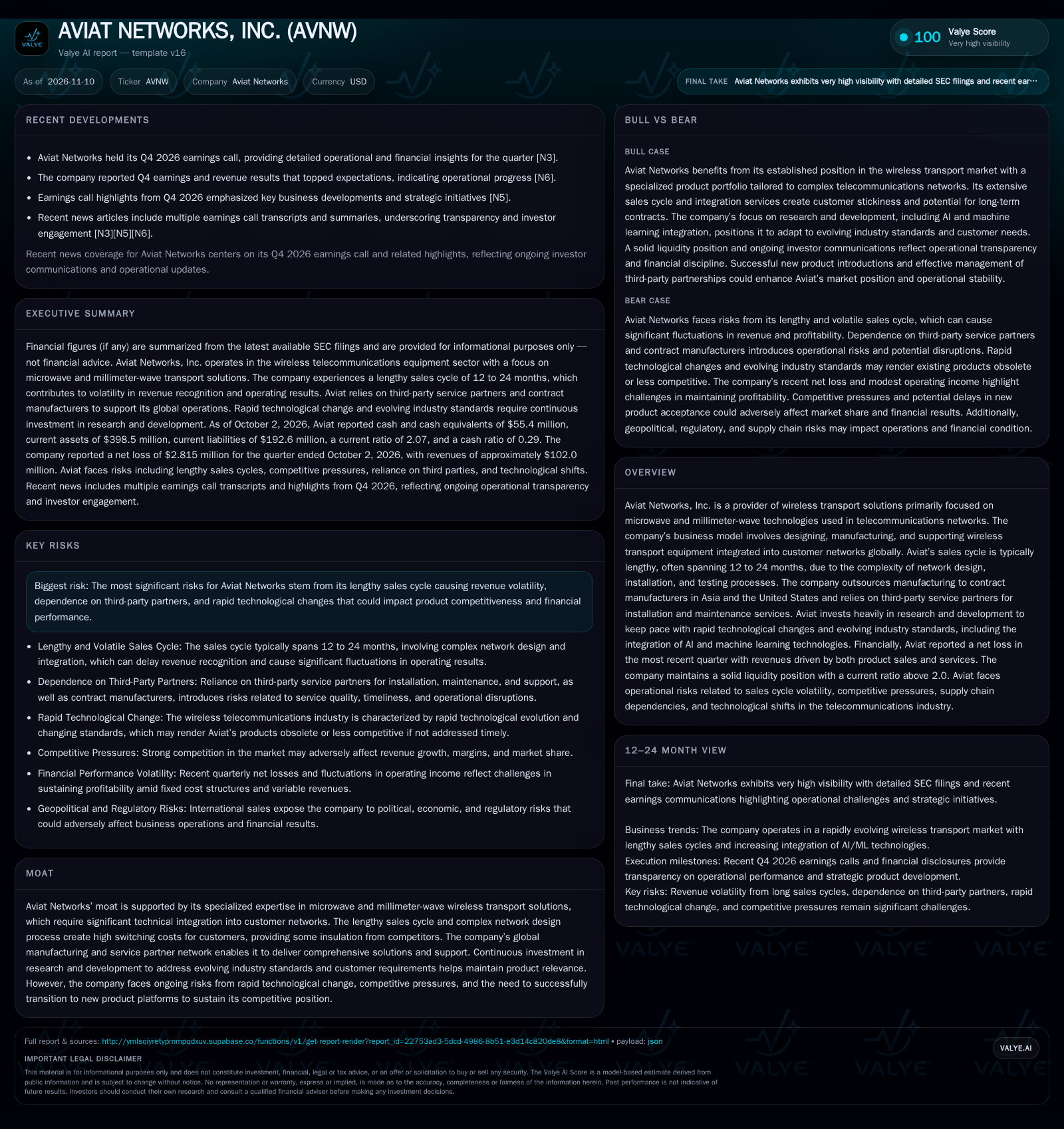
Aviat Networks reported Q4 2026 revenues of $102.0 million and a net loss of $2.815 million, underscoring ongoing revenue volatility linked to its lengthy sales cycle and fixed costs. The company’s balance sheet shows current assets of $398.5 million versus current liabilities of $192.6 million, providing a current ratio of 2.07. Aviat’s continued investment in R&D, including AI and machine learning, is critical as it navigates rapid technological shifts and competitive pressure in the wireless transport market. Execution risk around third-party partners and new product uptake remains high. [S2] [N3] [N6]
Aviat Networks sits at the intersection of wireless infrastructure necessity and the operational realities of a maturing telecom equipment market. The company’s Q4 2026 financials reflect both the opportunities and structural headwinds of its sector: demand for microwave and millimeter-wave transport remains critical for next-generation networks, but volatility from long sales cycles, fixed costs, and reliance on external partners continues to pressure margins and profitability. Aviat’s push into AI-driven product enhancements may offer a technological edge, but will only translate to sustainable growth if the company can manage integration complexity, accelerate sales conversion, and adapt to shifting industry standards.
Recent Results Highlight Revenue Volatility and Operational Leverage
For the quarter ended October 2, 2026, Aviat Networks reported total revenues of approximately $102.0 million, with product sales contributing $71.6 million and services revenue accounting for $30.3 million. Despite this topline, the company posted a net loss of $2.815 million and basic and diluted EPS of -$0.22. Gross profit for the quarter was $30.2 million, while operating income was a modest $0.9 million, impacted by interest and other expenses. These results illustrate the company’s ongoing challenge in converting revenue to consistent profitability given its fixed cost structure and the timing of large, complex orders. [S2] [N3] [N6]
On the balance sheet, Aviat reported cash and cash equivalents of $55.4 million and current assets of $398.5 million against current liabilities of $192.6 million, resulting in a current ratio of 2.07 and a cash ratio of 0.29. The company had approximately 12.9 million shares outstanding as of November 3, 2026. [S2]
How Aviat’s Revenue Mix and Cost Structure Shape Earnings Potential
Aviat generates revenue from both hardware (microwave and millimeter-wave transport equipment) and associated services such as network design, installation, and ongoing support. The product business is capital-intensive, with significant R&D investment required to keep pace with rapidly evolving telecom standards. The lengthy 12–24 month sales cycle means revenue recognition is lumpy and often tied to major project milestones rather than recurring contracts, creating quarter-to-quarter unpredictability.
The company’s fixed cost base—driven by engineering, support infrastructure, and R&D—means that operating leverage is high: modest changes in revenue can have an outsized impact on profitability. Outsourced manufacturing and reliance on third-party service partners help reduce variable costs and preserve flexibility but introduce supply chain and quality risks. Services revenue provides some margin stability, yet is still subject to the timing of customer deployment schedules and network upgrade cycles.
Future margin expansion may depend on Aviat’s ability to increase software and AI-driven solution content within its offerings, which could enable higher gross margins and more predictable revenue streams if customers adopt such solutions on a subscription or recurring basis. However, the current mix appears weighted toward project-based revenue, making the business sensitive to sales execution and industry investment cycles.
Customer Stickiness vs. Competitive Threats in Wireless Transport
Aviat’s core competitive advantage lies in its specialized expertise in microwave and millimeter-wave transport—critical technologies for backhaul and high-capacity wireless links in telecom networks. The complexity of integrating these solutions into customer environments could increase switching costs, as network operators are wary of service interruptions and the extended qualification cycles required for new vendors.
However, the industry is highly competitive, with rival equipment providers (including large diversified telecom hardware players and niche wireless transport specialists) vying for share. Rapid technological change—such as new spectrum allocations, the shift to 5G/6G, or advances in optical transport—poses the risk that Aviat’s incumbent solutions could be leapfrogged by rival technologies or integrated offerings from larger players. Price competition remains intense, particularly as telecom operators exert purchasing leverage through scale and multi-vendor procurement.
Aviat’s ongoing investment in AI and machine learning may help differentiate its network management and optimization offerings, but the question is whether these enhancements can be commercialized quickly enough to offset the risk of product commoditization or displacement.
AI-Driven Solutions and Execution on New Product Cycles Unlock Margin Expansion
If Aviat successfully integrates AI and machine learning into its network management software and transport products, it could create a differentiated value proposition for telecom operators seeking more intelligent, automated, and efficient network operations. Such solutions could justify a shift toward higher-margin, recurring software or managed service contracts, reducing the historical reliance on lumpy hardware sales.
Upside would also depend on effective management of third-party manufacturing and service partnerships, ensuring timely and high-quality delivery of complex projects. A meaningful improvement in the pace of sales conversion—reducing the average sales cycle or increasing win rates—would bolster revenue visibility and operating leverage.
Evidence supporting this scenario would include: a rising proportion of software or AI-enabled service revenue in quarterly disclosures (if disclosed), expanding gross margins, and a reduction in quarterly revenue and earnings volatility. Announcements of major contract wins with leading network operators for next-generation solutions would further validate the thesis.
Incremental Product Refresh, Ongoing Revenue Churn, and Margin Sensitivity
The most plausible trajectory is that Aviat continues to refresh its product portfolio to keep pace with evolving telecom standards, maintaining its existing customer relationships but facing ongoing quarter-to-quarter revenue churn due to the project-based nature of its business. Services and integration work provide a degree of revenue stability, but the overall mix remains largely dependent on large, episodic infrastructure orders.
Under this scenario, the company’s cost structure and reliance on external partners leave it exposed to periodic margin compression, especially if major orders are delayed or pricing pressure intensifies. Technological investments in AI and network management are necessary to remain competitive but may take multiple cycles to materially impact revenue mix or margin profile.
Confirmation of this scenario would come from continued volatility in quarterly earnings, stable but unremarkable gross margins, and the absence of a clear shift toward recurring or software-based revenue streams.
Delayed Product Adoption and External Shocks Drive Profitability Strain
A downside scenario could emerge if Aviat’s new product introductions fail to gain traction with major telecom operators, either due to technological missteps, insufficient differentiation, or slow adoption of AI-enabled features. Intensifying competition from larger, better-capitalized rivals could lead to price wars or loss of key accounts, eroding both revenue and margin.
Operationally, disruptions in third-party manufacturing or service delivery—whether from supply chain shocks, geopolitical tensions, or partner failures—could delay project completion and revenue recognition, compounding financial stress. A further risk is that rapid industry transitions (such as a move to new wireless backhaul standards or adoption of all-fiber solutions) could render Aviat’s core offerings less relevant.
This adverse scenario would be confirmed by a sharp drop in order backlog (if disclosed), persistent or widening net losses, negative operating cash flow, and customer or contract losses to competitors.
What Will Determine Aviat’s Next Phase: Execution, Innovation, and Market Signals
Quarterly revenue mix between product, services, and—if disclosed—software or AI-driven solutions, to gauge progress on shifting toward higher-margin recurring streams.
Gross margin trends over sequential quarters, reflecting the impact of new product introductions, pricing pressure, and cost management.
Length and conversion rate of the sales pipeline, as measured by order intake, backlog changes (if disclosed), and the timing of major contract wins or losses.
Operating cash flow and net working capital fluctuations, which would reveal stress from delayed payments, inventory buildup, or project execution risks.
Updates on the integration and commercial rollout of AI/machine learning features in Aviat’s product suite, validated by customer adoption announcements or new deployment case studies.
Disclosures or commentary on the stability and performance of third-party manufacturing and service partners, especially in light of global supply chain volatility.
Customer concentration and retention metrics (if disclosed), as a high reliance on a few large accounts could amplify revenue risk.
Competitive developments in wireless backhaul and transport technologies, including new standards or disruptive rival offerings that could challenge Aviat’s core business.
Disclaimer: This is research-only, informational analysis and not investment advice. It may include AI-generated interpretation and general industry context. Always verify important details using primary sources.

Comments