
Boundless Bio and the Serapha Merger: Portfolio Consolidation, Oncology Ambitions, and the Stakes of Capital Deployment
Boundless Bio’s planned merger with Serapha Bio and recent $230 million private placement signal a strategic consolidation and capital influx in a challenging biotech landscape. As the company navigates leadership restructuring, focused pipeline development, and extended liquidity, the next phase hinges on clinical progress, integration execution, and the competitive realities of oncology drug development.
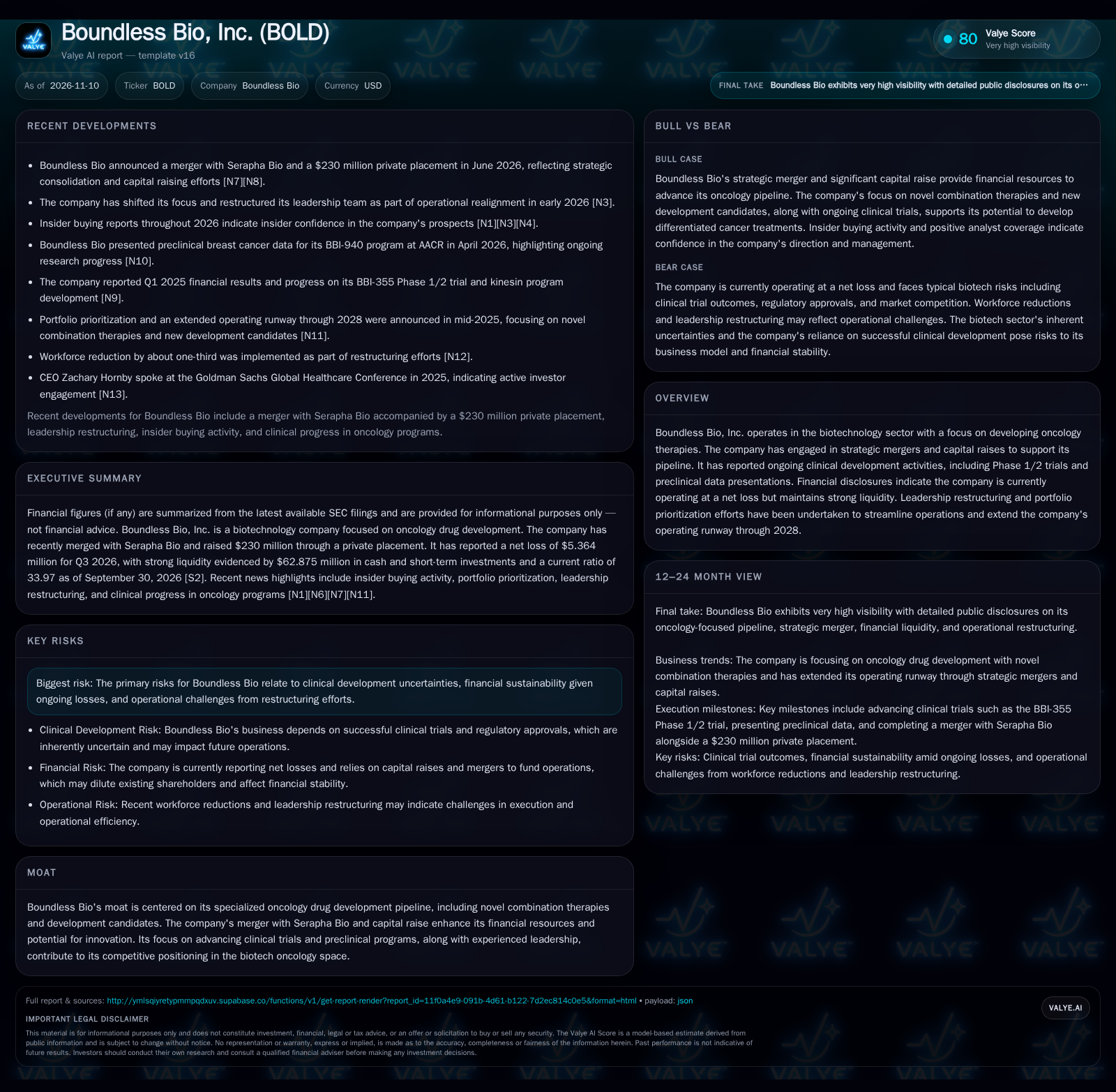
Boundless Bio’s merger with Serapha Bio and a $230 million private placement mark a decisive pivot for the oncology-focused biotech. [N7] [N8] [S2]
Boundless Bio, Inc. is at a critical inflection point, catalyzed by its announced merger with Serapha Bio and a major $230 million private placement. The company, which targets oncogene-amplified tumors through innovative small molecule therapies, is leveraging strategic consolidation and significant liquidity to reshape its pipeline and operating model.Insider transaction activity was reported in the cited source; this activity does not by itself establish insider confidence.
Merger, Capital Influx, and a Strategic Reset: The Present State of Boundless Bio
Boundless Bio announced a merger with Serapha Bio in June 2026, coupled with a $230 million private placement, signaling a transformative event for the company’s scale, capital structure, and future direction. The transaction, once closed, would result in Serapha shareholders owning the majority of the combined entity, fundamentally altering Boundless Bio’s ownership and strategic priorities.As of September 30, 2026, Boundless Bio reported $62.9 million in cash and short-term investments, and an reported current ratio of nearly 34, reflecting a reported liquidity position before the expected merger close and capital infusion. [S2] [N7] [N8]
Operationally, the company has undergone significant restructuring, cutting its workforce by about one-third and realigning its leadership team to focus on prioritized oncology programs. Insider buying activity throughout 2026 further underscores management’s stated confidence in the company’s revised trajectory. [N1] [N3] [N4]
Pipeline Progress, Capital Consumption, and the Economics of Oncology Innovation
Boundless Bio’s business model centers on the high-risk, high-reward economics of clinical-stage oncology drug development. Revenue generation is dependent on successful advancement of its pipeline through costly preclinical and clinical phases, with value inflection typically tied to positive data readouts, out-licensing, or eventual product commercialization. The merger with Serapha and associated capital raise are designed to fund continued R&D and portfolio expansion, but also introduce integration costs and potential dilution for pre-merger shareholders.
The company reported a quarterly net loss of $5.364 million for Q3 2026, a typical figure for early-stage biotechs without commercial products. Fixed costs are significant, but recent restructuring (including a one-third workforce reduction) suggests a shift toward a leaner cost structure and more targeted capital allocation. The extended runway through 2028, if the merger closes as anticipated, provides a rare window to pursue multiple assets without the immediate pressure of near-term fundraising. [S2] [N7] [N8]
The critical economic question is whether Boundless Bio can generate sufficient clinical and commercial milestones—either through direct product launches, strategic partnerships, or licensing agreements—to justify ongoing capital consumption and eventual returns for shareholders. Pricing power and reimbursement for novel oncology therapies, if achieved, can be substantial, but the path to market is both expensive and uncertain.
Navigating the Oncology Landscape: Differentiation, Counterforces, and Integration Challenges
Boundless Bio operates in an intensely competitive segment of biotechnology, focused on targeting oncogene-amplified tumors via the biology of extrachromosomal DNA (ecDNA). The company’s approach—developing small molecule ecDNA-directed therapeutics (ecDTx)—targets a novel mechanism implicated in tumor resistance and adaptation, potentially offering a differentiated angle versus conventional oncology pathways.
However, the broader oncology market is crowded with both large pharmaceutical incumbents and specialized biotechs, many of which pursue combination therapies, targeted agents, or next-generation modalities (e.g., cell therapy, bispecific antibodies). Barriers to entry remain high, with intellectual property, clinical validation, and regulatory milestones acting as key differentiators.
The merger with Serapha Bio could enhance Boundless Bio’s competitive toolkit by combining scientific talent, pipeline assets, and operational expertise. Yet, integration risks are nontrivial: aligning R&D priorities, managing cultural differences, and retaining critical staff will be essential to avoid disruption and maximize the combined entity’s value. The company’s future competitive position will hinge on whether its ecDNA platform can generate compelling clinical data, secure partnerships, and ultimately carve out a defensible niche in oncology.
From Capital to Catalysts: How Boundless Bio Could Outperform Expectations
A favorable scenario unfolds if Boundless Bio successfully integrates Serapha Bio, retaining key scientific and operational talent while rapidly advancing its prioritized pipeline. The influx of $230 million enables the company to accelerate clinical trials, expand into additional indications, and pursue novel combination regimens that attract strategic partners or acquirers.
The most powerful catalysts would be positive early-stage clinical data from its ecDTx programs, particularly if results demonstrate efficacy in patient populations with limited alternatives. Validation of the ecDNA-driven approach could also lead to licensing or co-development deals with larger pharmaceutical players, providing non-dilutive funding and external validation.
Evidence supporting this scenario would include: timely merger closing; successful integration with minimal disruption; initiation or advancement of key clinical trials; favorable safety and efficacy data; and announcements of new partnerships or significant licensing agreements. Sustained insider buying and continued analyst support would further reinforce external confidence in the company's trajectory. [N1] [N3] [N4] [N7] [N8]
Portfolio Focus, Measured Progress, and the Realities of Clinical-Stage Execution
The most plausible outcome is that Boundless Bio, post-merger, maintains a focused pipeline with incremental progress across select assets. The company leverages its extended cash runway to advance a handful of ecDTx candidates through preclinical and early clinical phases, prioritizing assets with the greatest differentiation or partnership potential.
Operational execution remains steady, with the organization absorbing the integration of Serapha and new leadership structure without major disruption. Clinical milestones are achieved on schedule but may not deliver transformative data, leading to periodic, modest value inflection points rather than dramatic re-ratings.
Confirming evidence would include: regular pipeline updates showing continued advancement; cash burn in line with projections; measured clinical progress without major setbacks; and periodic investor engagement. Falsifying evidence would involve material integration issues, significant clinical delays, or the need for unexpected capital raises despite the recent financing.
Integration Hurdles, Clinical Setbacks, and the Risk of Capital Erosion
The adverse scenario emerges if the Serapha merger encounters integration problems—loss of key personnel, cultural misalignment, or delays in combining research efforts. If pipeline reprioritization leads to unexpected asset discontinuations or poor clinical readouts, investor confidence could erode quickly.
A major risk is capital inefficiency: despite the substantial cash infusion, accelerated burn from failed trials, duplicative infrastructure, or unforeseen restructuring costs could shorten the operating runway. In a competitive oncology market, lack of meaningful differentiation or delays in demonstrating clinical proof-of-concept may result in reduced partnering interest and a need for further dilutive financings.
Downside confirmation would include: missed integration or clinical milestones; increased cash burn above projections; loss of key scientific or leadership staff; negative or inconclusive data from lead programs; and a decline in insider or analyst support. Regulatory setbacks or inability to secure additional non-dilutive funding would further compound the risk.
Milestones That Will Test Boundless Bio’s Consolidation and Oncology Ambitions
Actual closing of the Serapha Bio merger and public disclosure of integration plans, including leadership structure and R&D priorities.
Timing and content of pipeline updates, particularly first-in-human trial initiations or early clinical data readouts for ecDTx programs.
Quarterly cash burn rates and updated runway projections post-merger and capital raise.
Retention and recruitment of key scientific and operational talent through the integration period.
Announcement of new strategic partnerships, licensing deals, or collaborations with larger pharmaceutical companies.
Evidence of continued insider buying or meaningful changes in insider ownership, if disclosed.
Progress toward regulatory milestones, including IND filings, trial initiations, and interactions with FDA or other agencies.
If disclosed, metrics on pipeline attrition or reprioritization—such as discontinued programs or shifts in development focus—would help test the thesis.
Disclaimer: This is research-only, informational analysis and not investment advice. It may include AI-generated interpretation and general industry context. Always verify important details using primary sources.

Comments