
SEATech Ventures: Incubation Ambitions Confront the Realities of Liquidity and Execution in Asia’s ICT Sector
SEATech Ventures Corp. is positioned at the intersection of Asia’s digital transformation and capital markets innovation, offering incubation and advisory services to ICT entrepreneurs in Malaysia and Hong Kong. Despite a foothold in high-growth segments—such as digital asset listings and strategic regional partnerships—the company faces substantial financial constraints and execution risk. The question is whether SEATech can convert sectoral tailwinds and ecosystem positioning into sustainable business economics before liquidity pressures force a strategic reset.
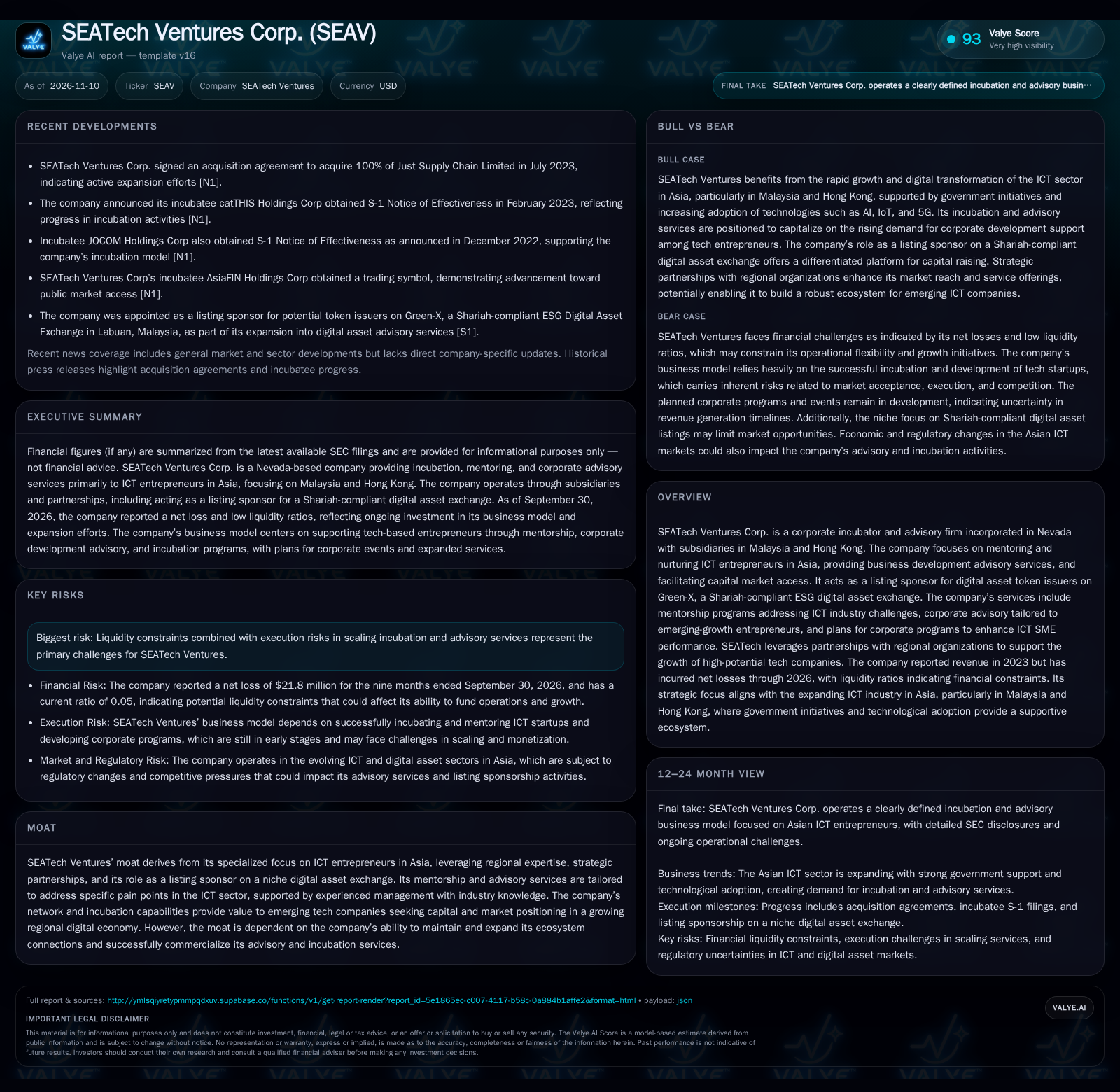
SEATech Ventures provides incubation and advisory services for ICT entrepreneurs in Asia, with a focus on Malaysia and Hong Kong, and acts as a listing sponsor for digital asset issuers on a Shariah-compliant platform. Its future trajectory depends on successful execution, regulatory stability, and the pace of ICT adoption in its target geographies. [S2]
SEATech Ventures Corp. operates at the confluence of Asia’s rapidly expanding ICT sector and the region’s evolving capital markets landscape. By offering incubation, advisory, and listing sponsorship services—especially for digital asset issuers—the company aims to support tech entrepreneurs and SMEs in Malaysia, Hong Kong, and beyond. The company’s future will hinge on its ability to convert sectoral opportunity into recurring, scalable revenue streams, all while navigating execution risks and regulatory uncertainties. [S2]
Liquidity Pressures and Strategic Partnerships Define SEATech’s Current State
The company reported cash and liquidity metrics for the period; these figures do not by themselves establish operating runway, investment capacity, financial flexibility, or financing capacity. At the same time, SEATech continues to serve as a listing sponsor for token issuers on Green-X, a Shariah-compliant ESG digital asset exchange, and maintains partnerships with entities such as GreenPro Capital Corp and the National ICT Association of Malaysia. These relationships provide a potential pipeline of clients and reinforce the company’s access to emerging-growth tech entrepreneurs in Malaysia and Hong Kong. The sale of certain Malaysian subsidiaries in October 2025 also signals ongoing portfolio adjustments. The company’s most recent annual revenue was $328.3 million in 2023, but losses and balance sheet strain dominate the near-term picture. [S2]
Incubation Model Economics: Where Value Could Be Created or Lost
SEATech’s business model relies on generating revenue through incubation, advisory, and corporate development services for ICT entrepreneurs. In principle, this model can produce attractive economics if the company can earn fees, equity stakes, or success-based compensation from startups that successfully scale or list on exchanges such as Green-X. However, the economics are complex: fixed costs for staffing, program development, and network building are front-loaded, while payoffs from incubated ventures are uncertain, lumpy, and often delayed. The company’s ability to monetize advisory and sponsorship services depends on the transaction flow, the success rate of incubatees, and the willingness of entrepreneurs to pay for mentorship or equity participation. If the company is compensated mainly through success fees or equity, capital needs may remain high until portfolio companies mature or exit, exacerbating liquidity pressures. Conversely, if SEATech can shift toward more predictable, retainer-based advisory contracts or recurring event revenues, it could improve cash flow stability, but this would likely demand demonstrable value and strong market positioning.
Positioning in Asia’s ICT Ecosystem: Differentiation and Counterforces
SEATech’s competitive edge is built on its regional focus—particularly on Malaysia and Hong Kong—where government support, advanced telecom infrastructure, and a growing digital asset market create fertile ground for ICT incubation. Its role as a listing sponsor for a Shariah-compliant exchange provides niche differentiation, appealing to companies seeking compliant capital market solutions. Strategic partnerships with regional organizations extend SEATech’s network and enhance deal sourcing. Nevertheless, the company faces competition from other incubators, accelerators, and advisory firms, including both local players and global consultancies moving into Asia’s tech ecosystems. The competitive landscape is further complicated by government-backed programs, university incubators, and emerging fintech platforms that may offer similar or substitute services. Switching costs for entrepreneurs are low if SEATech’s programs do not deliver tangible, differentiated value—raising the stakes for execution and relationship management. Regulatory changes in digital assets and capital markets also represent an ongoing threat to the company’s operating model.
If Incubation Converts to Monetizable Exits: The Path to Sustainable Growth
The most favorable scenario for SEATech is one in which its pipeline of incubated ICT ventures achieves successful listings or exits, generating material fees, equity monetization, or recurring advisory revenues. The company’s positioning as a listing sponsor on Green-X could attract a steady flow of token issuers, especially if Shariah-compliant, ESG-focused digital assets gain traction in Malaysia and the broader region. Confirming evidence would include a ramp-up in the number and value of client listings, reported equity or fee income from successful incubatees, and announcements of new, high-profile partnerships or mandates. Further, evidence of improved operating margins or positive operating cash flow would support the case that the business model is scaling. This scenario could be falsified if most incubatees fail to reach listing or exit events, or if revenue remains concentrated in one-off advisory fees rather than recurring or performance-based streams.
Navigating Between Opportunity and Constraint: A Tenuous Balancing Act
The most plausible outcome is that SEATech maintains its current role in the ICT advisory ecosystem, continuing to offer incubation and listing sponsorship services while contending with financial constraints. Revenue may remain volatile and largely dependent on sporadic advisory mandates or small participation in incubatee successes. The company is likely to face persistent execution risk as it seeks to scale new programs and corporate events, with some traction in client acquisition but limited ability to invest in growth given its balance sheet. Evidence confirming this scenario would include continued announcements of new partnerships and incubatee S-1 filings, but without a sustained shift to profitability or improvement in liquidity ratios. If cash outflows persist and no material improvement in working capital or recurring revenue is disclosed, this would further support the “balancing act” thesis.
When Liquidity Dominates: Pressure for Restructuring or Retrenchment
In a more adverse scenario, SEATech’s acute liquidity shortage forces it to curtail operations, divest additional assets, or seek emergency financing on unfavorable terms. If incubated companies fail to deliver exits or attract follow-on capital, and if no new funding is secured, SEATech could be compelled to restructure, downsize, or even wind down certain activities. Confirming evidence would include announcements of asset sales, debt or equity financings at dilutive terms, or reductions in headcount and program scope. Conversely, if the company manages to stabilize its working capital or secure non-dilutive funding, the downside could be mitigated.
Milestones That Will Determine Whether SEATech Surmounts Its Capital and Execution Challenges
Sustained improvement in cash and current ratios, indicating enhanced liquidity or successful capital raising, would be a critical test of near-term viability. [S2]
Evidence of recurring revenue streams from advisory, incubation, or listing sponsorship—not just one-off transaction fees—would help validate the shift toward a more durable business model.
Disclosure of the number and financial outcomes of incubatee listings or exits on Green-X, if provided, would clarify the effectiveness of the incubation pipeline.
Progress in launching or scaling planned corporate programs, seminars, and events for ICT entrepreneurs—if disclosed—would signal operational execution.
New strategic partnerships or mandates with government agencies, accelerators, or large corporates could expand deal flow and reinforce SEATech’s ecosystem position.
Material changes in the regulatory environment for digital assets or capital markets in Malaysia and Hong Kong could impact both opportunity and risk for the company.
If disclosed, data on client retention, satisfaction, or repeat business would provide insight into the stickiness and perceived value of SEATech’s services.
Announcements of asset sales, workforce reductions, or emergency financings would be warning signs of intensifying financial distress.
Disclaimer: This is research-only, informational analysis and not investment advice. It may include AI-generated interpretation and general industry context. Always verify important details using primary sources.

Comments