
Energy Focus: Leveraging Niche Expertise to Capture Emerging Opportunities in LED and Power Solutions
Energy Focus’s pivot toward energy storage and AI data center power solutions, alongside its core military-grade LED lighting business, signals both strategic ambition and heightened execution risk. Recent profitability, customer concentration, and competitive dynamics will determine whether its innovation-led approach can overcome structural industry headwinds.
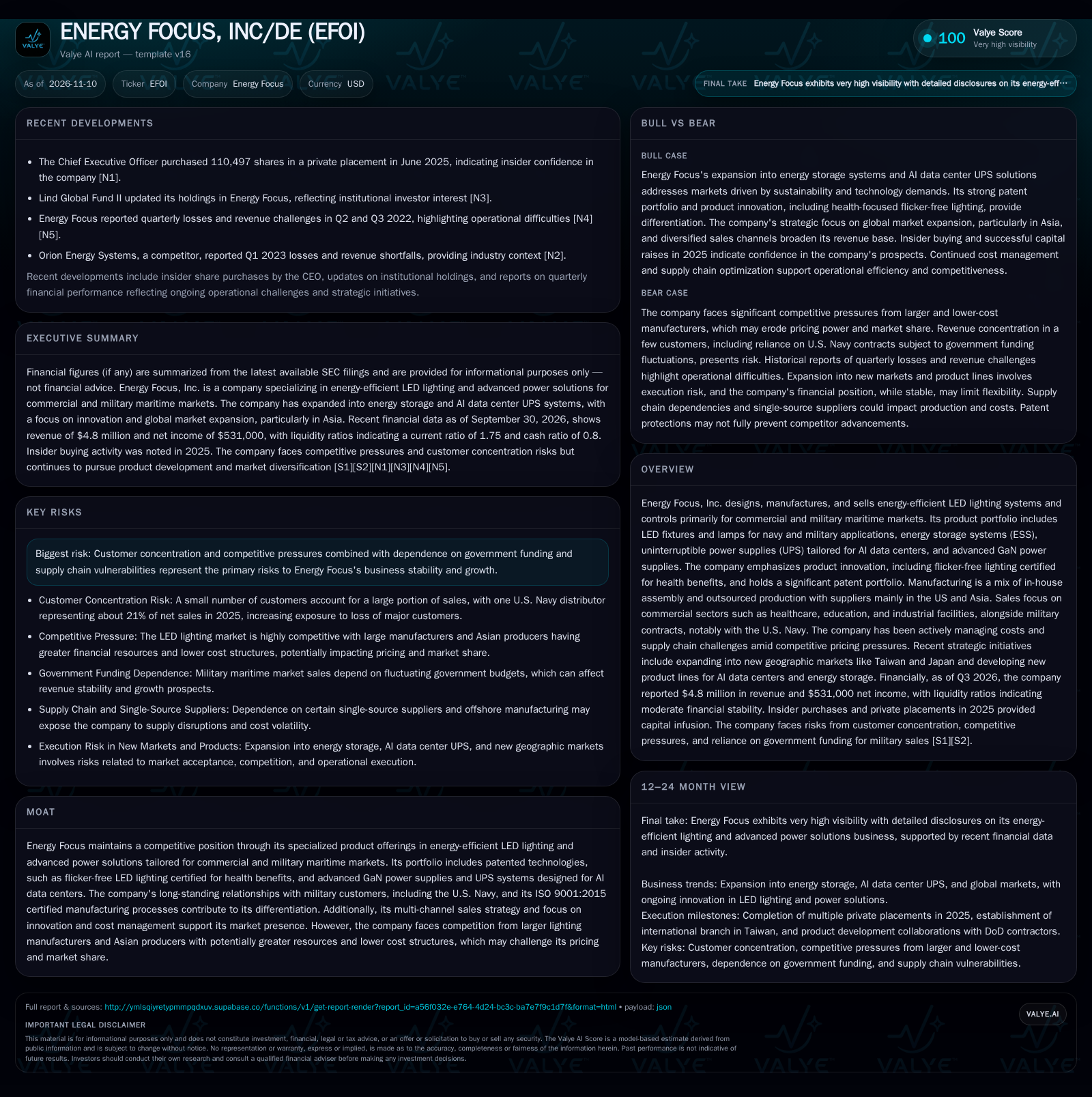
Energy Focus reported Q3 2026 net income of $531,000 on $4.8 million in revenue, reflecting a rare period of profitability. The company is expanding beyond core LED lighting for commercial and military maritime markets into energy storage and AI data center UPS solutions, targeting growth in Asia. Customer concentration remains high, with three customers comprising 48% of 2025 sales, while competition from larger and lower-cost manufacturers intensifies. Execution in new markets and product lines, as well as the ability to diversify revenue and preserve margins, will be critical for long-term viability. [S1] [S2]
Energy Focus, Inc. stands at a strategic crossroads: after years of operational volatility, the company recently posted a profitable quarter while simultaneously pushing into higher-growth, innovation-driven niches like AI data center power and energy storage. Its core business—LED lighting solutions for commercial and military maritime markets—remains exposed to both customer concentration and intense global competition. The next chapter for Energy Focus will turn on its ability to translate engineering innovation and new market entry into sustainable, diversified growth, all while managing the risks inherent in its concentrated revenue and evolving product mix. [S1] [S2]
Profit Trends, Product Line Growth, and Customer Base Concentration Shape Current Outlook
Energy Focus reported $4.8 million in revenue and $531,000 in net income for Q3 2026, marking a rare quarter of profitability after a history of operational challenges. The company’s current ratio stands at 1.75, with $3.33 million in cash and equivalents as of September 30, 2026. The company reported cash and liquidity metrics for the period; these figures do not by themselves establish operating runway, investment capacity, financial flexibility, or financing capacity. [S2]
The company has expanded its portfolio to include energy storage systems (ESS), uninterruptible power supply (UPS) units for AI data centers, and advanced Gallium Nitride (GaN) power supplies. This marks a strategic push beyond its traditional LED lighting core, targeting both high-growth technology markets and international expansion, notably in Taiwan and Japan.[S1] [S2]
However, revenue risk is elevated: in 2025, three customers represented 48% of net sales, with a U.S. Navy distributor accounting for 21%. This concentration exposes Energy Focus to contract renewal risk and government funding volatility, particularly in its military maritime segment.[S1]
Analyzing Product Mix and Margin Dynamics in Specialty Lighting and Power Segments
Energy Focus’s business model relies on selling specialized LED lighting fixtures, lamps, and power solutions to both commercial and military customers. Historically, LED lighting has been a margin-compressed, commoditized space with intense pricing pressure from Asian manufacturers. The company’s emphasis on patented, health-focused flicker-free lighting and long-life, high-warranty products attempts to differentiate on value rather than price—a strategy that can support premium pricing if customers perceive real performance or compliance advantages.
The expansion into ESS and AI data center UPS systems introduces both higher complexity and potentially higher-margin opportunities, especially if the company can secure contracts with data center operators or technology firms seeking ultra-reliable, energy-efficient backup power. However, these markets are capital-intensive and require ongoing investment in R&D, certifications, and potentially new sales channels.
Energy Focus’s manufacturing model blends in-house assembly with outsourced production, leveraging suppliers in the US and Asia. This provides some flexibility but also introduces supply chain risk, particularly if single-source suppliers or logistics disruptions impact cost or availability.
Operating leverage is present but limited by the need for continuous product development and the lumpy nature of military and large commercial orders. Cost management has been a recent focus, but the company’s ability to scale without margin erosion will depend on both volume growth in new segments and the resilience of its differentiated pricing.
Evaluating Differentiation and Patent Strength Versus Scale and Cost Competition
Energy Focus faces formidable competition from large global lighting manufacturers and agile Asian producers able to undercut on price. The company’s edge lies in its patent portfolio (over 50 issued patents), health and performance certifications (such as ultra-low flicker and 10-year warranties), and long-standing relationships with military customers. These factors can create switching frictions, especially in regulated or mission-critical environments where reliability and compliance are paramount.
However, these advantages are inherently fragile. Patent protection can slow, but not stop, technological leapfrogging by better-capitalized rivals. The military market, while sticky due to high qualification barriers, is subject to budget cycles and political fluctuations. In commercial and data center markets, Energy Focus must compete not just on product performance but on price, logistics, and integration with broader building or IT systems.
The company’s ISO 9001:2015 certification and multi-channel sales—including direct, agency, and selective e-commerce—support reach but do not inherently guarantee volume or retention. Larger competitors may have broader product lines, better supply chain leverage, and the ability to bundle offerings, making it difficult for a niche player to defend share outside its core.
Innovation and Market Expansion as Catalysts for Revenue Growth
The bullish scenario hinges on Energy Focus successfully leveraging its differentiated products and intellectual property to win sizable contracts in energy storage and AI data center power. If the company demonstrates traction in Asia—validating demand in Taiwan and Japan for its advanced GaN power supplies or ESS—it could diversify away from its current customer concentration.
A favorable outcome would see continued profitability, rising revenue from non-military sectors, and evidence of repeat business in new verticals. Confirmation would come from disclosed multi-year commercial contracts, growing order backlog in data center or energy storage segments, and improved gross margin trends despite industry price pressure.
Falsification would be evident if new product launches fail to translate into meaningful sales, or if the company is unable to maintain margin or extend its presence beyond its traditional military and commercial lighting base.
Maintaining Niche Leadership Amid Incremental Advances and Market Fluctuations
The most plausible outcome is that Energy Focus maintains its existing foothold in military and select commercial lighting, with incremental contributions from new product lines. Revenue remains concentrated, and while the company may achieve periodic profitability, results are likely to be volatile due to the lumpy nature of military contracts and competitive pricing in commercial sectors.
Growth in Asia and the AI/data center segment is gradual rather than transformative, limited by the company’s scale, brand, and resources relative to global peers. Margins are pressured by ongoing cost competition, but cost controls and product innovation help prevent major erosion.
Evidence for this scenario would be continued reliance on a handful of large customers, modest but positive cash flow, and stable or slightly improving gross margins. Falsification would occur if customer churn accelerates, or if price erosion outpaces cost controls, leading to renewed operating losses.
Risks from Customer Attrition, Operational Challenges, and Commodity Cost Pressures
In the adverse case, Energy Focus loses one or more of its major customers, particularly in the military segment, either due to government budget cuts, competitive displacement, or contract non-renewal. The company’s attempts to diversify stall, with new products failing to gain traction in commercial or data center markets.
Intensifying price competition from Asian manufacturers and larger global lighting firms could compress margins to unsustainable levels, especially if supply chain disruptions or input cost spikes compound the problem.
This scenario would be confirmed by sharp revenue declines, deteriorating gross margins, negative cash flow, and an inability to raise capital or refinance obligations as needed.
Key Developments Influencing Energy Focus’s Potential to Broaden Market Reach
Quarterly revenue contribution from new product lines (ESS, AI data center UPS, GaN power supplies) versus legacy LED lighting—if disclosed.
Gross margin trends, especially as new products are launched and as mix shifts toward higher-value or higher-competition segments.
Customer concentration metrics: the share of revenue from top three customers and any reduction in U.S. Navy-related exposure.
Order backlog or announced multi-year commercial/data center contracts—would help test demand for new solutions.
Geographic sales breakdown, particularly growth in Taiwan, Japan, or other Asian markets.
R&D and SG&A expense levels relative to revenue, indicating the company’s investment in innovation and sales expansion.
Working capital and cash flow from operations, to track liquidity risk as the company enters new markets.
Disclaimer: This is research-only, informational analysis and not investment advice. It may include AI-generated interpretation and general industry context. Always verify important details using primary sources.

Comments