
Xilio Therapeutics: Tumor-Activated Immuno-Oncology at an Inflection, But Clinical and Competitive Hurdles Remain
The next phases hinge on trial data, regulatory progress, and the ability to translate innovation into real commercial traction.
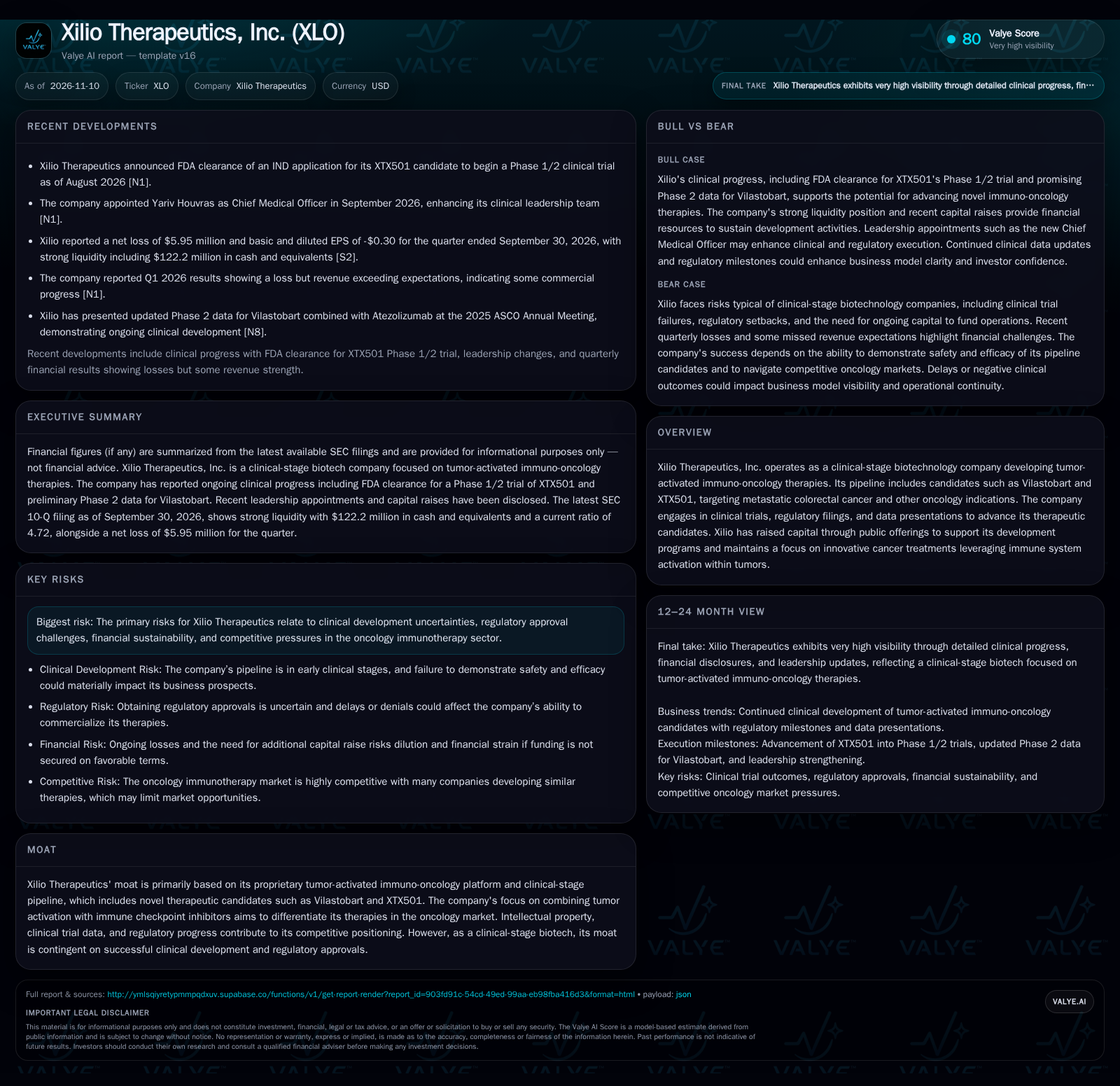
Xilio Therapeutics maintains a reported liquidity position and advances a novel tumor-activated immuno-oncology pipeline, but remains pre-commercial with ongoing losses. The company's future depends on proving clinical efficacy, securing regulatory approvals, and differentiating its therapies amid intense competition. Key milestones will be clinical data readouts, regulatory interactions, and evidence of commercial viability or meaningful partnerships.
Xilio Therapeutics sits at a pivotal stage in its evolution as a clinical-stage biotech, leveraging a reported cash position to fuel the development of tumor-activated immuno-oncology candidates. With ongoing clinical trials and leadership changes signaling focus, the real test will be the ability to carve out a defensible niche in the crowded oncology landscape, where both innovation and execution are prerequisites for commercial success.
Recent Financial and Clinical Milestones Shape Xilio’s Near-Term Trajectory
Xilio Therapeutics reported $122.2 million in cash and equivalents and a current ratio of 4.72 as of September 30, 2026, underscoring a reported liquidity position for a clinical-stage biotech [S2]. This financial cushion is significant, as it enables the company to fund ongoing and upcoming clinical trials for its tumor-activated immuno-oncology pipeline. However, Xilio remains pre-commercial, posting a net loss of $5.95 million for the most recent quarter and experiencing revenue volatility, with some quarters exceeding and others missing expectations [S2] [N1] [N4] [N7] [N8]. The pipeline, which includes assets such as Vilastobart and XTX501 targeting metastatic colorectal cancer and other oncology indications, remains central to the company’s value proposition. The next inflection points for Xilio will likely be driven by clinical data readouts, regulatory feedback, and the company’s ability to maintain financial discipline while advancing its candidates.
Pipeline Progress, Capital Needs, and the Economics of Clinical-Stage Oncology
Xilio’s business model is typical of clinical-stage biotech: significant upfront R&D investment, funded through equity raises and milestone-driven capital allocation, with the promise of substantial revenue only if clinical and regulatory hurdles are cleared. [S2] The company’s economics will hinge on the transition from development-stage spending to commercial-stage revenue, a leap that is contingent on successful clinical outcomes and regulatory approvals.
Pricing in oncology tends to be premium, especially for novel immunotherapies, but payor scrutiny and competition can erode margins. If Xilio’s therapies demonstrate meaningful clinical benefit and are differentiated, the company could pursue high-value pricing—subject to negotiations with insurers and health systems. The mix of fixed costs (R&D, regulatory, G&A) and variable costs (scale-up, eventual manufacturing, commercialization) means that operating leverage could be substantial if a lead product is approved. However, failure to achieve late-stage clinical milestones often leads to further dilution or pipeline reprioritization. Commercial mechanics—whether Xilio will pursue direct commercialization, licensing, or partnerships—remain to be clarified and will affect future cost structure and margin potential.
The timing and magnitude of capital requirements for Xilio are inherently linked to the outcomes of clinical trials and regulatory pathways pursued. If early-phase data are sufficiently compelling, the company may accelerate development programs, increasing near-term R&D expenditures but potentially shortening time to market. Conversely, ambiguous or mixed clinical signals could necessitate extended trials or additional studies, prolonging capital burn without revenue generation. Moreover, the choice between building a commercial infrastructure versus partnering or out-licensing will materially influence cost structures. Direct commercialization demands substantial upfront investment in sales, marketing, and distribution capabilities, whereas collaborations may trade margin for reduced financial risk. Understanding these trade-offs is critical for projecting long-term financial viability and shareholder value creation.
Tumor-Activated Immuno-Oncology: Promise and Pressures in a Crowded Field
Xilio’s competitive thesis rests on its proprietary tumor-activated immuno-oncology platform, aiming to achieve potent immune responses while minimizing off-tumor toxicity. This approach, if clinically validated, could offer differentiation from conventional immunotherapies that sometimes trigger systemic side effects. However, the company operates in an intensely competitive environment, with numerous biotech and pharmaceutical companies advancing checkpoint inhibitors, bispecific antibodies, and other next-generation immunotherapies.
Barriers to entry in this space are high—requiring not only scientific innovation but also clinical proof and regulatory acumen. The durability of Xilio’s potential moat will depend on demonstrating clear efficacy and safety advantages, as well as the ability to secure intellectual property and maintain first- or best-in-class status. Substitution risk is significant, given the rapid pace of innovation and the proliferation of combination regimens in oncology. The presence of large incumbents with commercial scale and deep pipelines means that even positive data may not guarantee commercial success unless paired with strong differentiation or strategic partnerships.
The competitive landscape for tumor-activated immunotherapies is shaped not only by scientific innovation but also by the ability to navigate regulatory complexities and reimbursement environments. The novelty of tumor-activation mechanisms may face challenges in gaining acceptance from payors who require robust evidence of clinical benefit and cost-effectiveness compared to existing therapies. Additionally, the rapid evolution of combination regimens in oncology means that Xilio’s candidates might need to demonstrate compatibility or superiority within multi-agent protocols. Intellectual property protection will also be pivotal; without strong patent barriers, competitors could rapidly develop similar approaches, eroding differentiation. Hence, the company’s success depends on a multifaceted strategy encompassing clinical validation, regulatory positioning, payer engagement, and IP enforcement.
What Success Looks Like: Clinical Validation and Strategic Leverage
In a favorable scenario, Xilio delivers compelling clinical data from trials of Vilastobart, XTX501, or other pipeline assets, demonstrating tumor-specific activation with robust efficacy and tolerable safety. Such results would likely attract interest from larger biopharma partners or acquirers, opening pathways for non-dilutive capital via licensing or collaboration agreements. Regulatory designations (e.g., Fast Track, Breakthrough Therapy) could accelerate timelines and raise the company’s profile.
Evidence supporting this scenario would include positive clinical readouts (e.g., statistically significant improvements in response rates or survival), high-profile data presentations at major oncology conferences, and subsequent partnership announcements. Additional confirming signals would be regulatory milestones, such as IND clearances or acceptance for pivotal trials. Downside falsification would occur if clinical data fails to differentiate from standard of care or if adverse events undermine the tumor-activation thesis.
Clinical Progress with Incremental Milestones, But Commercial Uncertainty Persists
The most plausible trajectory involves Xilio progressing its lead candidates through early- and mid-stage trials, generating a mix of promising and ambiguous data. Some data readouts may support further development, but questions around differentiation and long-term efficacy remain unresolved.
Confirmation would come from regular trial updates, regulatory interactions (such as end-of-Phase 2 meetings), and continued capital discipline. However, without clear late-stage data or commercial partnerships, the company remains exposed to dilution and market skepticism. Failure to secure additional funding or to show meaningful clinical advancement would challenge even this moderate scenario.
Clinical Setbacks and Capital Constraints: The Risks of Pre-Commercial Oncology
In a negative scenario, Xilio encounters disappointing clinical results—either through lack of efficacy or unacceptable safety signals—leading to program discontinuations or significant pipeline delays. The absence of positive data would undermine the company’s platform thesis and make it difficult to attract partners or investors. As cash reserves are depleted by ongoing R&D, the company faces the prospect of raising capital at unfavorable terms, risking substantial dilution or even restructuring.
This scenario would be confirmed by negative or inconclusive trial outcomes, delayed or terminated studies, and an inability to secure new financing or partnerships. Additional warning signs would include workforce reductions, pipeline reprioritization, or going-concern disclosures in SEC filings. Ultimately, the company’s survival would be contingent on finding external capital or radically reducing its operating footprint.
Beyond clinical and financial setbacks, operational risks such as delays in trial enrollment, manufacturing challenges, or regulatory hold-ups can compound difficulties for Xilio. The complex biology underlying tumor-activated immunotherapies may lead to unpredictable safety profiles or variable patient responses, increasing development uncertainty. If such issues arise, they could necessitate additional studies or reformulation efforts, further straining resources. Moreover, adverse market conditions or shifts in investor sentiment towards biotech risk profiles could restrict access to capital markets, intensifying funding pressures. In this context, the company’s strategic flexibility—such as the ability to prioritize programs, form partnerships, or streamline operations—will be crucial to navigating prolonged adversity and preserving enterprise value.
Milestones That Will Define Whether Xilio’s Platform Can Deliver Value
Upcoming clinical data readouts for Vilastobart, XTX501, or other pipeline candidates—particularly those demonstrating tumor-activated immune responses and meaningful efficacy.
Regulatory interactions and feedback, including IND acceptances, Fast Track or Breakthrough Therapy designations, and clear paths to pivotal trials.
Announcements of strategic partnerships, out-licensing deals, or collaborations with larger biopharma companies.
Quarterly cash burn rates and runway disclosures to assess financial sustainability and the timing of potential capital raises.
Evidence of pipeline diversification, such as new clinical-stage assets or expansions into additional oncology indications.
Updates on leadership or Board appointments that signal enhanced clinical, regulatory, or commercial expertise.
If disclosed, retention rates of key scientific and operational personnel, as high turnover can signal internal challenges.
Disclaimer: This is research-only, informational analysis and not investment advice. It may include AI-generated interpretation and general industry context. Always verify important details using primary sources.

Comments