
Liquidia After YUTREPIA: Commercial Execution, Litigation Fallout, and the Battle for Pulmonary Hypertension Markets
Liquidia’s launch of YUTREPIA and its Sandoz partnership mark a new commercial era, but ongoing operating losses, a costly litigation settlement, and infrastructure bottlenecks pose major tests for its business model and future market share.
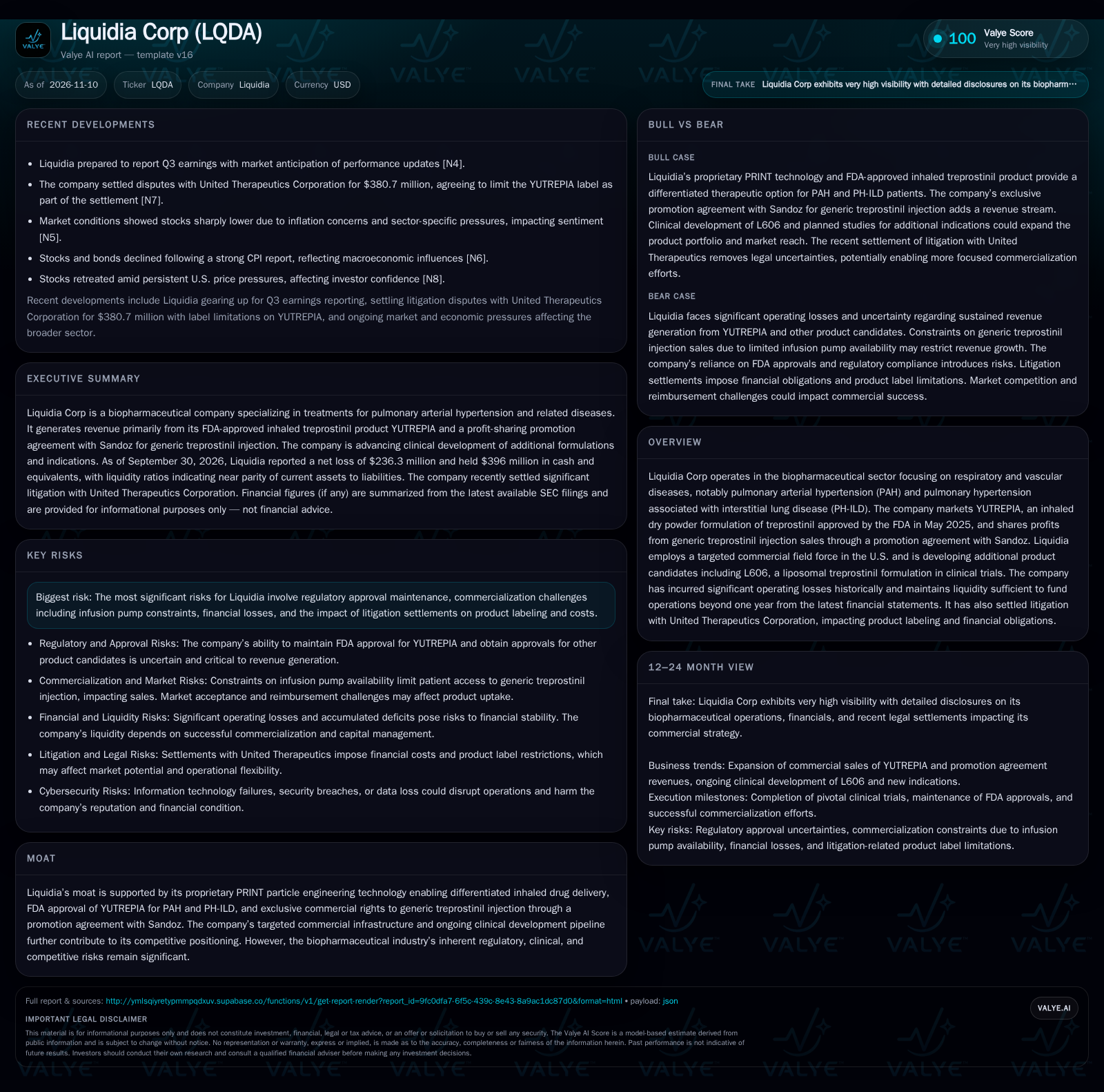
Liquidia now generates revenue from its inhaled treprostinil (YUTREPIA) and a U.S. promotion deal with Sandoz for generic treprostinil injection. However, it faces heavy operating losses, a $380.7M litigation settlement, and infusion pump shortages that constrain some commercial opportunities. The next phase will hinge on expanding YUTREPIA’s reach, executing new clinical programs, and adapting to regulatory and competitive uncertainties. [S2] [N7]
Liquidia Corp has transitioned from development-stage biotech to commercial player, following the 2025 launch of YUTREPIA, its FDA-approved inhaled treprostinil for pulmonary hypertension. With a promotion agreement for generic treprostinil injection via Sandoz, Liquidia now faces a test of commercial execution amid persistent operating losses, a substantial litigation settlement, and infrastructure bottlenecks that limit patient access in some segments. The company’s near-term prospects rest on expanding YUTREPIA’s market share, successfully navigating label limitations, and advancing new pipeline assets—each facing meaningful uncertainty in a competitive and regulated landscape.
YUTREPIA Launch, Litigation Settlement, and Commercial Constraints: What’s Changed in 2026
Liquidia’s commercial landscape underwent a major shift in 2025-2026. The FDA approval and launch of YUTREPIA, an inhaled treprostinil for PAH and PH-ILD, enabled the company to transition from pure R&D to revenue generation [S2]. The company also receives profit share from U.S. sales of generic treprostinil injection via its Sandoz partnership, but this opportunity is hampered by limited availability of the CADD-MS 3 infusion pump, which is no longer manufactured or supported [S2].
A pivotal development was the $380.7 million litigation settlement with United Therapeutics, which not only imposed a major financial obligation but also restricted the YUTREPIA label, directly impacting market potential and prescribing dynamics [N7].
Financially, Liquidia reported a net loss of $236.3 million for Q3 2026 and carried $396 million in cash with a current ratio of 1.02—indicating near-breakeven liquidity but continued heavy operating losses [S2]. These facts set the stage for a company in commercial expansion, but facing significant hurdles on both the revenue and cost sides.
How Liquidia’s Revenue Model and Cost Structure Shape Its Path to Profitability
Liquidia’s core revenue streams are: (1) direct sales of YUTREPIA, its proprietary inhaled treprostinil, and (2) profit-sharing from generic treprostinil injection sales through Sandoz [S2]. YUTREPIA leverages PRINT technology for precise particle engineering, aiming to differentiate on dosing convenience and patient experience—a potential lever for pricing premium versus older inhaled or parenteral formulations if payers and prescribers recognize clinical or practical advantages.
The economics of these products are shaped by high fixed R&D and commercial infrastructure costs, including a targeted sales force and ongoing clinical trials for new indications. Variable costs include third-party manufacturing, packaging, royalties, and logistics; the company expects cost of product sales as a percentage of revenue to rise in the near term as inventory costs normalize [S2].
Operating leverage could improve if YUTREPIA scales successfully, as incremental sales should outpace sales force and overhead additions. However, the litigation settlement and label restrictions may limit maximum attainable volume and pricing. The Sandoz promotion agreement is potentially high-margin, but its revenue ceiling is capped by hardware constraints in the infusion pump channel.
Pipeline assets such as L606 require continued investment without near-term revenue, and the company’s ongoing net losses and accumulated deficit ($626.3 million as of end-2025) underscore the high capital intensity and long payback typical of commercial-stage specialty pharma.
Assessing Liquidia’s Defensibility: Technology, Label Restrictions, and Market Access
Liquidia’s competitive strengths stem from its PRINT technology, which underpins YUTREPIA’s differentiated delivery profile, and its exclusive U.S. commercial rights for generic treprostinil injection via Sandoz [S2]. In the PAH and PH-ILD markets, these attributes could provide an edge if dosing convenience, safety, or adherence translate into superior real-world outcomes.
However, the biopharmaceutical sector is crowded with branded and generic treprostinil options, as well as alternative classes of pulmonary vasodilators. The litigation settlement’s label restrictions may blunt some of YUTREPIA’s differentiation, limiting prescriber adoption or payer coverage relative to less restricted products [N7].
Hardware bottlenecks—specifically, the discontinued CADD-MS 3 infusion pump—constrain patient access to the generic injection, ceding ground to competitors with alternative administration platforms. Market access also hinges on reimbursement dynamics, with payers scrutinizing cost-effectiveness and real-world outcomes.
Future defensibility will depend on (a) expanding YUTREPIA’s indications and label, (b) demonstrating clinical advantages in head-to-head or real-world studies, and (c) successfully commercializing pipeline assets like L606, which may offer further differentiation if approved.
Unlocking Market Expansion: What Could Drive a Step-Change for Liquidia
The most favorable scenario for Liquidia involves rapid adoption of YUTREPIA in both PAH and PH-ILD, supported by robust payer coverage and prescriber enthusiasm for its delivery profile. If real-world data or post-marketing studies demonstrate meaningful improvements in adherence, safety, or patient outcomes compared to legacy therapies, YUTREPIA could secure preferred formulary status and drive volume growth.
Expansion into new indications—such as PH-COPD, idiopathic pulmonary fibrosis, or progressive pulmonary fibrosis—would materially enlarge the addressable market if clinical trials are successful and regulatory approvals follow [S2]. The L606 asset, if proven effective and commercially viable, could add a novel administration route and further bolster the franchise.
A potential positive catalyst would be the resolution of hardware bottlenecks for treprostinil injection, either through new pump solutions or alternative delivery devices, reigniting that revenue stream. Confirmation of this scenario would include accelerating YUTREPIA sales, positive clinical data for pipeline assets, expanded payer coverage, and easing device constraints.
Commercial Progress Tempered by Frictions: Most Likely Outcomes for 2027
The most plausible near-term outlook is a modest ramp in YUTREPIA sales, with growth constrained by label limitations, payer caution, and competition from entrenched therapies. The Sandoz promotion agreement will likely continue to generate steady but capped revenue, given persistent infusion pump shortages.
[S2] The pace of pipeline progress—particularly for L606 and new YUTREPIA indications—will be gradual, with regulatory timelines and trial outcomes introducing further uncertainty.
This scenario would be confirmed by steady (but not breakout) YUTREPIA uptake, persistent cost pressures, slow progress on device solutions, and measured advancement in pipeline milestones. Downside risks remain if reimbursement or regulatory hurdles intensify, but a complete commercial stall appears unlikely barring negative trial or regulatory developments.
When Bottlenecks and Burn Override Potential: Adverse Chains for Liquidia
A more negative trajectory could unfold if YUTREPIA adoption stalls due to label restrictions, payer pushback, or lack of clear real-world differentiation. If competitors launch new or improved inhaled treprostinil products, or if alternative therapies gain market share, Liquidia’s commercial prospects could erode further.
Sustained hardware shortages for the generic injection may permanently cap that revenue stream, especially if no new pump solutions emerge. Ongoing heavy operating losses, without a clear path to material sales growth, could pressure liquidity and force the company to seek additional capital or cut back on pipeline investment.
Adverse clinical or regulatory outcomes for L606 or new YUTREPIA indications would further reduce future optionality. Confirmation of this scenario would include flat or declining YUTREPIA sales, no resolution of device bottlenecks, negative trial readouts, and a deteriorating cash position.
Milestones and Metrics That Will Shape Liquidia’s Pulmonary Franchise
Quarterly YUTREPIA sales growth and market share in PAH and PH-ILD—if disclosed—will provide direct evidence of commercial traction.
Updates on payer coverage, reimbursement rates, and formulary wins for YUTREPIA could signal progress or headwinds in market access.
Resolution or persistence of hardware bottlenecks affecting generic treprostinil injection sales, such as new pump partnerships or alternative delivery devices, would help test the Sandoz revenue stream’s upside.
Clinical trial readouts and regulatory milestones for L606 and new YUTREPIA indications (PH-COPD, IPF, PPF, Raynaud’s) are essential for long-term growth optionality.
Evidence of successful navigation of YUTREPIA label restrictions—such as prescriber uptake or payer acceptance despite the narrower label—would clarify the commercial ceiling.
Any new litigation, regulatory actions, or meaningful shifts in the competitive landscape that could impact Liquidia’s market positioning.
Disclaimer: This is research-only, informational analysis and not investment advice. It may include AI-generated interpretation and general industry context. Always verify important details using primary sources.

Comments