
Ovid Therapeutics: Clinical Pipeline Ambition and the Realities of CNS Drug Development
Ovid Therapeutics is advancing a diversified pipeline of small molecule therapies for treatment-resistant CNS disorders, but the company’s lack of approved products, ongoing net losses, and need for additional capital create a high-stakes environment where clinical milestones and capital market access will determine future viability.
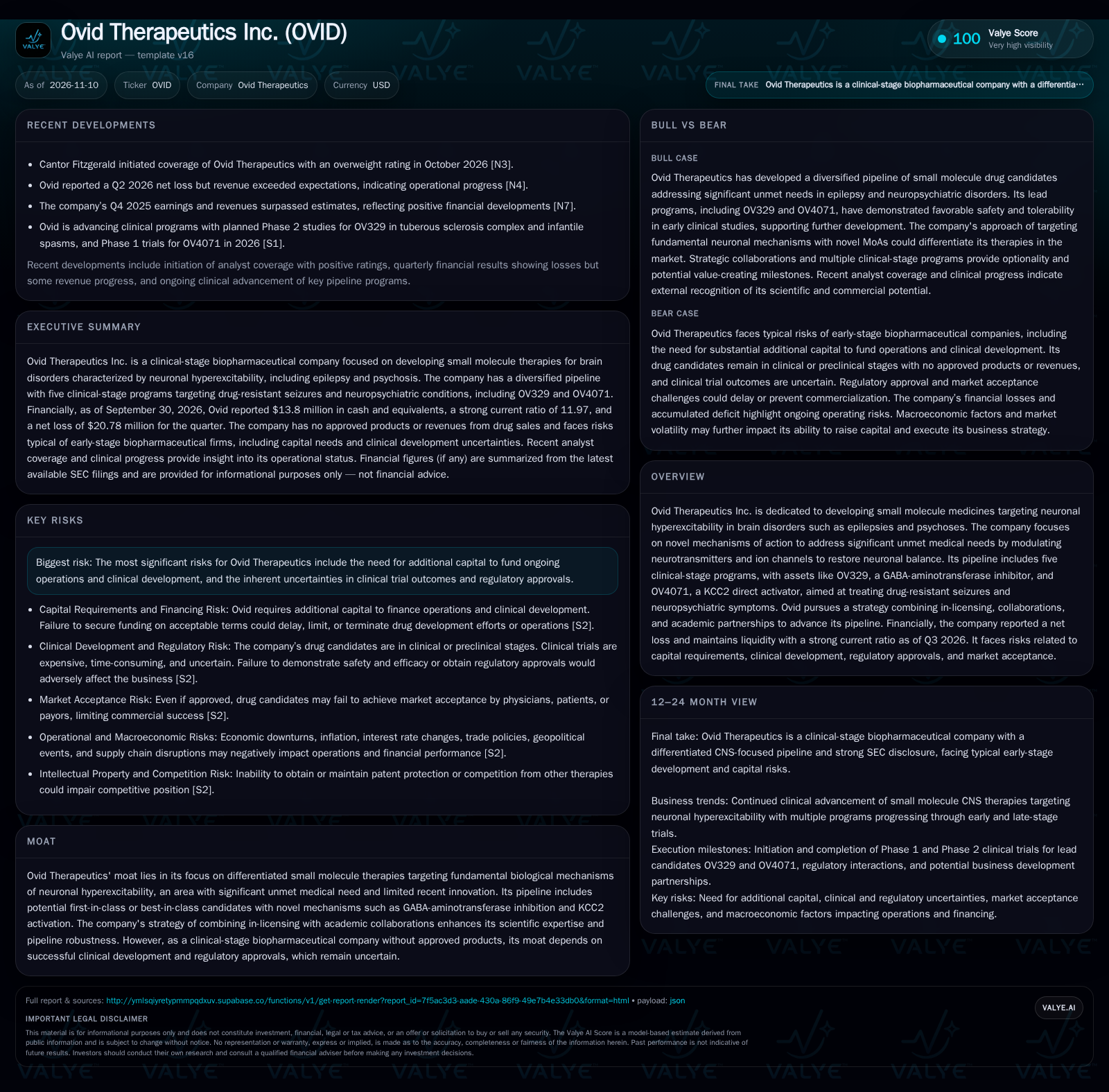
Ovid Therapeutics has five clinical-stage CNS drug programs, including late-stage trials for drug-resistant epilepsies and psychoses.Despite a reported current ratio, the company has no approved products or commercial revenue, and continues to post significant net losses. Its future depends on clinical progress, regulatory successes, and the ability to secure further funding [S1] [S2].
Ovid Therapeutics is positioning itself as a next-generation CNS innovator, advancing five clinical-stage drug programs for severe, often drug-resistant neurological and psychiatric disorders. With a focus on small molecule mechanisms targeting neuronal hyperexcitability, Ovid aims to address therapeutic gaps in epilepsy and psychosis. However, its future hinges on clinical and regulatory success, as it currently generates no commercial revenue and sustains significant operating losses.
Recent Pipeline Progress and Financial State Shape Ovid’s Risk Profile
Ovid Therapeutics is currently advancing five clinical-stage programs focused on severe CNS disorders, with two assets—OV329 (a next-generation GABA-aminotransferase inhibitor) and OV4071 (a KCC2 direct activator)—progressing into late-stage and early-stage trials, respectively [S1]. This pipeline breadth is notable for a company at Ovid’s stage, suggesting both scientific ambition and a strategy of portfolio diversification to mitigate clinical risk. However, as of September 30, 2026, the company reported $13.8 million in cash and equivalents, a current ratio of 11.97, and a net loss of $20.78 million for the quarter, with an accumulated deficit of $374.5 million [S2]. Ovid has no approved products and no drug sales revenue; its future revenue stream is entirely contingent on clinical and regulatory milestones. Recent overweight coverage from Cantor Fitzgerald and other analysts reflects external optimism but does not alter the fundamental capital and development risks facing the company [N3].
Pipeline Economics: High Upside, High Burn, and the Cost of CNS Innovation
Ovid’s economics are those of a classic clinical-stage biotech: high R&D spend, no commercial revenue, and a reliance on periodic capital raises. The company’s focus on small molecule CNS therapeutics, particularly for treatment-resistant epilepsies and neuropsychiatric conditions, positions it in high-value but high-risk markets. Pricing for novel, effective CNS drugs can be substantial, especially in rare or refractory indications, but payor skepticism and the need for robust efficacy and safety evidence are persistent headwinds.
If Ovid achieves positive phase 2/3 results and secures regulatory approval, its drugs could command premium pricing, especially in orphan or high-unmet-need markets. However, the economics depend on navigating lengthy and costly trials, achieving differentiation versus established therapies, and demonstrating both safety (for chronic use and polypharmacy) and efficacy. Fixed costs remain dominated by R&D and G&A, with variable costs only materializing upon commercial launch. Until then, negative operating leverage is the norm, and the company’s capital needs are ongoing and substantial.
Ovid’s strategy of in-licensing and academic collaborations may help reduce early-stage research risk and broaden the pipeline without the full cost of proprietary discovery, but milestone and royalty obligations could impact eventual gross margins if drugs are commercialized. The path to positive cash flow is long and highly contingent on clinical and regulatory outcomes.
Potential for Differentiation in a Crowded, Risk-Heavy CNS Landscape
Ovid aims to differentiate itself by targeting validated but underexploited mechanisms of neuronal hyperexcitability, such as GABA-aminotransferase inhibition and KCC2 activation. This focus could provide a scientific moat if the company achieves meaningful clinical efficacy with superior safety and tolerability—key for chronic CNS conditions, where side effects and drug-drug interactions often limit adoption.
However, the CNS drug space is notoriously competitive and littered with clinical failures. Ovid faces competition from large pharmaceutical companies with deeper resources, as well as from other biotechs pursuing both small molecule and biologic approaches to epilepsy and psychosis. Barriers to entry for new CNS drugs include the need for large, lengthy trials, regulatory conservatism, and entrenched standard-of-care therapies.
If Ovid’s candidates prove to be safer or more effective for drug-resistant populations, or offer a novel mechanism for patients with few options, it could capture share in high-value niches. But the burden of proof is high, and first-mover or best-in-class status can be fleeting in CNS as mechanisms become validated and competitors pivot rapidly.
Clinical Milestone Wins Could Transform Ovid’s Valuation
The most favorable scenario for Ovid involves successful late-stage clinical trials for OV329 in tuberous sclerosis complex and infantile spasms, as well as promising early results for OV4071 in neuropsychiatric indications. Positive data would enable regulatory filings, potential fast-track or orphan designations, and strategic partnerships or licensing deals.
If Ovid demonstrates clear efficacy and safety advantages—especially for drug-resistant or orphan populations—this could drive significant pharma interest, leading to upfront payments, milestone revenue, or even acquisition. The ability to out-license or co-commercialize would provide non-dilutive capital and validate the platform’s scientific underpinnings.
Confirmation signals would include: (1) robust phase 2/3 efficacy and safety data; (2) regulatory designations that expedite review; (3) partnership announcements with commercial-stage pharma; and (4) successful capital raises on favorable terms. Falsification would come from failed or inconclusive trials, lack of regulatory progress, or inability to secure external funding.
Navigating the Typical Biotech Development Cycle
The most plausible path for Ovid is continued advancement of its lead programs through clinical trials, punctuated by incremental data readouts and periodic capital raises. The company will likely face the usual setbacks—protocol amendments, trial delays, or mixed results—common in CNS drug development. Its liquidity, while strong in ratio terms, is modest in absolute dollars and will require augmentation within the next year or two if no partnership or out-licensing deals materialize [S2].
Ovid’s valuation will remain highly sensitive to clinical milestones. The absence of near-term revenue means that progress will be measured by pipeline de-risking, regulatory interactions, and the ability to secure additional, non-dilutive funding. Any positive signals from trials or external partnerships could support further investment, but dilution risk and development setbacks remain persistent threats.
The scenario is confirmed by ongoing clinical progress (e.g., advancement to Phase 2 or regulatory submissions), modest but sustained analyst optimism, and continued ability to access capital markets. Downside would be signaled by extended trial delays, poor data, or inability to raise needed funds.
Clinical or Financing Setbacks Could Force Restructuring or Pipeline Abandonment
The primary downside risk for Ovid is a combination of negative or ambiguous clinical trial results and tightening capital markets. Failed or inconclusive trials for OV329 or OV4071 would undermine the investment case, potentially forcing the company to halt development, cut staff, or divest assets.
If Ovid is unable to raise additional capital on acceptable terms, it may have to significantly scale back its pipeline, seek a distressed partnership, or pursue strategic alternatives. The absence of commercial revenue and accumulated deficit of $374.5 million underscore the company’s vulnerability to funding shocks [S2].
Downside confirmation would include negative trial readouts, regulatory setbacks, unsuccessful or highly dilutive capital raises, or management signaling a strategic review or cost-cutting measures. Falsification of the downside scenario would require clear clinical wins and visible access to new funding.
Milestones That Will Define Ovid’s CNS Therapeutics Trajectory
Initiation, enrollment, and topline readouts of Phase 2 trials for OV329 in tuberous sclerosis complex and infantile spasms, including safety and efficacy endpoints [S1].
Progression of OV4071 into—and through—Phase 1 clinical trials, with a focus on safety, tolerability, and early pharmacodynamic signals [S1].
Updates regarding regulatory interactions, including orphan drug or fast-track designations that could expedite development or enhance commercial prospects (if disclosed).
Announced partnerships, licensing deals, or collaborations with commercial-stage pharma or academic institutions, which could provide non-dilutive funding or validate the scientific platform.
Quarterly cash and equivalents balances, burn rate, and capital-raising announcements, as these will determine Ovid’s operational runway and ability to advance its pipeline [S2].
Any changes in analyst sentiment, coverage initiations, or downgrades, which may reflect external confidence in the pipeline or emerging trial risks [N3].
Intellectual property developments or new patent filings, as these underpin long-term exclusivity and bargaining power (if disclosed).
Disclaimer: This is research-only, informational analysis and not investment advice. It may include AI-generated interpretation and general industry context. Always verify important details using primary sources.

Comments