
Fervo Energy: Scaling Enhanced Geothermal with Capital Intensity, Transmission Constraints, and Commercial Proof Points
Fervo Energy is executing a capital-intensive, modular approach to enhanced geothermal systems (EGS), with its Cape Station project and a landmark Google PPA as early validation.
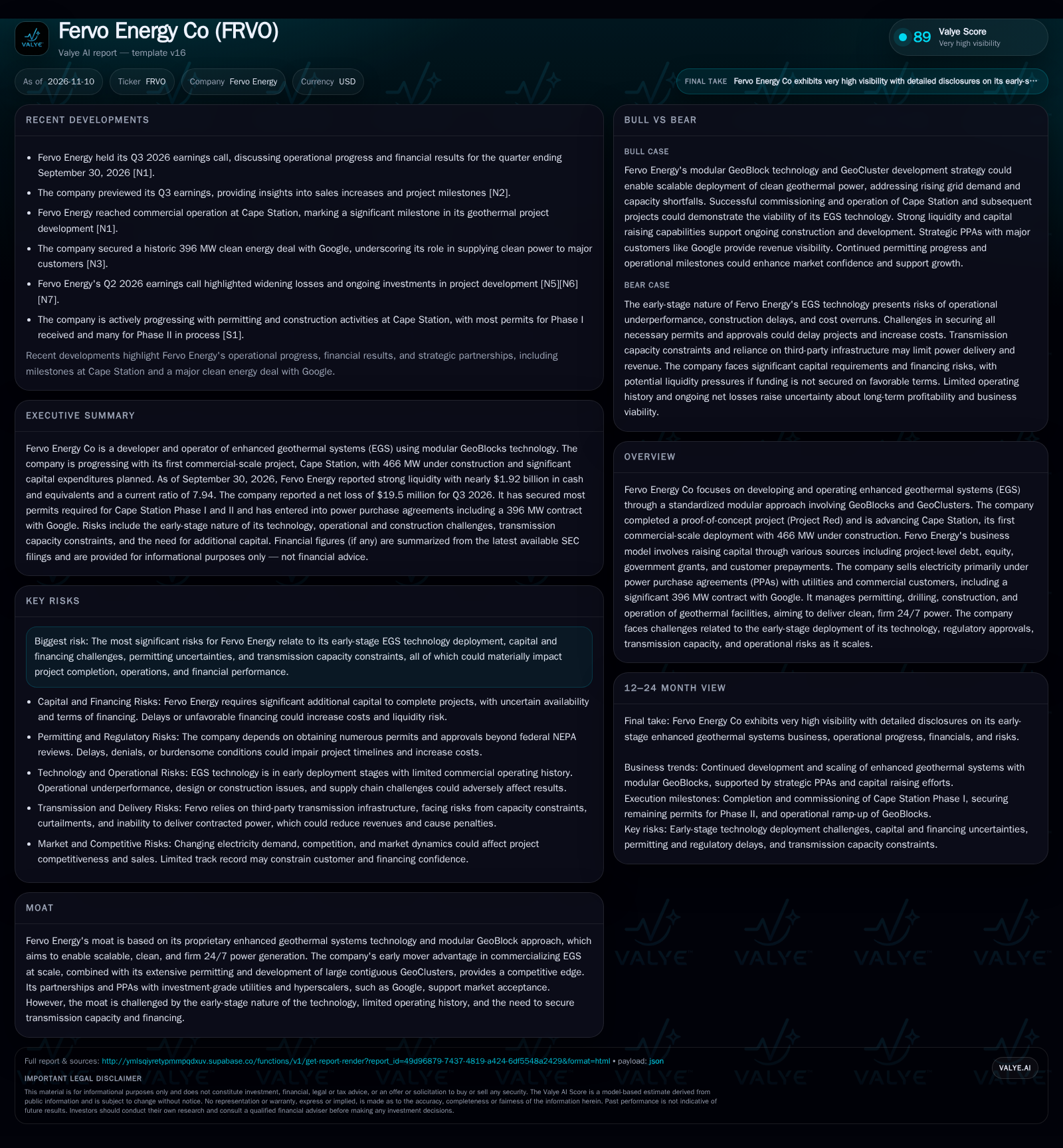
Fervo Energy is advancing commercial-scale enhanced geothermal power with its modular GeoBlocks, highlighted by Cape Station’s construction and a 396 MW Google contract. The company’s ability to scale beyond Cape Station and achieve reliable delivery will be critical to validating its business model.
Fervo Energy is at a pivotal inflection point in commercializing enhanced geothermal systems (EGS) using its modular GeoBlocks and GeoClusters. The company’s reported cash position and progress at Cape Station—its first commercial-scale project—are paired with a landmark 396 MW Google power purchase agreement, signaling early market validation. However, transmission bottlenecks, large capital requirements, and the inherent uncertainties of deploying early-stage geothermal technology mean that Fervo’s path to scale is neither linear nor assured. The next 12–24 months will test whether Fervo can translate technical milestones and liquidity into reliable, scalable power delivery and commercial acceptance.
Cape Station, Google PPA, and Transmission Constraints Define Fervo’s Current Position
Fervo Energy’s present operating context is shaped by three critical facts. Second, Cape Station—Fervo’s first commercial-scale EGS deployment—is under construction with a planned 466 MW capacity; all permits for Phase I (80/80) have been secured, and more than half of Phase II permits (96/179) are in hand, with no expected material delays. Third, Fervo has signed a 396 MW power purchase agreement with Google, marking a high-profile commercial validation, but currently only has 300 MW of interconnection and transmission rights at Cape Station, creating a near-term delivery bottleneck. These facts set the stage for Fervo’s transition from proof-of-concept to attempted commercial scale, while highlighting the key risks around infrastructure, execution, and capital deployment. [S1] [N3]
Capital-Intensive, Project-Financed Geothermal: Economics and Scalability Questions
Fervo’s business model is fundamentally capital-intensive, with upfront investments in drilling, infrastructure, and permitting. The company’s estimated $450–$500 million in 2026 capital expenditures primarily support Cape Station and reflect the significant fixed costs typical of geothermal projects. Funding is sourced through a mix of project-level non-recourse debt, equity, government grants, and customer prepayments, aiming to de-risk development and limit corporate-level exposure. Revenue is generated through power purchase agreements (PPAs) with utilities and large enterprises, providing some visibility but also anchoring returns to long-term, fixed or indexed pricing.
The modular GeoBlocks and GeoClusters approach is designed to increase scalability and reduce per-unit construction risk, potentially allowing for phased deployment and more predictable learning curves. However, the degree of operating leverage is uncertain until the technology operates reliably at scale. Variable costs are likely dominated by operations and maintenance, but the economics hinge on achieving high availability and sustained output from each well and GeoBlock. If successful, Fervo could see attractive margins from baseload, firm clean power—an increasingly valuable grid attribute. But any underperformance, cost overruns, or curtailments could quickly erode returns given the high capital at risk and long payback periods.
Transmission capacity is a critical external constraint: even fully operational geothermal assets cannot monetize output without sufficient interconnection rights. This dynamic can cap near-term revenue, delay project ramp, and affect the return profile of each buildout phase.
Proprietary Technology and Early-Mover Status—But Facing Traditional and Emerging Rivals
Fervo’s competitive position is anchored in its proprietary EGS technology and modular deployment strategy, which could, if proven, offer a differentiated path to scalable, firm renewable power. Early-mover status in commercial-scale EGS and the visibility provided by high-profile PPAs (such as with Google) create a perception of leadership and customer traction. The ability to secure permits and demonstrate operational milestones at Cape Station further strengthens Fervo’s standing among project financiers and counterparties.
However, the company faces competition from both traditional geothermal providers (using conventional hydrothermal resources) and a broad array of clean energy alternatives—including solar, wind paired with storage, advanced nuclear, and emerging long-duration storage solutions. Many of these alternatives are further along the cost curve, have established supply chains, or benefit from broader customer familiarity. Fervo’s moat depends on successfully proving that its EGS approach can deliver reliable, cost-competitive, and scalable 24/7 clean power in real-world conditions.
Transmission access and project siting are also competitive battlegrounds: grid interconnection queues are congested, and the ability to secure rights at high-value nodes will directly affect project economics and growth runway.
If EGS Reliability and Transmission Expansion Align, Flywheel Effects Could Drive Scale
The most optimistic scenario for Fervo involves successful commissioning of Cape Station with high capacity factors, stable output, and minimal operational surprises. If the modular GeoBlock approach delivers as promised—demonstrating repeatability and cost reductions with each deployment—Fervo could unlock rapid expansion, benefiting from a capital flywheel: each operational success would support further financing, customer confidence, and regulatory acceptance.
The expansion of transmission rights beyond the current 300 MW constraint would be pivotal, enabling Fervo to deliver on its 396 MW Google contract and sell additional output. Further, if EGS technology achieves widespread validation, Fervo could leverage its early-mover advantage to secure more PPAs with utilities and hyperscalers seeking firm clean power.
Evidence that would confirm this scenario includes: Cape Station meeting or exceeding output targets; new transmission agreements or upgrades; additional large-scale PPAs; and declining unit costs for new GeoBlocks. Conversely, persistent technical issues, cost overruns, or inability to secure transmission would falsify this upside.
Commercial Milestones Are Met, but Growth Is Paced by Infrastructure and Funding Cycles
The most plausible mid-term trajectory is that Fervo achieves operational launch at Cape Station Phase I, delivering contracted power to Google and perhaps select other customers, but remains constrained by the current 300 MW of transmission rights. Permitting and construction for Phase II proceed, but delays or incremental bottlenecks are periodically encountered, typical for first-of-kind projects.
Revenue ramps gradually as additional capacity comes online, but margins remain pressured by high fixed costs, learning-curve inefficiencies, and ongoing capital needs. Fervo continues to raise capital through a mix of project finance and equity, but must demonstrate consistent operational performance to unlock the next wave of customer contracts and transmission rights.
Confirmation for this scenario would come from steady, if unspectacular, progress on output, permitting, and incremental PPA wins. Falsification would involve a material breakdown in Cape Station operations, a failure to secure additional transmission, or a marked increase in financing costs or capital scarcity.
Technology Shortfalls, Cost Overruns, and Transmission Gaps Could Undermine the Model
The bear case for Fervo centers on the failure of EGS technology to deliver reliable, commercial-scale output. If Cape Station suffers from low capacity factors, unexpected maintenance issues, or design flaws, the modular approach may fail to deliver promised cost and performance benefits—potentially leading to contract penalties or customer attrition.
Compounding this, construction delays, supply chain disruptions, or unanticipated permitting setbacks could inflate costs and extend project timelines, eroding investor and customer confidence. Should Fervo be unable to secure expanded transmission rights, even a technically successful plant would face revenue caps and underutilization. The need to raise additional capital at unfavorable terms, or the inability to refinance project-level debt, could force project deferrals or asset sales.
Evidence confirming this scenario would include missed operational targets at Cape Station, negative revisions to capacity or cost guidance, persistent inability to expand transmission access, or the loss of marquee customers like Google. Any of these could call the long-term viability of the business model into question.
Milestones That Will Define Fervo’s Progress Toward Commercial Geothermal Scale
Actual capacity factor and uptime of Cape Station’s operational GeoBlocks, if disclosed, to assess real-world technology reliability and scalability.
Progress in securing additional transmission and interconnection rights for Cape Station beyond the current 300 MW cap.
Unit capital cost trends for subsequent GeoBlocks and GeoClusters—declining costs would support the modularity thesis.
Execution against the Google PPA: delivery volume, potential penalties, and any evidence of customer expansion or renewal.
Permitting pace for Cape Station Phase II and for any announced new project sites.
Success in raising project-level non-recourse debt or attracting additional equity/grant funding on favorable terms.
Evidence of new long-term PPAs with utilities or large corporate buyers, indicating market acceptance beyond the Google contract.
Any operational, regulatory, or supply chain setbacks flagged in future earnings or construction updates.
Disclaimer: This is research-only, informational analysis and not investment advice. It may include AI-generated interpretation and general industry context. Always verify important details using primary sources.

Comments