
Sono Group N.V.: Navigating Strategic Reinvention, Capital Complexity, and the Uncharted Terrain of Sports Franchise Expansion
Sono Group’s rapid pivot from solar mobility to digital asset strategies—and now sports franchise ambitions—creates a unique but high-risk business profile. The key question: can Sono turn strategic breadth into durable value before funding frictions force further change?
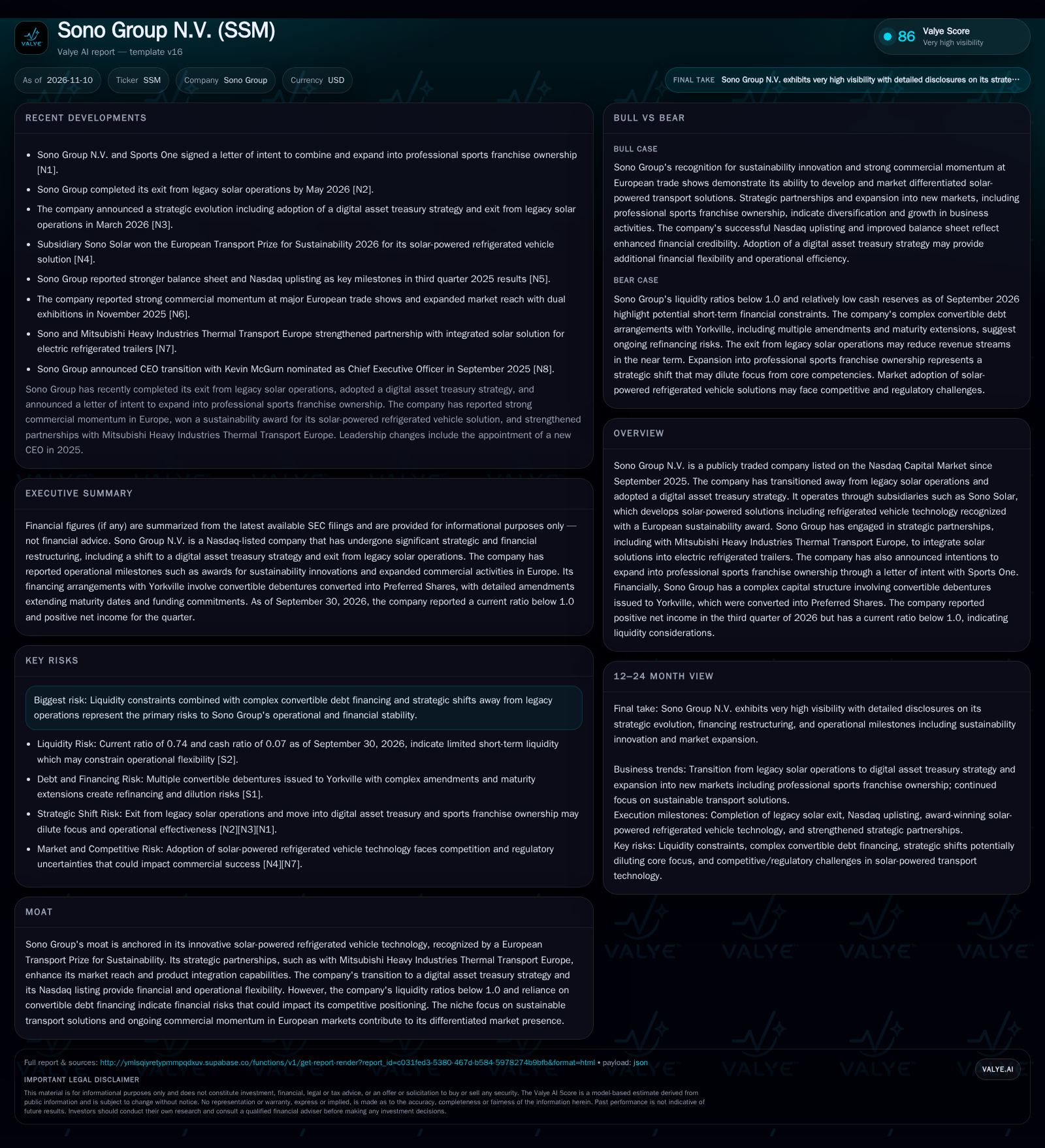
Sono Group has completed its exit from legacy solar, adopted a digital asset treasury model, and is pursuing a new venture into professional sports franchise ownership. Execution on new strategies and resolution of funding constraints will determine whether Sono’s reinvention translates to lasting shareholder value. [S2] [N1] [N3] [N4]
Sono Group N.V. stands at a strategic crossroads after a whirlwind transformation: the company has exited solar operations, embraced digital asset treasury management, and signaled intent to expand into the high-profile but operationally distinct world of professional sports franchise ownership. Despite recent profitability and accolades for sustainability-driven technology, Sono’s liquidity remains tight and its capital structure—entwined with Yorkville’s convertible securities—adds ongoing complexity. The company’s next chapter hinges on whether its pivot to asset-light, diversified business models can outpace the risks posed by near-term funding needs and the operational demands of new market entries.
Major Strategic Shifts and the Financial Realities Facing Sono Group
Three developments are most material to Sono Group’s outlook as of late 2026. First, the company has completed its exit from legacy solar operations and transitioned to a digital asset treasury strategy, fundamentally altering its revenue model and asset base. The company reported cash and liquidity metrics for the period; these figures do not by themselves establish operating runway, investment capacity, financial flexibility, or financing capacity. [N2] [N3] [S2] Third, the company has entered a letter of intent with Sports One to pursue professional sports franchise ownership, a move that could diversify income sources but also introduces unfamiliar operational risks. [N1] These milestones signal a company in rapid transition, with both the promise of new opportunity and the risk of strategic overreach.
How Sono Group’s Revenue Model and Capital Structure Could Shape Its Economic Potential
Sono Group’s business economics are currently in flux. With the exit from solar product operations, historical revenue streams tied to hardware sales, engineering services, or recurring maintenance contracts are likely diminished or discontinued. The adoption of a digital asset treasury model suggests a pivot toward managing and potentially trading digital financial instruments as a primary or supplementary income source. This model could, in theory, provide high capital efficiency and low fixed operating costs, but introduces volatility and dependence on asset price movements, with less predictable recurring cash flow versus traditional industrial operations.
The company’s capital structure is dominated by convertible debentures, now converted into Preferred Shares for Yorkville, with conversion price floors set for six months at $4.00 and $1.00 thereafter. [S1] This arrangement creates ongoing potential for equity dilution, particularly if Sono’s share price weakens. If Sono moves forward with sports franchise investments, capital requirements could spike—professional sports ownership typically demands substantial upfront and ongoing funding, often with high fixed costs and uncertain returns. Unless Sono can structure minority or asset-light participations, the risk of negative operating leverage is material.
In sum, Sono’s current business model appears to be shifting from asset-heavy engineering to asset-light (but potentially volatile) digital asset management, with a new, capital-intensive sports investment layer on the horizon. The economic outcome will depend on Sono’s ability to either generate recurring, low-volatility digital income or secure external partners and financing to avoid overextending its balance sheet.
Positioned Between Sustainability Innovation and New Market Frontiers: Competitive Dynamics for Sono
Historically, Sono’s competitive edge lay in its solar-powered refrigerated vehicle technology, which garnered European sustainability awards and partnerships with established players like Mitsubishi Heavy Industries Thermal Transport Europe. [N4] [N7] This niche, focused on sustainable transport solutions, is characterized by moderate barriers to entry (engineering know-how, regulatory compliance, partnership access) but remains vulnerable to scale-driven competitors and rapid technological obsolescence.
In digital asset treasury management, competitive advantage is less about product differentiation and more about risk management, access to proprietary trading strategies, and regulatory compliance. Here, Sono faces an array of competitors from fintech firms to institutional asset managers, many with greater scale and deeper technology stacks. Unless Sono can carve out a unique risk/reward profile or offer value-added services, defensibility in this segment may be limited.
The move toward professional sports franchise ownership is an even more radical departure. Barriers to entry are typically high—requiring capital, industry relationships, and operational expertise—while returns can be highly variable and are often driven by media rights, sponsorships, and on-field performance. Sono’s lack of operational experience in this domain means it will compete with established investment groups and high-net-worth individuals who specialize in sports asset management. Unless Sono accesses exclusive opportunities or develops synergistic offerings (e.g., technology-driven sports analytics, sustainability branding), its competitive position in this space may be tenuous.
If Strategic Diversification Pays Off: Pathways to Lasting Value Creation
The bull case for Sono Group rests on the successful execution of its diversification strategy. If Sono can leverage its digital asset treasury model to generate consistent, outsized returns (for example, through proprietary trading, staking, or digital asset lending) while tightly controlling risk, it may offset the loss of legacy solar revenues and provide a scalable, high-margin profit engine. Concurrently, if the company’s foray into sports franchise ownership results in participation in high-growth, cash-generative teams or leagues—particularly through minority stakes or innovative partnership models—Sono could access new, decorrelated revenue streams and enhance its brand equity.
Strategic Repositioning with Ongoing Funding Tensions: Most Likely Medium-Term Outcome
The most plausible medium-term scenario is that Sono Group, after its rapid strategic shift, encounters both incremental progress and persistent obstacles. The digital asset treasury strategy may yield sporadic gains, but is unlikely to generate stable, sufficient cash flow under current market conditions and with limited scale. [S2]
Sports franchise expansion may proceed, but likely through structured deals (e.g., joint ventures, minority investments) that limit capital outlay and operational risk. However, the lack of operational expertise in sports means execution risk is high, and returns may be lumpy or delayed. Sono’s core value proposition—sustainable technology—may become less central unless the company finds ways to integrate these competencies into new ventures.
Evidence for this base case would be continued reliance on convertible or dilutive financing, modest digital asset-related income, and incremental but not transformative progress in new business lines. Improvement in liquidity ratios and recurring digital asset or sports-related revenue would be necessary to shift the scenario toward a more bullish outcome.
When Strategic Ambition Outpaces Funding and Focus: How Sono Could Falter
The bear scenario materializes if Sono’s new ventures fail to generate meaningful cash flow before liquidity constraints force asset sales, restructuring, or further dilution. If digital asset management delivers volatile or negative returns—due to market downturns, operational missteps, or regulatory headwinds—the company’s reported cash balance could quickly erode. The convertible Preferred structure with Yorkville could result in significant dilution, especially if shares are converted at or near the post-floor minimum price. [S1] [S2]
If the sports franchise initiative requires significant upfront capital (e.g., acquisition of controlling interests or stadium investments), Sono may not be able to finance these commitments without tapping dilutive or high-cost external sources. Execution missteps in an unfamiliar sector could compound losses and distract management. In this scenario, Sono’s shift away from its sustainability innovation roots may leave it without a clear competitive advantage or recurring revenue engine, making it vulnerable to creditor or shareholder pressure.
Confirmation of this downside would include: persistent sub-1.0 current ratios, continued or deepening net losses, large-scale equity dilution, and the absence of material, recurring revenue from new business lines.
Factors That Will Determine Whether Sono’s Reinvention Delivers Shareholder Value
Recurring digital asset income: If disclosed, regular reporting of realized gains or losses from digital asset treasury operations would shed light on the stability and scalability of this income stream.
Dilution from convertible Preferred Shares: Actual conversion activity and the proportion of new shares issued to Yorkville or other financiers will clarify dilution risk and shareholder value impact.
Structure and economics of sports franchise transactions: Details on deal structure (minority vs. controlling stakes, capital commitments, partnership terms) would help assess risk and capital needs.
Integration of sustainability or technology into new ventures: Evidence of cross-selling, co-branding, or technology adoption in sports franchise activities would suggest Sono is leveraging its historic strengths.
Progress in non-dilutive or partnership-based funding: Announcements of joint ventures, strategic partnerships, or non-equity funding for new business lines would reduce financing risk.
Leadership continuity and strategic focus: Management disclosures on how the company will allocate attention and resources across digital, sports, and any remaining sustainability initiatives would help test the risk of strategic drift.
Disclaimer: This is research-only, informational analysis and not investment advice. It may include AI-generated interpretation and general industry context. Always verify important details using primary sources.

Comments