
EQV Ventures Acquisition Corp. II: SPAC Structure, Sponsor Influence, and the Stakes of Energy-Focused Deal Execution
EQV Ventures Acquisition Corp. II is a SPAC with $469 million in trust, a Sponsor-aligned with the energy sector, and a 24-month deadline to close a business combination—making execution, governance, and leverage decisions central to its future value creation.
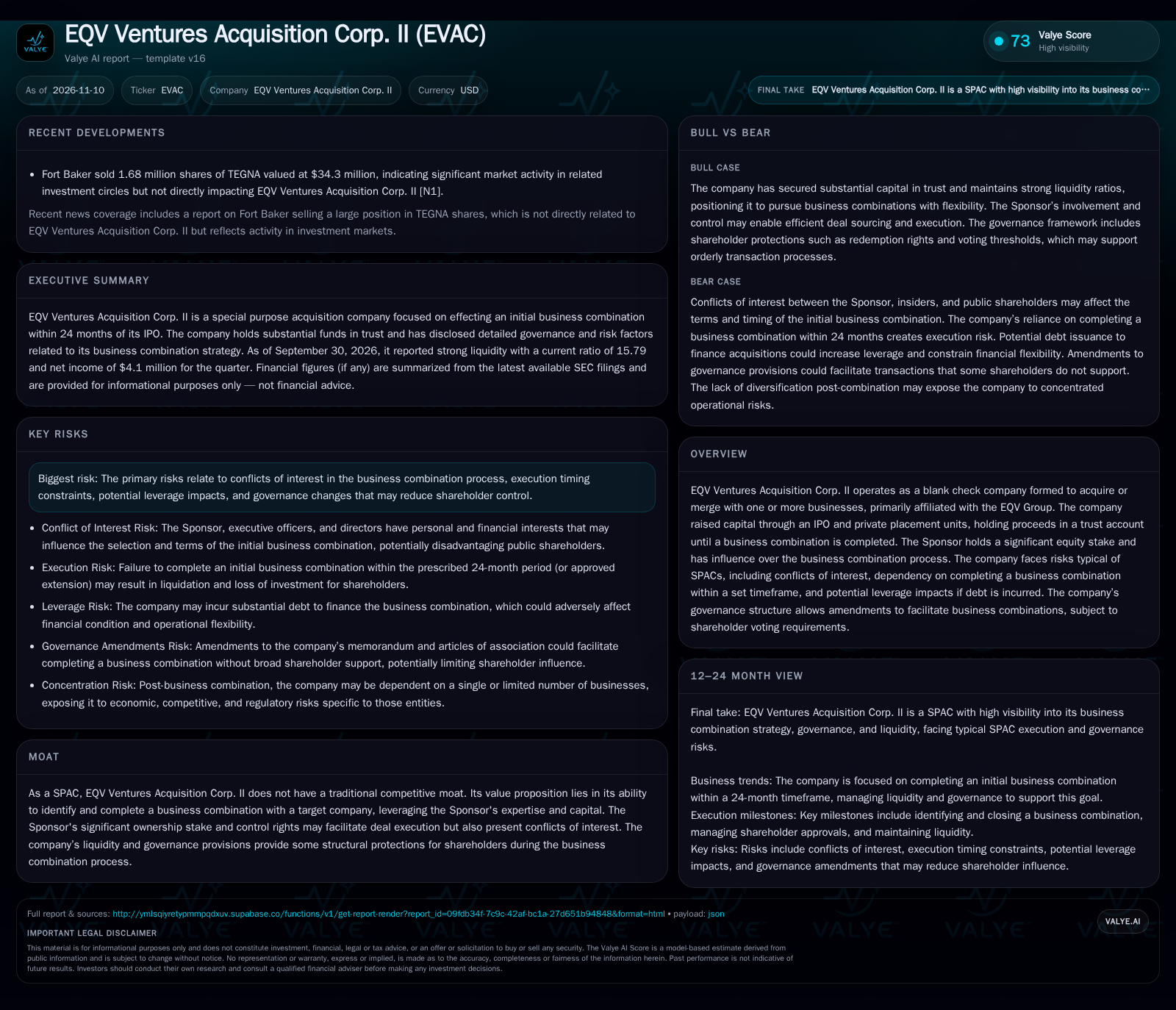
EQV Ventures Acquisition Corp. II, a blank check company with $469 million in trust as of year-end 2025, faces a 24-month window to close a business combination, likely in the energy sector. The Sponsor’s significant ownership and sector expertise may aid deal sourcing but also introduces conflict risks. Leverage, shareholder protections, and the ability to execute a value-accretive acquisition will define the SPAC’s outcome for public investors. [S1] [S2]
EQV Ventures Acquisition Corp. II (EVAC) stands at the intersection of SPAC market mechanics and energy sector opportunity, with $469 million in trust and a Sponsor team rooted in oil & gas asset management. As the 24-month acquisition clock ticks, the company must balance Sponsor-driven deal sourcing advantages against conflicts of interest, leverage risk, and the complexities of public shareholder governance. The next major move—identifying and closing a business combination—will determine whether current liquidity and expertise translate into long-term value or expose investors to the pitfalls of concentrated, leveraged acquisitions.
Liquidity, Sponsor Control, and the Countdown to Acquisition
As of December 31, 2025, EQV Ventures Acquisition Corp. II reported $469 million in its trust account, representing the core capital base for its initial business combination. The Sponsor, through Class B ordinary shares and private placement units, controls approximately 20% of outstanding shares, giving it significant influence over deal selection and negotiation. The company faces a 24-month deadline from its IPO to complete a business combination, a constraint that introduces execution risk and heightens the importance of timely opportunity sourcing. These facts frame the company's strategic flexibility, governance dynamics, and the stakes of its next move. [S1] [S2]
SPAC Capital Structure and Post-Merger Economic Dynamics
EQV Ventures Acquisition Corp. II’s business model centers on deploying capital from its trust account into an acquisition or merger, effectively transforming itself from a cash shell into an operating company. The economics of this transition depend on several variables: the valuation and quality of the target, the structure of the transaction (including potential leverage), and post-merger operational performance. SPACs typically generate value for public shareholders through share appreciation if the acquired business outperforms expectations or rerates in the public markets. However, the possibility of incurring substantial debt to finance a larger deal could introduce high fixed costs and increase financial risk, particularly if commodity prices or asset performance fluctuate post-transaction.
Fixed costs may rise sharply if the target requires significant integration or restructuring, while variable costs and margins will be dictated by the underlying asset base—likely upstream oil & gas assets, given the Sponsor’s stated sector focus. Operating leverage could be substantial in a commodity-driven business, amplifying both upside and downside depending on market cycles. The SPAC structure also means that failure to close a deal within the deadline results in liquidation and return of trust capital to shareholders, with little value creation for equity holders beyond nominal interest earned on trust funds.
Sponsor Expertise in Energy Deal-Making: Edge or Liability?
The competitive positioning of EQV Ventures Acquisition Corp. II hinges on the Sponsor’s track record and network within the energy sector. With a focus on mature, low-decline upstream oil & gas assets and related infrastructure, the company may access proprietary deal flow and operational insights not readily available to generalist SPACs. This specificity could be an advantage in sourcing undervalued or overlooked assets, especially in fragmented or under-capitalized basins.
Conversely, the Sponsor’s sector alignment may narrow the scope of opportunities and introduce bias in target selection, especially if the Sponsor's other portfolio interests overlap. Competing SPACs and private equity funds are active in energy asset roll-ups, and public market investors have become more discerning about commodity exposure, environmental liabilities, and cyclicality. The lack of a traditional moat means that execution quality, deal structuring, and post-merger governance will largely determine whether EVAC delivers durable value or faces the same pitfalls as prior energy-focused SPACs.
Unlocking Value Through a Transformative, Well-Structured Energy Acquisition
In a favorable scenario, EVAC leverages its $469 million trust and Sponsor’s sector expertise to acquire a portfolio of cash-generating, low-decline oil & gas assets at attractive valuations. If the acquired business demonstrates operational stability, hedges commodity risk, and achieves cost synergies, the post-merger entity could deliver robust free cash flow and re-rate positively in the public markets. The Sponsor’s alignment and governance could help navigate integration and drive operational optimization, further enhancing returns.
Confirmation of this scenario would come from the announcement of a disciplined acquisition with transparent terms, limited leverage, and a clear path to operational scale. Evidence would include shareholder support, minimal redemptions, and early post-merger financial outperformance—such as strong EBITDA margins, stable production levels, and effective risk management disclosures.
Executing a Conventional Energy Asset Roll-Up Under Sponsor Stewardship
The most plausible outcome is that EVAC completes a business combination with a mid-sized upstream energy asset or platform, reflecting both the Sponsor’s expertise and the realities of the market. The transaction is likely to involve some leverage, but not to the extent that it constrains flexibility or introduces existential risk. Shareholder protections—such as redemption rights and voting thresholds—remain intact, but public holders end up as minority owners in the new entity, with the Sponsor and insiders retaining significant influence.
This scenario would be confirmed by a deal announcement in the expected sector, moderate redemptions, and post-merger updates showing stable financial performance, manageable debt levels, and steady production metrics. Falsification would come from deal delays, excessive redemptions, or an inability to close within the 24-month window, triggering liquidation.
Sponsor Conflicts, Leverage, and the Risks of a Rushed or Dilutive Deal
Adverse outcomes could arise if the Sponsor’s conflicts of interest lead to a suboptimal or rushed acquisition—potentially overpaying for assets or structuring the deal to favor insiders at the expense of public shareholders. High leverage used to close a larger transaction could saddle the new entity with unsustainable debt, particularly if commodity prices weaken or integration proves more complex than expected. Amendments to governance provisions, even if technically compliant, could erode shareholder influence and trigger discontent or litigation.
Warning signs would include a last-minute deal with limited disclosure, high redemption rates, or a transaction that relies heavily on debt and leaves public shareholders with a small minority stake in a risky or undiversified asset. Liquidation due to failure to close a deal within the deadline remains a persistent risk if the Sponsor cannot secure an acceptable transaction.
Thesis-Testing Milestones for EQV Ventures Acquisition Corp. II’s SPAC Strategy
Announcement of a definitive business combination agreement, including target sector, size, and valuation.
Level of shareholder redemptions prior to and at closing, as high redemptions may signal weak support or deal quality concerns.
Amount and structure of debt financing in the proposed transaction, as excessive leverage could jeopardize post-merger stability.
Post-merger ownership structure, specifically the proportion of equity held by public shareholders versus Sponsor and insiders.
Disclosure of operational metrics for the acquired business, such as production volumes, EBITDA margins, and capital expenditure profiles (if disclosed).
Governance amendments or changes to shareholder rights, especially those affecting redemption rights or voting thresholds.
Ability to close the transaction within the 24-month deadline, as failure would trigger liquidation and return of trust funds.
Disclaimer: This is research-only, informational analysis and not investment advice. It may include AI-generated interpretation and general industry context. Always verify important details using primary sources.

Comments