
Black Diamond Therapeutics: Clinical Milestones Shape Precision Oncology Prospects
Black Diamond Therapeutics advances Silevertinib for EGFR-mutated cancers, with recent Phase 2 data and pipeline expansion into glioblastoma shaping its near-term trajectory.
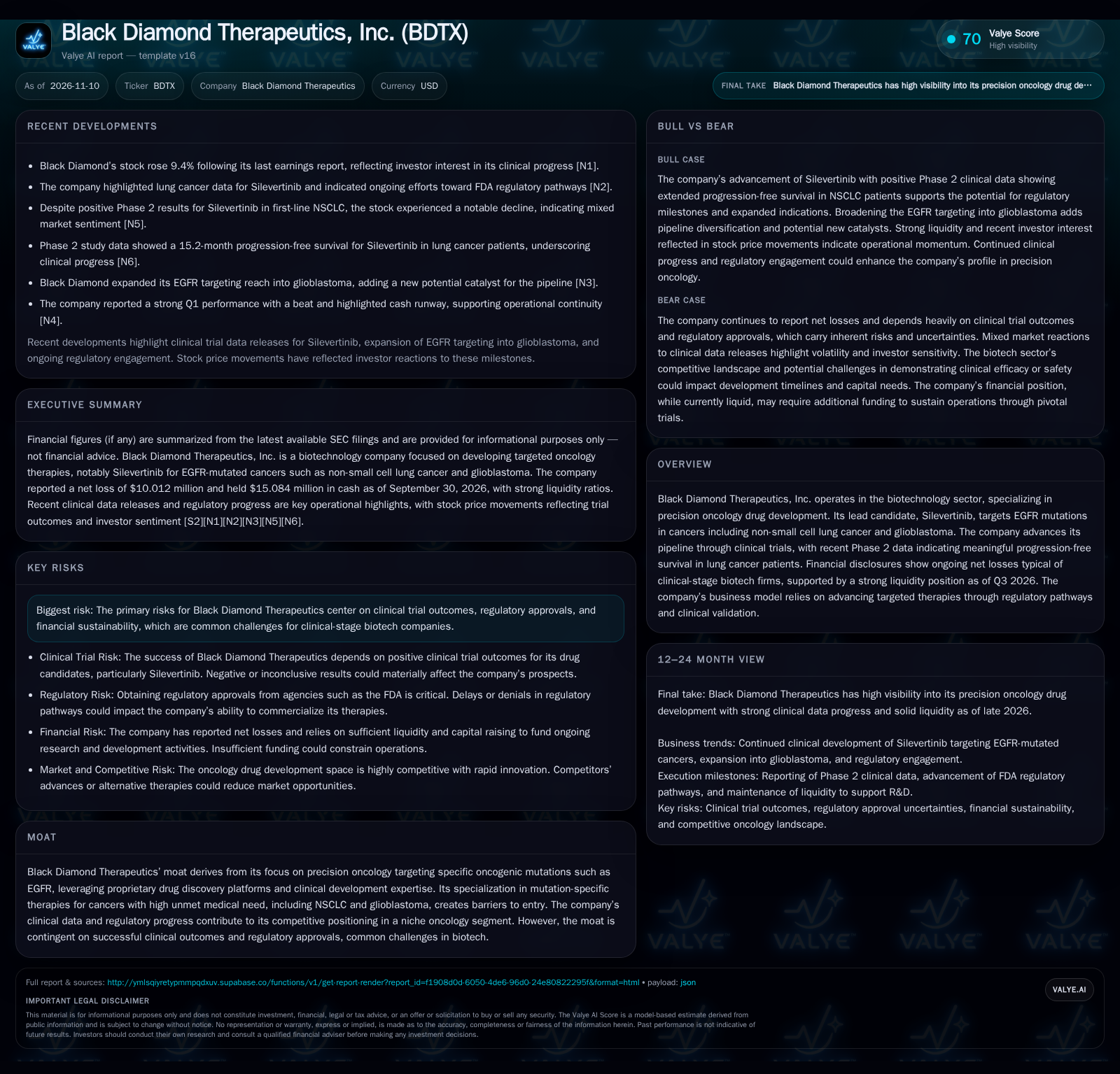
Black Diamond Therapeutics reported a 15.2-month median progression-free survival for Silevertinib in lung cancer, expanded its pipeline into glioblastoma, and maintains reported liquidity position as of Q3 2026. The company remains dependent on positive clinical and regulatory outcomes to unlock commercial value, with recent stock volatility reflecting investor sensitivity to trial data.
Black Diamond Therapeutics sits at a pivotal moment in its evolution as a precision oncology developer. The company’s lead asset, Silevertinib, recently delivered encouraging Phase 2 data in non-small cell lung cancer (NSCLC), and Black Diamond is leveraging its EGFR mutation expertise to expand into glioblastoma. These advancements, supported by reported liquidity position, create tangible clinical and operational milestones. However, the company’s trajectory remains tightly coupled to regulatory decisions and the challenging economics of early-stage biotech, with recent stock price volatility underscoring the sector’s inherent risks.
Recent Clinical Results and Cash Position Set the Strategic Context
Black Diamond Therapeutics reported a median progression-free survival (PFS) of 15.2 months for Silevertinib in a Phase 2 study targeting EGFR-mutated non-small cell lung cancer (NSCLC), a result that stands out in a competitive landscape where PFS is a key regulatory and commercial benchmark [N6]. The company expanded its pipeline reach by targeting glioblastoma, broadening its addressable market and diversifying clinical risk [N3]. The company reported cash and liquidity metrics for the period; these figures do not by themselves establish operating runway, investment capacity, financial flexibility, or financing capacity. [S2] Market reactions to these milestones have been volatile, with both sharp gains and declines following clinical updates, reflecting investor uncertainty and the binary nature of clinical-stage biotech outcomes [N1] [N5].
Beyond the headline clinical and financial metrics, a deeper understanding of the competitive and regulatory environment is crucial. The reported median progression-free survival (PFS) must be contextualized against existing standards of care and emerging therapies, as regulators and payers increasingly expect robust comparative data demonstrating meaningful clinical benefit. The volatility in market reactions underscores the binary risk profile inherent in clinical-stage biotech, where single data points can disproportionately influence investor sentiment and capital access.
Precision Oncology Approach Entails Significant Risk and Reward
Black Diamond’s economics are characteristic of clinical-stage biotech: the company has no commercial revenue and is funded primarily through equity, cash reserves, and potentially milestone payments or partnerships if achieved. The primary value inflection comes from successful clinical trial results and regulatory approvals, which can unlock licensing deals or eventual commercialization. The PFS result for Silevertinib, if validated in subsequent studies and accepted by regulators, could allow Black Diamond to seek out-licensing, co-development, or direct commercialization opportunities—each with distinct margin and capital requirements.
Variable costs are dominated by R&D and clinical trial expenses, while fixed costs are relatively modest, centered on a lean corporate structure. Should Silevertinib reach the market, the company could see dramatic operating leverage, as incremental sales in oncology often carry high gross margins due to premium pricing for targeted therapies. However, the capital needs remain significant: additional funding may be required either to support pivotal trials or to scale commercial infrastructure if Black Diamond chooses a direct go-to-market path. The economics may shift if the company can secure non-dilutive capital through partnerships, but until then, dilution risk is ever-present.
The economics of precision oncology development hinge not only on clinical success but also on the scalability of manufacturing and the cost-effectiveness of patient identification strategies. Given the mutation-specific targeting approach, the company must ensure efficient and reliable diagnostic testing to identify eligible patients, which can influence market penetration and reimbursement negotiations. Furthermore, the pathway to commercialization involves complex trade-offs between partnering for global reach versus building in-house capabilities, each affecting long-term margin profiles and capital intensity. The potential for premium pricing in niche indications must be balanced against payer scrutiny and health technology assessment outcomes, which increasingly demand evidence of real-world effectiveness and value.
Positioning Amid Intense Competition in Oncology
Black Diamond’s competitive strength lies in its precision targeting of EGFR mutations—a well-validated but crowded space in oncology. The company’s approach, focusing on mutation-specific drug design, seeks to differentiate Silevertinib from broader-spectrum EGFR inhibitors, potentially offering efficacy or safety advantages in genetically defined patient subgroups. Expansion into glioblastoma, a tumor type with significant unmet need and few effective targeted therapies, could provide a first-mover or fast-follower advantage if clinical efficacy is demonstrated [N3].
However, the landscape is highly competitive, with multiple established and emerging players developing EGFR-targeted drugs, including both small molecules and antibody-based approaches. Larger incumbents have deeper resources and commercial infrastructure, posing a challenge if Black Diamond seeks to commercialize independently. Furthermore, the pace of innovation in oncology—such as the rise of bispecifics, antibody-drug conjugates, and cell therapies—means substitution risk is ever-present. To defend its niche, Black Diamond must demonstrate clear clinical differentiation and efficiently navigate regulatory hurdles.
In addition to direct competition from other EGFR-targeted therapies, Black Diamond faces indirect competitive pressures from alternative modalities such as immunotherapies and combination regimens that may alter treatment paradigms. The company’s ability to demonstrate a differentiated clinical profile—whether through improved efficacy, safety, or patient convenience—will be critical to securing a foothold. Moreover, the evolving regulatory landscape, including accelerated approval pathways and post-marketing requirements, shapes the risk-reward calculus and influences the speed at which competitive advantages can be realized. Strategic alliances, intellectual property strength, and the agility to adapt to emerging scientific insights also play pivotal roles in sustaining competitive positioning.
Transformational Value Emerges from Pipeline Confirmation
The most favorable chain of events for Black Diamond involves successful completion of pivotal Silevertinib trials, regulatory approval for NSCLC, and compelling early data in glioblastoma. In this scenario, Silevertinib’s PFS advantage is confirmed in larger, randomized trials, leading to FDA approval and positioning the drug as a new standard for EGFR-mutated NSCLC. Regulatory milestones may catalyze lucrative licensing deals or partnerships, providing non-dilutive capital and accelerating commercial rollout.
Expansion into glioblastoma opens a second, less crowded market, potentially establishing Black Diamond as a leader in EGFR-driven brain tumors. Positive data here would further validate the company’s platform, increasing its attractiveness to acquirers or collaborators. Evidence confirming this scenario would include: initiation and successful readouts from pivotal trials, regulatory filings or approvals, partnership announcements, and sustained stock appreciation following data releases.
Focus on Near-Term Goals with Attention to Funding Impact
The most plausible trajectory is continued advancement of Silevertinib through later-stage clinical development, with ongoing data updates driving incremental value but also exposing the company to interim volatility. Modest pipeline progress in glioblastoma provides optionality but may not deliver near-term revenue. The company likely seeks additional funding—potentially through secondary offerings or partnerships—to bridge development phases.
Confirmation of this scenario would come from: regular clinical data releases that support drug efficacy and safety, maintenance of R&D momentum, responsible cash management, and announced steps toward regulatory submissions. Evidence to the contrary would be trial setbacks, negative data, or delays in recruitment, which could force deeper cost-cutting or unfavorable financing.
Funding Strains Could Intensify Following Clinical or Regulatory Challenges
The adverse scenario unfolds if Silevertinib fails to demonstrate sufficient efficacy or safety in pivotal trials, or if regulatory agencies raise concerns that delay or block approval. Negative or inconclusive data would likely trigger sharp stock declines, erode access to capital, and potentially force pipeline reprioritization or workforce reductions. The expansion into glioblastoma may not offset the loss of momentum if NSCLC progress stalls.
Financially, the company could face a funding shortfall, requiring dilutive financings on unfavorable terms or even strategic alternatives such as out-licensing assets at distressed valuations. Evidence confirming this scenario would include: negative clinical updates, regulatory delays or rejections, rapid cash burn without replenishment, and sustained stock price deterioration.
Critical Developments Influencing Black Diamond’s Growth Trajectory
Progression and outcomes of ongoing and upcoming pivotal trials for Silevertinib in NSCLC, including enrollment rates and interim efficacy/safety readouts.
Advancement and initial clinical data for the glioblastoma program, especially any signals of efficacy in this high-unmet-need indication.
Updates on regulatory interactions, such as FDA feedback, guidance on approval pathways, or acceptance of filings.
Cash burn rate and updates to cash runway projections, especially in relation to planned clinical milestones and capital-raising events.
Announcements of partnerships, licensing deals, or co-development agreements that could provide non-dilutive funding or commercial leverage.
Stock price reaction and trading volume around clinical data releases, which may indicate shifting investor sentiment or risk appetite.
If disclosed, retention and turnover among key scientific and clinical leadership, as management stability is critical in navigating clinical and regulatory hurdles.
Disclaimer: This is research-only, informational analysis and not investment advice. It may include AI-generated interpretation and general industry context. Always verify important details using primary sources.

Comments