
Ampco-Pittsburgh: Order Rebound, Legacy Risks, and the Economics of Industrial Resilience
Ampco-Pittsburgh’s recent surge in customer orders and sequential operational improvement arrives amid persistent profitability challenges and legacy liabilities. How the company navigates demand momentum, cost structure, and environmental exposures will shape its next phase.
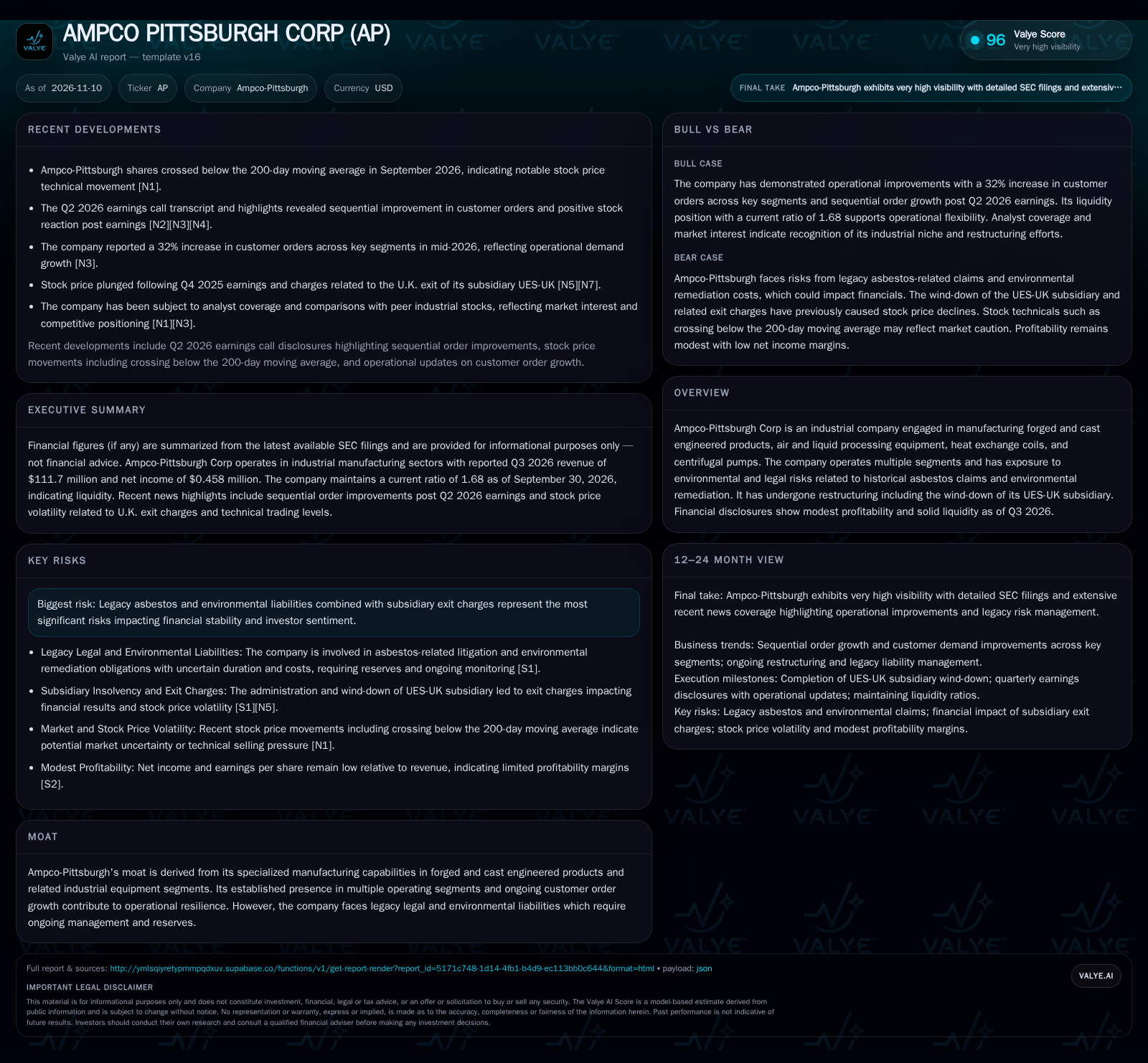
Ampco-Pittsburgh reported Q3 2026 revenue of $111.7 million with net income of $0.458 million, following a 32% mid-year increase in customer orders across key segments. The company reported liquidity-ratio trends of 1.68 but continues to manage asbestos-related and environmental liabilities, as well as the fallout from the UES-UK subsidiary wind-down. The interplay between rising demand and persistent cost/legal headwinds will determine whether recent operational gains translate to sustained margin improvement or remain transitory. [S2] [N3]
Ampco-Pittsburgh Corp’s recent operational momentum—highlighted by a 32% surge in customer orders and sequential improvement in orders—contrasts with its persistent legacy liabilities and razor-thin profitability. The company’s manufacturing portfolio in engineered products and industrial equipment provides exposure to cyclical demand, but long-standing asbestos and environmental risks, combined with the aftershocks of its U.K. subsidiary exit, complicate the investment case. The critical question is whether Ampco-Pittsburgh can convert order growth into durable margin expansion while managing elevated structural and legal costs.
Order Surge, Legacy Liabilities, and a Complex Recovery
Ampco-Pittsburgh reported $111.7 million in revenue and $0.458 million in net income for Q3 2026, translating to basic and diluted earnings per share of $0.02. While these figures confirm continued operations and a return to profitability following restructuring, margins remain thin. A standout operational development was the 32% mid-2026 increase in customer orders across key segments, which management and news sources attribute to improved demand and possibly commercial execution. The company reported cash and liquidity metrics for the period; these figures do not by themselves establish operating runway, investment capacity, financial flexibility, or financing capacity. Meanwhile, Ampco-Pittsburgh continues to manage significant asbestos-related and environmental remediation liabilities, with reserves established to address these exposures. The recent orderly wind-down of the UES-UK subsidiary—triggering exit charges and a material stock price impact—adds another layer of complexity and underscores the financial and reputational risks of legacy issues. [S2] [N3] [S1] [N5] [N7]
Industrial Margin Structure: Volume Leverage vs. High Fixed Costs
Ampco-Pittsburgh’s business spans engineered forgings, cast products, and industrial equipment—markets characterized by high fixed manufacturing costs, cyclical order patterns, and sensitivity to input prices. Revenue is ultimately a function of volume, pricing discipline, and product mix, but the company’s modest net income margin—less than 0.5% of sales in Q3 2026—suggests limited ability to convert incremental revenue into profit. Fixed costs related to labor, plant operations, and regulatory compliance are significant, while variable input costs (such as steel and energy) can compress margins during periods of inflation or supply chain disruption.
Operating leverage is potentially high: if order growth persists and capacity utilization rises, profit margins could expand disproportionately. However, legacy asbestos and environmental liabilities represent a quasi-fixed cost, requiring ongoing legal, insurance, and remediation outlays that dilute operating leverage. Capital needs are moderate for a mature industrial company, but any required investments in compliance, modernization, or liability management could constrain free cash flow. The company’s ability to capture margin improvement hinges on raising prices or shifting mix toward higher-value products, without triggering customer attrition or competitive retaliation.
Specialized Manufacturing as Differentiator—But Not a Moat
Ampco-Pittsburgh’s competitive position rests on its technical expertise in forged and cast engineered products, as well as its established customer relationships in industrial markets. These capabilities can create switching frictions for customers who value quality, reliability, and engineering support, especially in applications where certification and performance are critical. However, the company operates in segments where global competition—ranging from diversified industrial conglomerates to specialized foundries—is intense, and price-based competition remains a persistent threat.
The lack of proprietary technology or regulatory barriers limits the company’s ability to create a durable economic moat. Peer industrials may have greater scale, geographic reach, or integration with end customers, enabling them to absorb cost shocks or invest in automation more aggressively. Environmental and legal legacy exposures could further erode Ampco-Pittsburgh’s relative attractiveness to customers or partners, especially if counterparties factor in reputational or continuity risks. Analyst coverage and peer comparisons underscore the company’s niche but also highlight its vulnerability to external shocks and cyclical downturns. [N1] [N3]
Sustained Order Momentum Unlocks Margin Expansion
If Ampco-Pittsburgh’s 32% order increase signals a durable shift in demand—driven by infrastructure cycles, industrial recovery, or successful share gains—the company could experience a virtuous cycle of rising utilization, operating leverage, and margin expansion. As fixed costs are spread across higher volumes, incremental revenue may translate into a higher proportion of profit, particularly if cost inflation is subdued and pricing discipline holds. Improved cash generation could support liability management, modest reinvestment, and potentially attract new customer segments or partnerships.
Confirmation of this scenario would require evidence of consecutive quarters of revenue and order growth, a visible uptick in gross or operating margins, and progress in reducing the absolute burden of legal/environmental liabilities. Signs of customer stickiness—such as contract wins, renewals, or references to multi-year relationships—would further validate the company’s ability to convert demand into durable financial gains. Conversely, a quick reversal in orders, margin stagnation, or escalation in liability costs would falsify the upside thesis. [N3] [S2]
Incremental Gains Offset by Persistent Cost and Liability Drag
The most plausible trajectory is one in which Ampco-Pittsburgh achieves modest revenue growth and operational improvement, but legacy costs and competitive pressure keep margins subdued. Order increases may moderate as pent-up demand is absorbed or macro conditions become less favorable. The company’s efforts to manage asbestos and environmental liabilities likely remain an ongoing drag on cash flows and investor sentiment, even if reserves are adequate and no new shocks emerge.
This scenario would be confirmed by continued low single-digit net income margins, stable but unremarkable liquidity metrics, and ongoing disclosures about legal and environmental exposures. External analyst coverage and peer comparisons may continue to highlight the company’s operational progress but also its lack of a clear structural advantage. Any sign of renewed volatility—such as large charges, unexpected legal outcomes, or sudden demand reversals—would suggest downside risk is more pronounced than baseline improvement. [S2] [S1] [N1]
Legacy Liabilities and Margin Compression Undermine Recovery
A less favorable outcome would see order growth stall or reverse, while legal and environmental liabilities escalate—either through adverse litigation, regulatory changes, or underestimation of required reserves. In this scenario, the company’s thin profitability would be wiped out by rising costs, and liquidity could become constrained if operating losses or remediation outlays outpace cash generation. Competitive responses—such as price cuts by peers or loss of major customers—could amplify revenue pressure and erode scale advantages.
Downside confirmation would come from negative earnings surprises, additional charges or reserve increases, worsening liquidity ratios, and evidence of customer attrition or contract non-renewals. News of material adverse legal outcomes or regulatory findings would further intensify risk, as would technical stock price breakdowns or coverage downgrades. [S1] [S2] [N5] [N7]
Measuring the Next Phase: Demand, Margins, and Liability Management
Quarterly order intake and backlog trends, especially by segment, would test whether recent demand growth is sustainable or transitory. A useful metric would be disclosed order backlog by product line.
Gross and operating margin progression over the next several quarters would reveal whether higher volumes are translating into improved profitability or being offset by higher costs.
Updates on the status, magnitude, and cash impact of asbestos-related and environmental liabilities, including any changes in reserves or new claims, are essential for assessing long-term risk.
Liquidity developments—such as changes in cash, working capital, or credit facility utilization—would help clarify the company’s potential financial flexibility if disclosed.
Evidence of customer retention, contract renewals, or new multi-year agreements would indicate whether operational improvements are translating into durable commercial relationships.
Disclosures regarding additional restructuring actions, cost-savings initiatives, or strategic pivots following the UES-UK exit would shed light on management’s ability to adapt.
Comparisons with peer industrials’ margin, order, and liability trends would contextualize Ampco-Pittsburgh’s performance and competitive position.
External developments—such as changes in environmental regulation or industrial demand cycles—would impact both risk and opportunity for the company.
Disclaimer: This is research-only, informational analysis and not investment advice. It may include AI-generated interpretation and general industry context. Always verify important details using primary sources.

Comments