
Chicago Atlantic Real Estate Finance: Merger Ambitions, Regulatory Shifts, and the Economics of Cannabis-Backed Lending
Chicago Atlantic Real Estate Finance is navigating a pivotal merger with Chicago Atlantic BDC, Inc., a planned regulatory transition to BDC status, and continued exposure to cannabis-sector lending. With mixed financial results in 2026 and a changing legal landscape, the company faces both upside from scale and diversification, and downside from execution risks and evolving collateral quality.
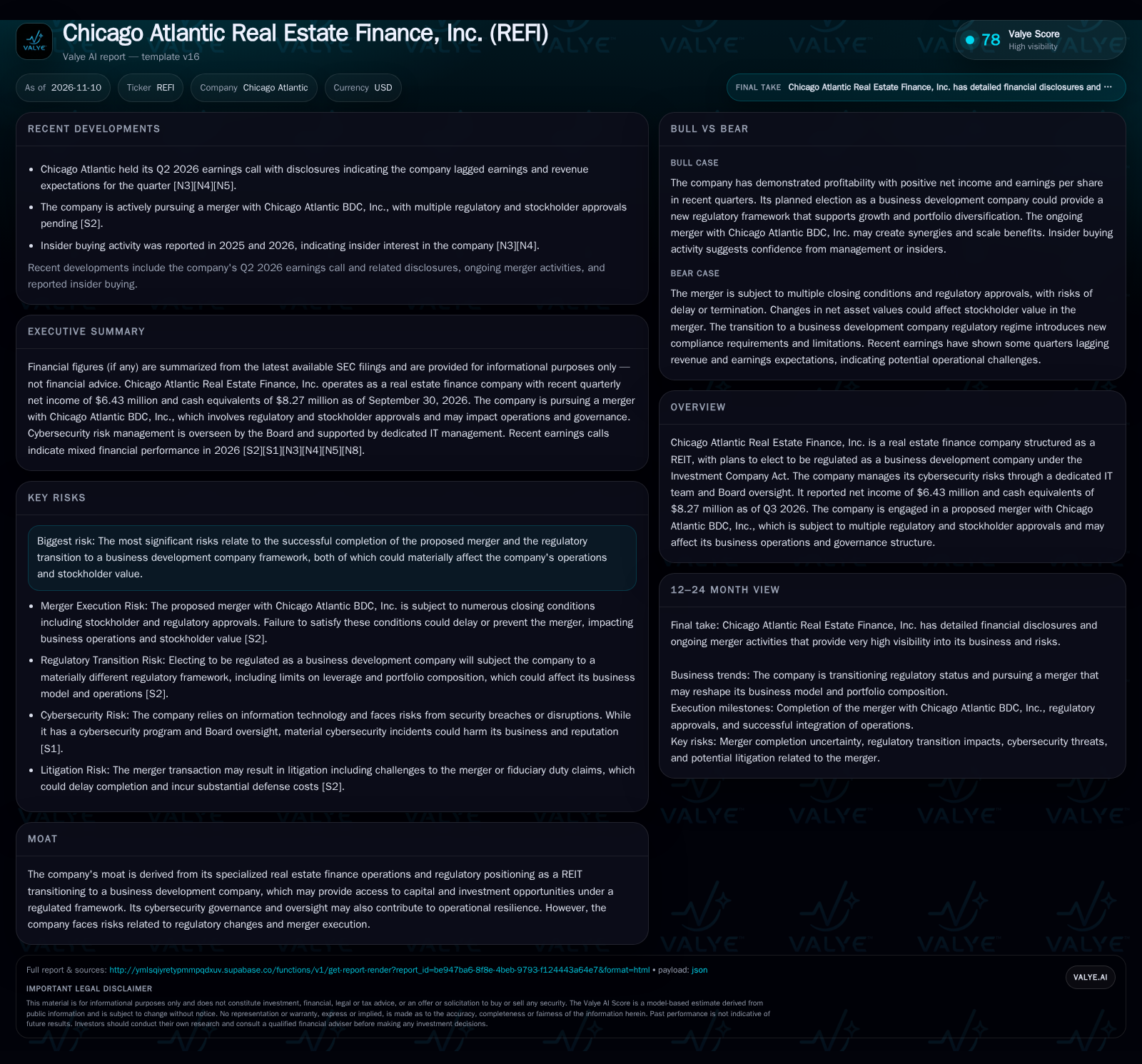
Chicago Atlantic Real Estate Finance reported Q3 2026 net income of $6.43 million and $8.27 million in cash equivalents, even as recent quarters lagged expectations. The company is pursuing a merger with Chicago Atlantic BDC, Inc., which, if completed, will bring regulatory and operational changes. The core business centers on senior secured loans to cannabis operators, a sector shaped by evolving state and federal policy. The transition to BDC regulation and the merger’s execution represent the biggest near-term variables for the company’s economics and risk profile. [S2] [N3] [N4] [N5] [N8]
Chicago Atlantic Real Estate Finance stands at a strategic crossroads: a proposed merger with Chicago Atlantic BDC, Inc. could reshape its governance, capital structure, and scale, while a planned shift to business development company (BDC) regulation will change its allowable leverage and asset mix. The company's lending model—focused on senior, asset-backed loans to cannabis operators—remains exposed to both regulatory tailwinds and risks, particularly as federal cannabis policy evolves. With recent quarters showing mixed results and insider buying reported, the next year will likely be defined by merger outcomes, regulatory adaptation, and the quality of its loan book.
Merger Progress, Financial Results, and Regulatory Inflection Points
As of September 30, 2026, Chicago Atlantic Real Estate Finance reported net income of $6.43 million and held $8.27 million in cash and equivalents. These figures reflect continued profitability but arrive amid mixed quarterly performance, with some recent earnings and revenue coming in below expectations. [S2] [N3] [N4] [N5] [N8]
The most consequential development is the proposed merger with Chicago Atlantic BDC, Inc., which remains subject to stockholder and regulatory approvals. This transaction, if completed, will shift the company’s regulatory regime from a REIT to a business development company (BDC) under the Investment Company Act, bringing new leverage and portfolio composition rules. [S2]
Insider buying activity was reported in 2025 and 2026, suggesting management or insider confidence, though this is not a definitive indicator of future performance. [N3] [N4]
Loan Structure, Collateral Dynamics, and the Impact of Regulatory Transition
Chicago Atlantic’s core business model centers on originating and structuring senior secured loans—primarily to state-licensed cannabis operators. The loans are typically backed by a mix of real estate, equipment, receivables, licenses, or other assets, with real estate collateral coverage averaging 0.9x as of Q3 2026, down from 1.2x in Q3 2025. The weighted average loan-to-enterprise value ratio stands at 45.5%. [S2]
Interest income and fees represent the primary revenue streams, and the company’s externally managed structure means management and incentive fees are paid to an affiliated manager. This creates a relatively fixed cost structure at the management company level, while interest income provides operating leverage as the loan book expands.
The planned transition to BDC status will introduce leverage caps and stricter portfolio composition requirements, potentially limiting the company’s ability to use debt to drive returns and requiring a broader asset mix. The cited source reports dividend-related activity; that disclosure alone does not establish dividend-policy continuity, management confidence, or a material constraint on capital flexibility.
The company’s exposure to the cannabis sector means its addressable market expands or contracts with state and federal policy changes. Default and collateral risks are heightened by the inability to take possession of some cannabis-related assets if a loan defaults, potentially forcing loss realization on distressed loans.
Specialization, Market Niche, and the Threat of Mainstream Entrants
Chicago Atlantic’s specialization in cannabis-backed lending provides it with a defensible niche, as many mainstream lenders remain wary of the sector due to federal legal uncertainty. This allows the company to command higher yields and tighter covenants than would be possible in more commoditized real estate lending segments.
However, this advantage is vulnerable to multiple counterforces: if federal cannabis laws liberalize further, traditional banks and institutional lenders could enter the market, compressing spreads and eroding the company’s pricing power. Conversely, if legal or regulatory headwinds intensify, collateral values could decline and access to new lending opportunities may shrink.
Within the alternative credit and specialty finance universe, Chicago Atlantic competes with other cannabis-focused lenders, private credit funds, and non-bank finance companies. Its externally managed structure means its cost base and strategic flexibility may differ from internally managed peers, especially after a BDC transition.
How Successful Merger Execution and BDC Transition Could Unlock Scale and Diversification
If the merger with Chicago Atlantic BDC, Inc. closes smoothly and the transition to BDC status is well-managed, the combined entity could benefit from greater scale, portfolio diversification, and improved access to capital. BDC regulation may attract new investor classes and provide a more flexible investment mandate, allowing for expansion into non-cannabis segments if market conditions warrant.
A favorable regulatory environment—such as continued state-level legalization and potential federal cannabis rescheduling—could expand the addressable market and reduce default risk, enhancing the quality and yield of the loan portfolio.
Confirmation of this scenario would require evidence of merger completion, stable or rising net interest margins, improved credit performance, and the ability to originate loans outside the cannabis sector without diluting returns. Shareholder approval, minimal attrition of key borrowers or staff, and cost synergies from the merger would further support the upside case.
An Evolving Portfolio Navigates Operational Hurdles During Regulatory and Corporate Transition
The most plausible outcome is a period of operational adjustment as the company works through the merger process and adapts to the BDC regulatory regime. The loan book is likely to remain concentrated in cannabis-backed assets, with incremental diversification as permitted under BDC rules.
Revenue and earnings could remain lumpy as the company balances originations, repayments, and potential credit events. The cost structure may shift with the new regulatory framework, but the externally managed model likely persists.
This scenario would be confirmed by moderate growth in the loan portfolio, stable (but not expanding) net interest margins, and periodic credit losses reflecting sector and collateral volatility. Delays in merger closing, or a slower-than-anticipated regulatory transition, would not derail the business but could constrain near-term upside.
Merger Delays, Regulatory Friction, and Asset Quality Erosion Threaten Returns
The adverse pathway centers on failure to complete the merger or prolonged delays, leading to management distraction, borrower uncertainty, and potential litigation. If regulatory approvals are denied or major closing conditions are not met, the company could lose the anticipated benefits of scale and diversification.
Simultaneously, if federal or state cannabis policies tighten or if the market experiences a correction, collateral values could drop and loan losses could rise—especially for loans not fully secured by real estate. The company’s ability to recover on defaulted loans is already limited by restrictions on owning cannabis assets.
This scenario would be confirmed by merger termination announcements, rising non-performing loans, declining net interest margins, and increasing legal or operating expenses. A spike in realized credit losses or covenant breaches among borrowers would further validate the downside thesis.
Milestones and Metrics That Will Shape Chicago Atlantic’s Next Chapter
Progress toward regulatory and stockholder approvals for the Chicago Atlantic BDC, Inc. merger; public filings or press releases confirming milestone completion would be key.
Changes in portfolio composition, especially the proportion of loans fully secured by real estate versus other collateral; a useful metric would be real estate collateral coverage if disclosed.
Trends in weighted average loan-to-enterprise value and any movement in credit quality or non-performing loans.
Quarterly net interest margin and its sensitivity to changes in funding costs or competitive pressure.
Disclosure around the impact of BDC regulation on leverage, portfolio limits, and permissible asset classes.
Earnings call commentary on borrower demand, pipeline growth, and any shifts in market competition.
Material litigation or regulatory developments related to the merger or the company’s cannabis lending focus.
Any evidence of cost synergies, staff retention, or operational disruptions resulting from the merger process.
Disclaimer: This is research-only, informational analysis and not investment advice. It may include AI-generated interpretation and general industry context. Always verify important details using primary sources.

Comments