
Scholar Rock: First Commercial Revenue, Platform Leverage, and the Test of Rare Disease Execution
Scholar Rock’s transition to commercial-stage biopharma is defined by the U.S. launch of ISEMBYLD for SMA, robust cash reserves, and a pipeline targeting additional neuromuscular and rare disease indications. The next phase will test the scalability of its muscle-targeted platform, clinical risk management, and ability to translate scientific differentiation into durable revenue.
Scholar Rock’s FDA approval and first commercial sales of ISEMBYLD™ mark a turning point from pure clinical-stage development to initial market execution. Near-term value hinges on ramping U.S. SMA sales, successful ex-U.S. approvals, and pipeline proof points.
Scholar Rock has crossed a critical threshold in its evolution, registering its first commercial revenue from ISEMBYLD following FDA approval for SMA. The move from a purely clinical-stage risk profile to one that now blends commercial execution, ongoing R&D, and geographic expansion is a defining shift. With a reported cash position and multiple clinical programs in motion, the company faces a classic biopharma inflection: can its differentiated platform and early commercial foothold in SMA translate into sustained growth, or will clinical, regulatory, and market headwinds limit the realization of its pipeline potential?
FDA Approval and Initial Sales: A New Commercial Era for Scholar Rock
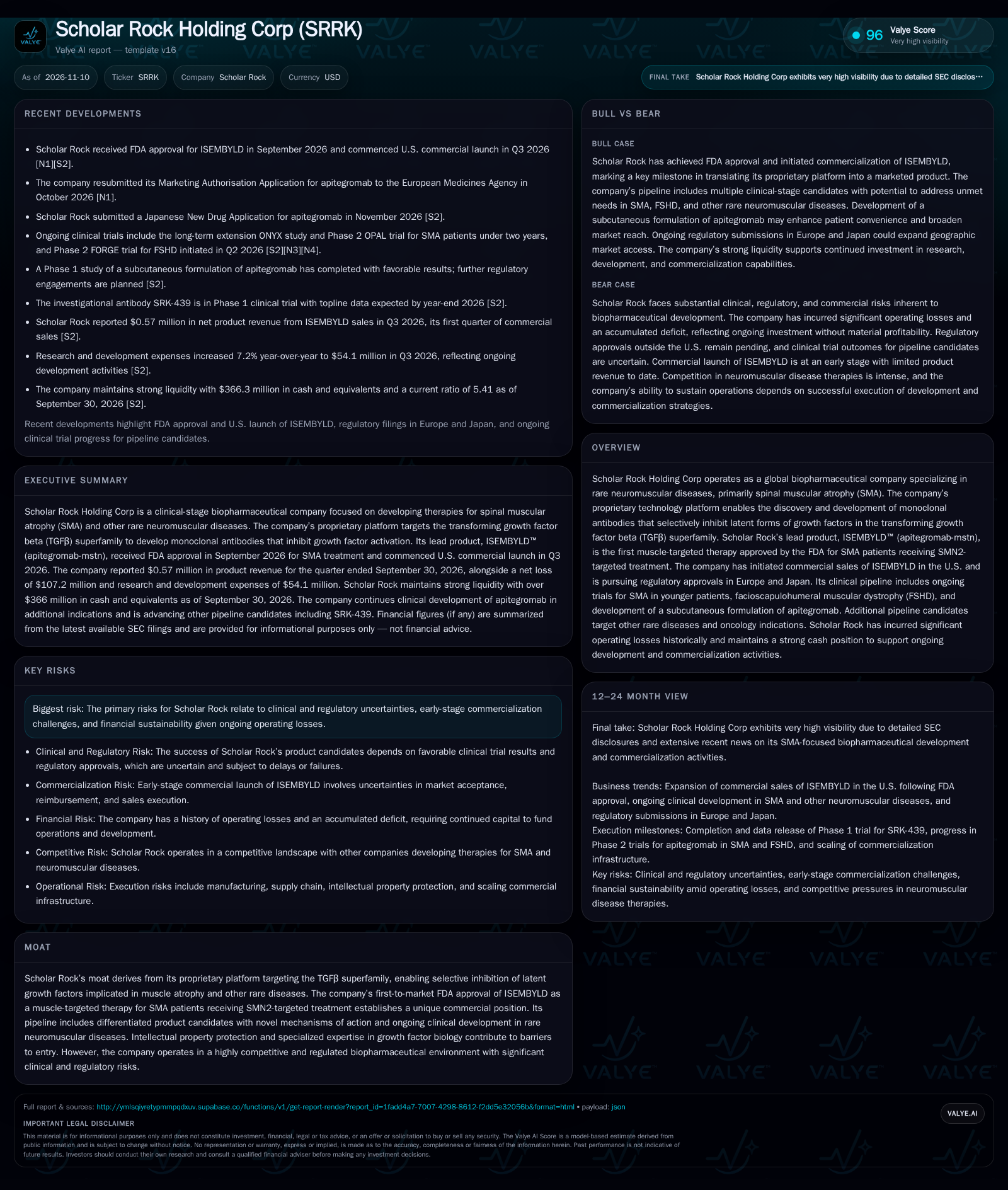
The most material recent development for Scholar Rock is the FDA approval and U.S. commercial launch of ISEMBYLD™ (apitegromab-mstn) for SMA patients aged two and older receiving SMN2-targeted therapy. This marks the company’s first approved product and transition into commercial-stage operations [S2]. Revenue of $0.57 million in Q3 2026, while modest, is Scholar Rock’s first recognized product revenue, providing tangible validation of its platform and regulatory execution.
Despite this, the company reported a net loss of $107.2 million for the quarter, reflecting ongoing high R&D and launch spend, and an accumulated deficit of $1.6 billion [S2].
Regulatory expansion is underway, with a resubmitted European application and a new Japanese filing for apitegromab, both within the last two months [S2] [N1]. The outcome of these filings will shape the near-term global revenue landscape.
Therapy Pricing, R&D Spend, and the Path to Operating Leverage
Scholar Rock’s business model is built around high-value therapies for rare neuromuscular diseases, where pricing per patient is typically high but commercial success depends on market access, payer reimbursement, and physician adoption. The economics of ISEMBYLD will be shaped by the size of the addressable SMA population, the proportion receiving SMN2-targeted therapy, and the company’s ability to secure favorable reimbursement terms.
Initial revenue is small relative to the company’s cost base—Q3 2026 R&D expenses of $54.1 million (up 7.2% year-over-year) and the continued net loss highlight the fixed cost intensity and long investment horizon typical in this sector [S2]. Commercial infrastructure, including sales, medical affairs, and patient support, adds further fixed costs as the company ramps up.
If the company achieves significant sales growth, particularly as ex-U.S. approvals materialize, there is potential for operating leverage: incremental gross margins in specialty biopharma can be high once scale is achieved. However, this scenario depends on robust demand, successful reimbursement, and limited pricing pressure. The capital intensity of ongoing clinical programs and the need to fund additional indications or new launches will continue to weigh on cash flow until a broader revenue base is established.
Scientific Differentiation vs. Entrenched Rivals in Neuromuscular Disease
Scholar Rock’s competitive edge rests on its proprietary platform targeting latent forms of TGFβ superfamily growth factors, aiming for muscle-specific effects rather than systemic inhibition. This mechanism positions ISEMBYLD as a differentiated muscle-targeted therapy for SMA, where most competitors focus on SMN upregulation or gene therapy.
However, the company operates in a landscape with large, well-capitalized competitors offering established SMA therapies and pursuing adjacent neuromuscular indications. Incumbents may have greater commercial reach, pricing power, and physician relationships, making market penetration a challenge. The degree to which Scholar Rock’s clinical profile (efficacy, safety, quality of life improvements) translates into real-world adoption will be the critical test.
Pipeline differentiation is a potential advantage: ongoing programs in FSHD, subcutaneous formulations, and other indications could broaden the addressable market and reduce reliance on a single asset. Intellectual property and specialized expertise in growth factor modulation provide some barriers to entry, but the risk of competitive innovation and clinical setbacks remains high.
Platform Validation Unlocks Expanding Revenue Streams
In an upside scenario, Scholar Rock rapidly ramps U.S. ISEMBYLD sales through strong physician uptake, robust reimbursement, and clear differentiation in clinical outcomes compared to existing SMA therapies. Approval and commercial launch in Europe and Japan could significantly expand the addressable market, especially if regulatory reviews proceed smoothly.
Pipeline success would compound the story: positive data from the ONYX extension, OPAL (younger SMA patients), and FORGE (FSHD) trials may establish apitegromab as a platform therapy for muscle atrophy, unlocking additional indications and patient segments. The subcutaneous formulation, if shown to be as effective and more convenient, could accelerate adoption and improve adherence.
Confirmation would come from sequential quarterly revenue growth, positive ex-U.S. regulatory outcomes, expanded label indications, and favorable clinical trial readouts. Early-stage pipeline assets such as SRK-439 could add further optionality if Phase 1 results are promising and external partnerships are secured.
Commercial Uptake Grows Gradually Amid Persistent R&D Spend
The most plausible scenario is a measured ramp of ISEMBYLD sales in the U.S., constrained by the size of the eligible SMA population and the realities of payer/practitioner adoption cycles. Ex-U.S. launches may be delayed or staggered, with initial revenues offset by ongoing investment in regulatory, commercial, and clinical infrastructure.
R&D expenses are likely to remain high as the company advances multiple trials and prepares for potential label expansions. The cash runway supports this strategy, but operating losses will persist until commercial sales materially increase or pipeline assets are partnered/licensed.
Evidence supporting this scenario would include steady but moderate quarterly revenue growth, continued high R&D spend, and incremental progress on regulatory and clinical milestones. Falsification would be a sharp inflection in either direction—unexpected rapid adoption, or a setback in key clinical or regulatory events.
Regulatory Setbacks or Commercial Misses Threaten Sustainability
A downside scenario would be triggered by unexpected regulatory delays or rejections in Europe or Japan, or by slower-than-expected U.S. uptake of ISEMBYLD due to payer resistance, safety signals, or lack of clinical differentiation. In this case, revenue growth would stall while high fixed costs persist, forcing the company to consider cost containment or external financing earlier than planned.
Clinical setbacks in ongoing trials—such as ONYX, OPAL, or FORGE—would erode confidence in the platform’s broader applicability, potentially diminishing pipeline value and partnership prospects. If subcutaneous or next-generation assets fail to deliver, the company could become increasingly reliant on a single product in a competitive, niche market.
This scenario would be confirmed by flat or declining product revenue, negative regulatory news, or clinical trial terminations. Accelerating cash burn and a lack of external business development progress would further validate a bearish outlook.
Milestones That Will Define Scholar Rock’s Platform Viability
Quarterly ISEMBYLD revenue growth: Sequential sales figures will show whether early adoption is accelerating or plateauing, testing both demand and payer acceptance.
Ex-U.S. regulatory milestones: Approval decisions and launch timing from European and Japanese regulators will determine geographic expansion and revenue diversity.
ONYX, OPAL, and FORGE clinical trial readouts: Data supporting efficacy and safety in new patient populations or indications will influence both label expansion and competitive positioning.
Progress on subcutaneous apitegromab: Regulatory feedback, subsequent trial design, and initial uptake (if launched) will gauge the convenience-driven market opportunity.
Pipeline advancement for SRK-439: Topline Phase 1 data (expected by year-end 2026) and any partnership announcements would help validate platform breadth.
SMA market dynamics: Changes in treatment guidelines, competitive launches, or reimbursement policy shifts could materially impact ISEMBYLD’s trajectory.
Cash burn and operational runway: Actual quarterly burn rates and updated guidance on cash runway, if disclosed, will be critical for assessing financial sustainability.
Disclaimer: This is research-only, informational analysis and not investment advice. It may include AI-generated interpretation and general industry context. Always verify important details using primary sources.

Comments