
WhiteFiber’s AI Data Center Ambitions: Scale, Revenue Visibility, and the Frictions of Hypergrowth
WhiteFiber, Inc. is racing to build a high-density AI infrastructure platform by retrofitting industrial sites, securing long-term contracts, and integrating cloud GPU services, but faces regulatory, customer, and supply chain frictions that will test the economics of rapid scale.
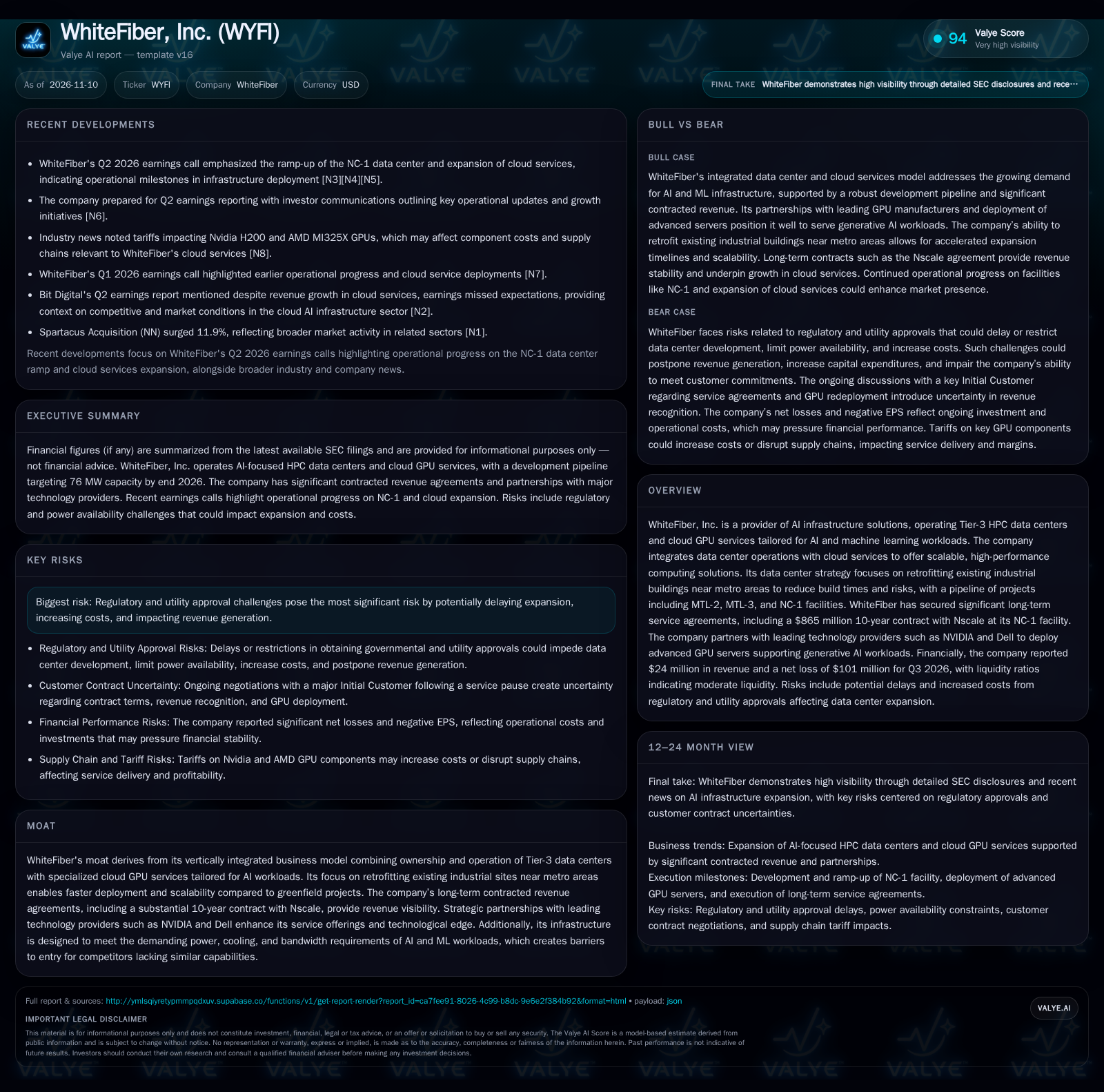
WhiteFiber is aggressively scaling Tier-3 data centers and cloud GPU services for AI workloads, with a $865M decade-long contract anchoring its NC-1 facility and a pipeline targeting 76 MW by late 2026. While the company is winning major contracts and deploying top-tier GPUs, it is contending with regulatory approval risks, customer renegotiations, and ongoing net losses as it invests in infrastructure and expansion. The firm's ability to translate its contracted backlog and rapid build cycles into sustainable margins and capital efficiency will determine whether it can emerge as a winner in the AI infrastructure race. [S1] [S2]
WhiteFiber, Inc. is positioning itself as a critical enabler of the generative AI boom, blending high-density Tier-3 data centers and specialized cloud GPU services for demanding machine learning workloads. With a rapid-fire retrofit strategy, a flagship $865 million decade-long contract at its NC-1 site, and partnerships with top GPU vendors, WhiteFiber is chasing scale at a moment when AI infrastructure demand is surging. But the company’s aggressive expansion also exposes it to regulatory bottlenecks, customer friction, and the capital intensity of building out a hyperscale platform. The next twelve months will test whether contracted backlog and technical advantages can overcome execution, cost, and margin headwinds. [S1] [S2]
Contracted Revenue Anchors, Expansion Pipeline, and Customer Friction Define the Present
WhiteFiber’s current thesis pivots on three pivotal facts: First, the company has secured a 10-year, $865 million contracted revenue agreement with Nscale for colocation and related services at its NC-1 data center, with billing for an initial 40 MW phase expected to commence in June 2026. This agreement provides substantial revenue visibility and underpins the economics of its largest facility to date. Second, WhiteFiber is targeting 76 MW of gross data center capacity by the end of 2026, including active development on MTL-2, MTL-3, and NC-1, while reviewing a much larger 1,500 MW pipeline. Third, the company is navigating an ongoing renegotiation with a major Initial Customer after a service pause, leading to redeployment of GPU resources—a development that introduces uncertainty around revenue recognition and customer stickiness. Financially, the company reported $24 million in Q3 2026 revenue and a net loss of $101 million, with liquidity ratios indicating moderate short-term resource coverage. [S1] [S2]
How WhiteFiber’s Economics Could Scale—And Where Margin Pressures May Emerge
WhiteFiber’s business model blends the capital intensity of data center ownership with the recurring revenue potential of cloud GPU services. Revenue streams are primarily anchored in long-term colocation and service contracts (such as the 10-year Nscale agreement) and shorter-term, usage-based GPU cloud services for AI/ML workloads. The economics hinge on maximizing the occupancy and utilization of high-density, retrofit data centers, where fixed costs (real estate, construction, power provisioning, and cooling) are substantial but can be amortized over multi-year customer contracts if capacity is quickly filled.
Variable costs include power, maintenance, and hardware depreciation, with GPU server refresh cycles and electricity pricing as major cost drivers. The ability to secure power at scale and pass through utility costs to customers is critical. The retrofit model—converting industrial buildings near metro areas—can reduce time-to-revenue and capex per MW compared to greenfield builds, but may yield higher ongoing maintenance or retrofitting costs if legacy infrastructure requires upgrades.
Cloud GPU services introduce software-layer economics, potentially yielding higher gross margins if hardware is efficiently utilized and customer churn is low. However, margin pressure could arise from hardware supply constraints, tariffs on GPUs, or the need to redeploy underutilized resources if large contracts are paused or renegotiated. Significant up-front investment and negative operating leverage are likely until occupancy and utilization stabilize at scale. [S1] [S2]
Specialized AI Data Centers Face Both Traditional and Next-Gen Rivals
WhiteFiber occupies a competitive landscape where traditional hyperscale colocation providers, cloud giants, and emerging AI-native data center operators all vie for share. Its focus on high-density, AI-optimized Tier-3 infrastructure—emphasizing power, cooling, and bandwidth for generative AI workloads—differentiates it from legacy colocation players who may lack the technical requirements for GPU-intensive deployments.
The company’s partnerships with NVIDIA, Dell, SuperMicro, and HPE, as well as early deployment of NVIDIA GB200 and H100 GPU servers, provide a technical edge and access to advanced hardware. However, cloud hyperscalers (such as AWS, Google Cloud, and Microsoft Azure) offer integrated AI infrastructure at global scale—often with proprietary software layers and deep customer relationships—creating a formidable threat. WhiteFiber’s retrofit strategy may enable faster metro-area expansion, but it must consistently deliver reliability, power density, and service flexibility to retain customers who have alternatives.
Switching costs in this market are moderate: while physical migration of AI workloads can be complex due to data gravity, major customers can shift contracts or split workloads across multiple providers if service levels or economics falter. The biggest competitive risks are the commoditization of basic colocation, the entry of new AI-specialized players, and the potential for customers to vertically integrate their own private AI infrastructure if economics permit.
If Contracted Backlog Converts Rapidly, WhiteFiber Could Achieve Operating Leverage Ahead of Schedule
A favorable trajectory for WhiteFiber would see its contracted backlog—anchored by the decade-long Nscale agreement and new GPU cloud service orders—translating into high occupancy rates and strong, recurring revenue streams across its data center portfolio. Rapid buildout and commissioning of facilities (enabled by the six-month retrofit cycles) could allow the company to outpace slower-moving competitors, maximizing asset utilization while AI/ML infrastructure demand remains robust.
If regulatory and utility approvals proceed without major delay, and power can be reliably secured at predictable rates, WhiteFiber could achieve positive operating leverage as fixed costs are amortized over a larger revenue base. Early resolution of customer contract renegotiations, combined with further GPU service orders and stable supply of advanced GPUs from partners like NVIDIA, would provide additional momentum.
Evidence supporting this scenario would include: sustained ramp-up in recognized revenue from existing contracts (especially Nscale), consistently rising occupancy/utilization rates, minimal downtime or service interruptions at new facilities, and clear margin improvement as new capacity comes online. Additional multi-year contract wins or successful expansion into new metro markets would further validate the upside.
Most Probable Outcome: Rapid Growth with Episodic Friction and Prolonged Margin Pressure
The most likely path for WhiteFiber involves continued rapid expansion of its data center footprint and cloud GPU services, driven by strong AI/ML demand and ongoing contract wins. However, the company is expected to encounter episodic regulatory, utility, and customer frictions that cause delays in facility commissioning or revenue recognition. Customer renegotiations—such as the current situation with the Initial Customer—may result in revenue timing volatility or require redeployment of hardware, creating short-term inefficiencies.
Capital intensity will remain high, with negative operating margins likely until a critical mass of contracted capacity is achieved and stabilized. Supply chain risks, particularly around GPU tariffs or hardware shortages, could periodically pressure gross margins. The retrofit strategy should continue to confer a speed advantage in select metro markets, but as competitors adapt, WhiteFiber will need to differentiate on reliability, service quality, and power economics to retain and attract customers.
Confirmation of this scenario would be evidenced by quarterly revenue growth with persistent (but gradually narrowing) net losses, periodic customer contract updates, and variable but generally rising utilization rates. Regulatory or power approval delays may cause occasional revenue deferrals but not fundamentally derail the growth trajectory.
Delays, Customer Attrition, or Cost Shocks Could Stall WhiteFiber’s Growth Engine
The principal downside risks for WhiteFiber stem from exogenous shocks or execution missteps that disrupt the planned expansion and revenue ramp. Significant regulatory or utility approval delays—particularly for power-intensive sites—could push back facility launches, stranding capital and deferring contracted revenue. If customer renegotiations become widespread or lead to contract cancellations, the company could face underutilized assets and downward revenue revisions.
Supply chain volatility, such as extended tariffs or shortages of next-gen GPUs, could inflate costs or limit the company’s ability to deliver on cloud service SLAs, undermining customer trust and eroding margins. Additionally, if competitors aggressively undercut pricing or offer superior technology/service integration, WhiteFiber could face pressure to discount or invest further, deepening operating losses.
Material regulatory, power, or supply chain disruptions would be key adverse triggers.
What Will Determine Whether WhiteFiber’s AI Infrastructure Bet Pays Off
Quarterly recognized revenue from the Nscale contract and other major multi-year agreements: sustained growth would support the backlog-to-revenue conversion thesis. [S1]
Utilization and occupancy rates at new and existing data centers: if disclosed, rising figures would indicate successful demand capture and operating leverage.
Resolution and terms of ongoing contract negotiations with the Initial Customer: a useful metric would be retention or expansion of GPU commitments post-renegotiation.
Progress and timing of regulatory and utility approvals for MTL-2, MTL-3, and future sites: delays or denials would signal execution risk.
Trends in hardware procurement costs and supply chain stability, particularly for NVIDIA and AMD GPUs: cost spikes or shortages would impact gross margin.
Quarterly net loss trajectory and margin progression as new capacity comes online: narrowing losses would suggest operating leverage is emerging.
Announcements of new multi-year service agreements or expansions into additional metro markets: would validate demand and expansion strategy.
Any material changes in the timing, size, or collectibility of contracted backlog: would test the durability of WhiteFiber’s revenue visibility.
Disclaimer: This is research-only, informational analysis and not investment advice. It may include AI-generated interpretation and general industry context. Always verify important details using primary sources.

Comments