
Meridian Holdings: Navigating Regulatory Shocks, Platform Complexity, and the Economics of Multi-Jurisdictional Gaming
The company’s fate now hinges on its ability to adapt its business model, stabilize operations, and demonstrate resilience in the face of sector-wide volatility.
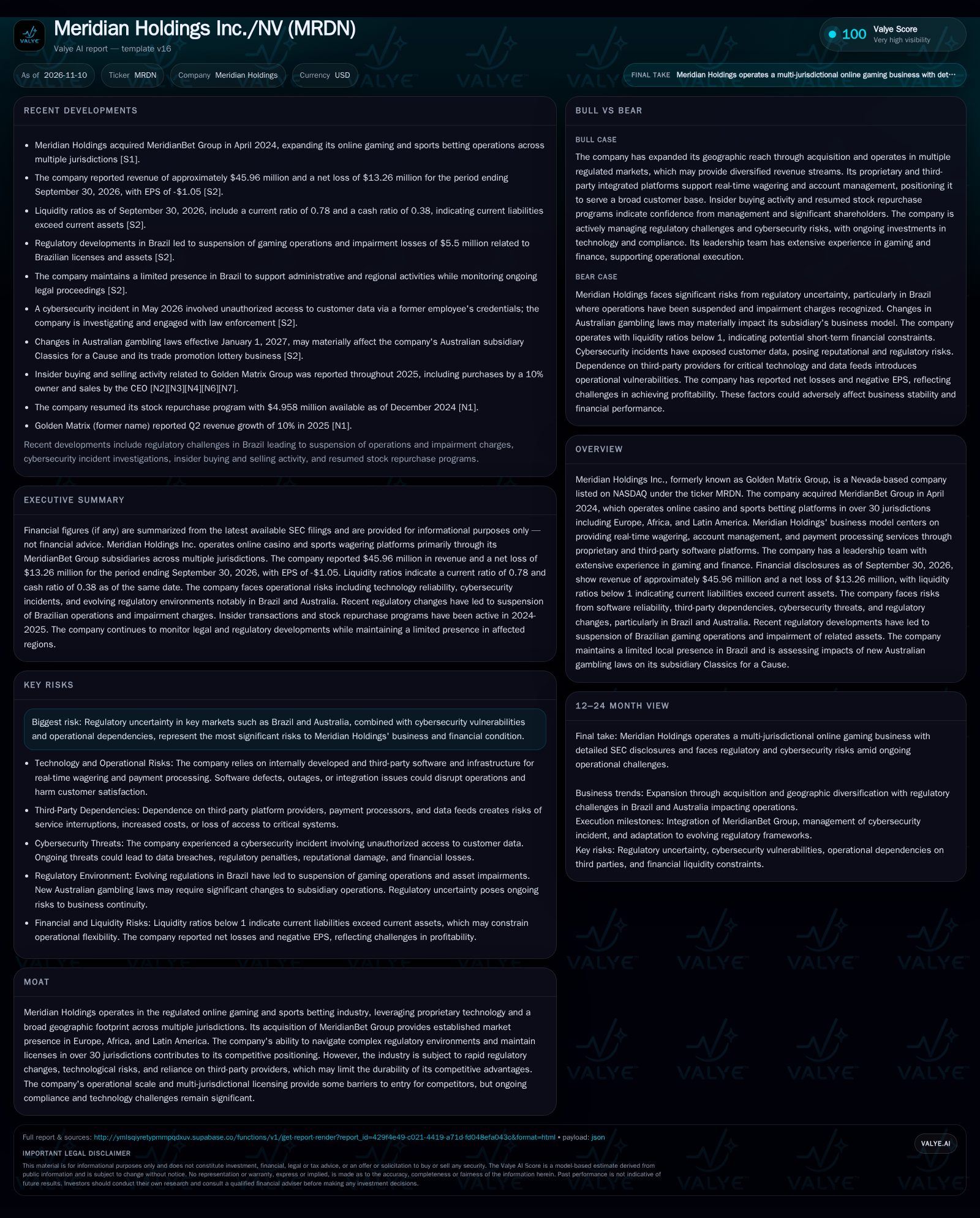
Meridian Holdings (MRDN) operates a multi-jurisdictional online casino and sports betting platform, reporting $45.96 million in revenue and a net loss of $13.26 million as of September 2026. Suspension of Brazilian operations following regulatory changes, impairment of related assets, and looming Australian law shifts highlight the company’s exposure to legal and compliance risks. The next phase will test whether Meridian’s platform, leadership, and geographic spread can offset mounting external pressures. [S2]
Meridian Holdings has rapidly transformed into a global online gaming operator by acquiring MeridianBet Group and expanding into more than 30 jurisdictions across Europe, Africa, and Latin America. Yet, this multi-market strategy now faces acute stress: regulatory upheaval in Brazil has forced a costly operational retreat, while looming law changes in Australia threaten a key lottery subsidiary.
Regulatory Turbulence and Financial Strains Define Meridian’s Present
Meridian Holdings’ recent trajectory is dominated by three material developments: the suspension of its Brazilian operations following regulatory changes, the recognition of $5.5 million in impairment losses tied to Brazilian licenses and assets, and a reported net loss of $13.26 million on $45.96 million in revenue as of September 30, 2026. Additionally, a May 2026 cybersecurity incident involving unauthorized access to customer data highlights ongoing operational vulnerabilities. The company’s Australian subsidiary also faces material uncertainty due to new gambling laws effective January 2027. Collectively, these facts signal a business model under significant external and internal pressure, testing the resilience of Meridian’s multi-jurisdictional platform. [S2]
How Meridian’s Platform Could Drive or Drain Value
Meridian’s core business economics hinge on volume-driven, transaction-based revenues from online casino and sports wagering, operating across diverse regulatory regimes. The company leverages both proprietary and third-party software to deliver real-time betting, account management, and payment processing. In theory, this model offers high operating leverage: incremental wagers processed through the platform can generate substantial gross margin once fixed technology and compliance costs are covered. However, actual profitability is highly sensitive to regulatory compliance costs, jurisdictional taxes, licensing fees, and marketing outlays required for customer acquisition and retention.
The capital intensity of entering and maintaining compliance in multiple markets is non-trivial, often requiring upfront license payments, ongoing regulatory reporting, and localized technology adaptation. The recent impairment in Brazil underscores the risk of stranded capital and sunk costs when regulatory winds shift. Meanwhile, the company’s liquidity ratios suggest reported liquidity metrics that do not by themselves establish potential financial flexibility. If Meridian can scale active users and betting volumes in stable markets, while keeping customer acquisition costs and fraud losses in check, it could ultimately achieve positive operating leverage—but the path is currently clouded by loss-making operations, asset write-downs, and regulatory uncertainty.
A critical factor influencing Meridian’s economics is the interplay between customer lifetime value (LTV) and customer acquisition cost (CAC) across different jurisdictions. Given the fragmented regulatory landscape, marketing strategies must be highly localized, which can inflate CAC and compress margins. If Meridian can leverage data analytics and targeted promotions to improve player retention and increase LTV, it may offset elevated acquisition expenses. Conversely, failure to optimize this balance risks perpetuating losses, especially in markets where regulatory constraints limit promotional flexibility or impose additional compliance costs.
Another dimension is the platform’s scalability and modularity in adapting to diverse regulatory requirements. A platform architecture that allows rapid customization for local rules, payment methods, and responsible gaming features can reduce time-to-market and compliance costs. However, if platform adaptations require significant bespoke development or manual oversight, operational complexity and costs may escalate disproportionately as Meridian expands. The ability to standardize core components while maintaining regulatory agility is thus a key determinant of sustainable operating leverage and margin expansion.
Geographic Breadth as Moat or Mirage: The Reality of Online Gaming Competition
Meridian’s competitive position rests on its broad geographic footprint and ability to operate in over 30 jurisdictions, acquired primarily through the MeridianBet Group. In principle, this multi-market presence can create barriers to entry—new entrants must replicate complex licensing, compliance, and localized marketing efforts. Yet, in practice, the regulated online gaming sector is fiercely competitive, with global, regional, and local operators vying for share. Technology platforms, user experience, breadth of betting options, and brand trust all influence market share, but there is little evidence that Meridian enjoys a structural advantage in any of these dimensions.
Reliance on third-party providers for software and payment processing introduces further vulnerability, as technical outages, integration failures, or unfavorable contract terms could erode customer experience or margins. Regulatory risk is a persistent equalizer: sudden changes can neutralize geographic diversification if several markets tighten simultaneously. The recent Brazilian and Australian developments highlight that even a wide footprint may not guarantee resilience if key jurisdictions are lost or heavily restricted.
From a competitive dynamics standpoint, Meridian’s multi-jurisdictional presence can be a double-edged sword. While geographic diversification may mitigate revenue volatility from any single market, it also exposes the company to a patchwork of regulatory regimes that can shift unpredictably. Competitors who focus on fewer, more stable markets may achieve deeper customer engagement and operational efficiencies. Meridian’s success therefore depends on its capacity to balance breadth with depth—achieving sufficient scale in each jurisdiction to justify compliance investments without spreading resources too thinly across marginal markets.
Additionally, the reliance on third-party technology providers introduces strategic dependencies that can influence competitive positioning. If Meridian negotiates favorable terms and maintains strong vendor relationships, it can benefit from continuous innovation and robust platform performance. However, vendor lock-in or service disruptions could impair customer experience and increase costs. In a sector where user trust and seamless functionality are paramount, the company’s ability to manage these external relationships effectively will be critical to sustaining market share and profitability.
Resilience Through Diversification: What a Recovery Would Look Like
A favorable outcome for Meridian would require successfully offsetting regulatory headwinds through growth in other, more stable markets, and demonstrating that its platform can scale profitably. This path could be catalyzed by: (1) swift adaptation to Brazilian and Australian regulatory changes—either regaining compliant access or reallocating resources to more attractive markets; (2) visible improvement in operating leverage, as fixed platform costs are spread over rising transaction volumes; and (3) effective cybersecurity remediation, restoring customer trust and minimizing future incident risk.
Confirmation of this scenario would include: a return to positive net income and EPS, improvement of liquidity ratios above 1.0, stabilized or growing active user counts (if disclosed), and resumed or new market launches without major compliance setbacks. Evidence of successful geographic reallocation—such as new licenses or partnerships in growth markets—would further support the case for Meridian’s resilience and long-term value creation.
Adapting to a Patchwork of Constraints: Meridian’s Most Likely Course
The most plausible near-term outcome is that Meridian remains in a period of operational triage, working to stabilize its financials while navigating ongoing regulatory and cybersecurity challenges. The company is likely to maintain a limited presence in Brazil and pivot resources elsewhere, while closely monitoring the impact of Australian law changes on its lottery subsidiary. Revenue could stagnate or grow only modestly, as gains in some jurisdictions are offset by losses or compliance costs in others.
Confirmation of this scenario would involve continued negative or marginally improving net income, persistent sub-1 liquidity ratios, and incremental updates on regulatory engagement without transformative new market wins. If disclosed, user and transaction volume metrics would likely show volatility or plateauing rather than robust growth. The company’s fate in this scenario hinges on risk management and operational discipline rather than breakout expansion.
When Regulatory Shocks Compound: Risk of Further Contraction
The adverse scenario for Meridian would see regulatory tightening spread to additional key markets, further impairing assets and eroding revenue. Should the company face new suspensions, fines, or license losses—whether due to compliance failures, policy changes, or another major cybersecurity breach—its already thin liquidity could be exhausted, forcing asset sales, business retrenchment, or even insolvency.
Signals confirming downside risk would include: new impairment charges, additional market exits, worsening net losses, a declining cash balance, and inability to maintain current operations without external financing. Material adverse findings from ongoing cybersecurity investigations or regulatory reviews would further increase the risk of reputational and financial damage.
Milestones That Will Determine Meridian’s Recovery or Retreat
Sustained improvement in net income and EPS, signaling that operational leverage is achievable despite regulatory churn.
Movement of the current and cash ratios above 1.0, indicating improved liquidity and reduced short-term financial risk.
Updates on the status of Brazilian and Australian operations—particularly any restoration of gaming activity or successful adaptation to new legal frameworks.
If disclosed, trends in active user counts, transaction volumes, and average revenue per user (ARPU) to gauge core platform health.
Resolution and follow-up disclosures regarding the May 2026 cybersecurity incident, including any regulatory penalties or customer remediation costs.
Evidence of new market entries, license wins, or strategic partnerships in jurisdictions with stable or favorable regulatory environments.
Updates on insider transactions, stock repurchase activity, or capital raises that clarify management conviction and financial runway.
Disclaimer: This is research-only, informational analysis and not investment advice. It may include AI-generated interpretation and general industry context. Always verify important details using primary sources.

Comments