
PMV Pharmaceuticals Nears Accelerated Approval Pivot: Precision Oncology Ambitions, Capital Reset, and the Realities of Single-Asset Biotech
PMV Pharmaceuticals approaches a critical inflection as it readies rezatapopt, its tumor-agnostic p53 Y220C inhibitor, for an accelerated approval filing in platinum-resistant ovarian cancer. With fresh capital, key management hires, and pivotal Phase 2 enrollment complete, the company faces the intertwined challenges of clinical risk, future commercialization execution, and the competitive dynamics of the oncology landscape.
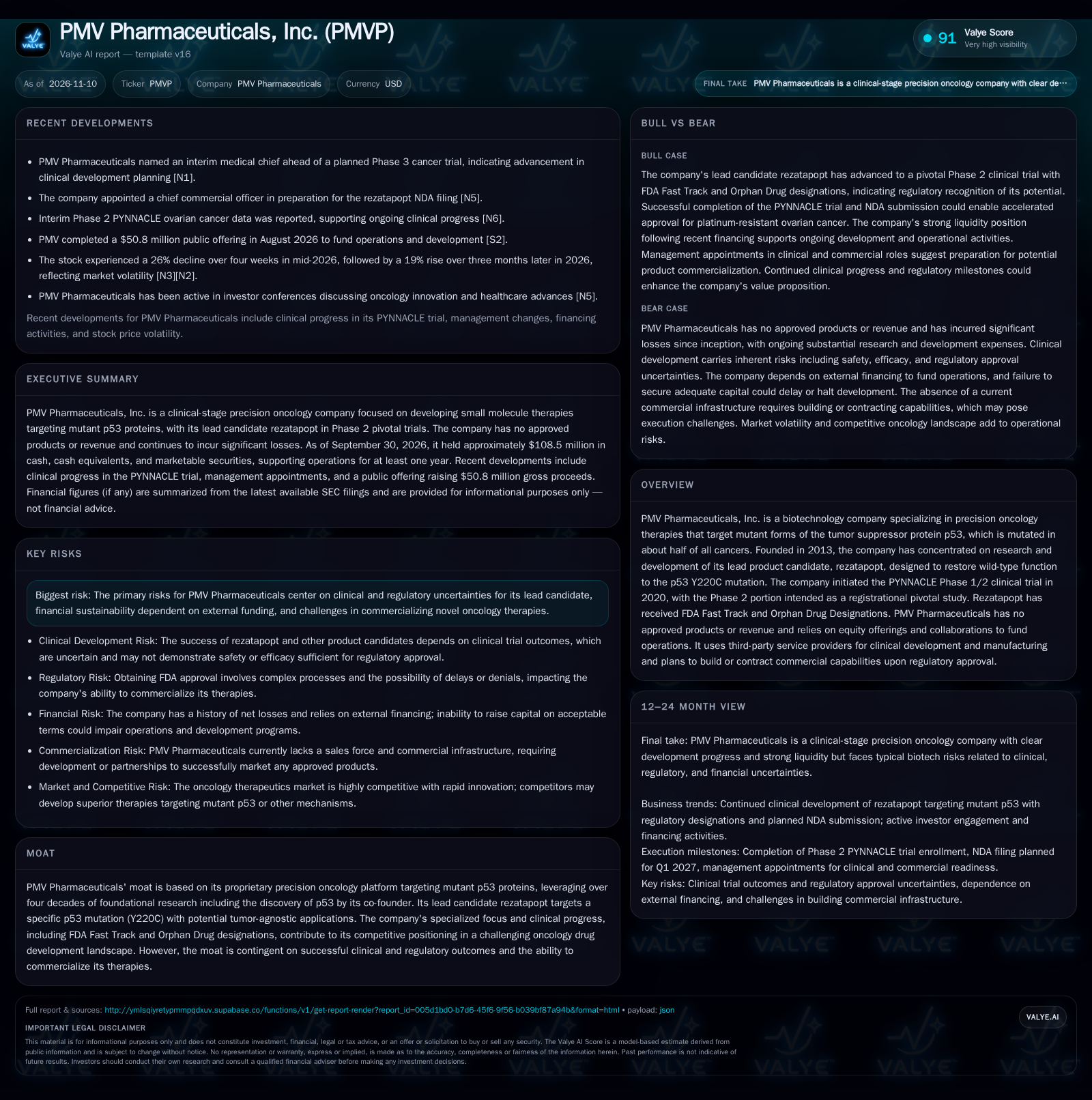
PMV Pharmaceuticals is advancing rezatapopt, a precision oncology therapy for p53 Y220C mutant cancers, toward an accelerated approval NDA in early 2027 after completing pivotal Phase 2 enrollment. The company recently raised $50.8 million, easing near-term liquidity concerns, and appointed new leadership in clinical and commercial roles. Success now depends on late-stage clinical outcomes, regulatory review, and execution of a go-to-market strategy in a highly competitive and rapidly evolving oncology field. [S2] [N6]
PMV Pharmaceuticals stands at a pivotal juncture as its lead therapy rezatapopt, a targeted agent for p53 Y220C-mutant cancers, completes pivotal Phase 2 enrollment and heads toward an accelerated approval submission in a high-unmet-need ovarian cancer subset. The company recently shored up its balance sheet with a $50.8 million offering and installed new clinical and commercial leadership, reducing near-term survival risk and signaling readiness for the next stage. The question is whether clinical outcomes and regulatory momentum can translate into commercial success—especially as PMV will need to build or partner for go-to-market capabilities in a fiercely competitive oncology landscape. [S2] [N6]
Pivotal Trial Completion, Fresh Capital, and Leadership Changes Shape the Next Six Months
Three developments materially alter PMV Pharmaceuticals’ near-term outlook. First, the company has completed primary enrollment in the pivotal Phase 2 portion of the PYNNACLE trial for rezatapopt in platinum-resistant/refractory ovarian cancer, with a registrational primary analysis now possible and an NDA submission targeted for Q1 2027. This marks a transition from pure R&D risk to regulatory and pre-commercial risk. Second, the August 2026 public offering raised $50.8 million in gross proceeds ($46.9 million net), boosting the company’s liquidity to approximately $108.5 million in cash and investments as of September 30, 2026—enough to alleviate short-term going-concern anxieties. Third, management made strategic hires in both clinical and commercial leadership, signaling preparation for potential product launch and regulatory engagement. [S2] [N6]
Single-Asset Biotech Economics: Capital Consumption, Dilution, and Commercialization Cost Hurdles
PMV Pharmaceuticals’ current business model is classic pre-commercial biotech: the company generates no revenue, funds operations through equity offerings, and incurs significant R&D outlays in pursuit of a lead asset. Net losses for the nine months ended September 30, 2026 were $70.5 million, with R&D and G&A expenses dominating the cost structure. Research spending has declined modestly as the pivotal trial matures, but commercialization—if approval is achieved—would require a rapid transition to either building a sales force, partnering, or licensing.
The economics of a first-in-class, tumor-agnostic, small-molecule oncology drug can be attractive if the therapy achieves both regulatory approval and commercial adoption. Orphan Drug and Fast Track designations could yield seven years of market exclusivity and expedited review. However, PMV would face a steep ramp in commercial costs, including market access, physician education, and post-marketing studies. The lack of a current commercial infrastructure implies either significant fixed-cost buildout or reliance on revenue-sharing partnerships, both of which dilute margins and value capture.
PMV’s capital needs remain substantial. The recent offering improved immediate liquidity, but further fundraising may be needed for commercialization or additional indications, especially if timelines slip or if post-approval studies are required by regulators. The company’s ability to extract operating leverage depends on both clinical success and the efficiency of its commercialization strategy. [S2]
Precision Oncology in a Crowded Arena: PMV’s Platform, Differentiation, and Substitution Risks
PMV’s competitive positioning rests on rezatapopt’s specificity for the p53 Y220C mutation, a well-validated oncogenic driver present in a subset of solid tumors. The company’s scientific pedigree and regulatory designations provide a degree of differentiation, but the broader precision oncology landscape is intensely competitive. Multiple large and small companies are pursuing mutant p53 reactivation or alternative synthetic lethality approaches, and the pace of innovation is rapid.
The tumor-agnostic label could, in principle, enable broader market penetration if clinical benefit is demonstrated beyond ovarian cancer. However, payers and physicians will demand compelling efficacy and safety data. Substitution risks loom from both existing standard-of-care therapies and emerging modalities, such as other targeted small molecules, bispecific antibodies, or even cell therapies. Without head-to-head data or real-world outcomes, PMV’s platform could struggle to maintain differentiation if competitors with larger commercial footprints move quickly in the same space.
Barriers to entry include the complexity of targeting mutant p53 and the regulatory hurdles of first-in-class oncology drugs, but these are not insurmountable for well-capitalized or strategically partnered competitors. The company’s intellectual property and clinical progress offer some moat, yet the ultimate defensibility will be determined by real-world clinical and commercial performance.
Accelerated Approval Spurs Commercial Momentum and Platform Validation
In the most favorable scenario, the pivotal Phase 2 data for rezatapopt demonstrate clear efficacy and an acceptable safety profile in platinum-resistant/refractory ovarian cancer, leading to a successful accelerated approval by the FDA in 2027. Orphan Drug and Fast Track designations would enable a swift review and confer a period of market exclusivity. Early commercial uptake could be catalyzed by the lack of effective alternatives in this patient population and the tumor-agnostic potential of the agent.
If PMV is able to rapidly execute a disciplined commercial launch—either through a targeted internal sales force or a strategic partnership—the company could generate meaningful top-line revenue, validate its precision oncology platform, and unlock broader indications for rezatapopt. Confirmation of this scenario would come from positive pivotal data, acceptance of the NDA, regulatory approval, and evidence of early formulary access or commercial partnerships. Success in follow-on indications or label expansions would further reinforce the upside.
Regulatory Review and Commercial Buildout: A Costly, Uncertain Transition
The transition from clinical-stage to early commercial-stage biotech is typically marked by operational growing pains and further capital needs.
Commercial uptake, even if approval is secured, may be gradual as payers and clinicians evaluate real-world efficacy and cost-effectiveness. Competitive launches or negative sentiment around data robustness could limit penetration. Evidence confirming this scenario would include regulatory acceptance with requests for further data, measured hiring in commercial roles, and announcements of partnership discussions or limited initial launch geographies.
Clinical or Regulatory Setbacks Amplify Funding and Commercialization Risk
A less favorable scenario would see disappointing pivotal data—either insufficient efficacy or safety concerns—leading to regulatory delay, a refusal-to-file, or a requirement for additional studies before approval. In this outcome, PMV would likely face a sharp decline in investor confidence, limited ability to raise capital on favorable terms, and a reversion to a pre-commercial, high-burn model with increased dilution risk.
Even if the NDA is accepted, a negative advisory committee vote, new competitors with better data, or reimbursement pushback could stymie commercial prospects. Confirmation of the downside would come from regulatory setbacks, public disclosure of negative or ambiguous trial outcomes, or announcements of significant cost cuts or halted development programs.
What Will Determine PMV’s Transition from Clinical to Commercial Oncology Player
Readout of pivotal Phase 2 PYNNACLE trial efficacy and safety data for rezatapopt in platinum-resistant/refractory ovarian cancer.
Regulatory acceptance and review progress of the NDA submission for rezatapopt, including any requests for additional data or advisory committee scheduling.
Updates on commercial infrastructure development, including hiring, third-party partnerships, or licensing agreements—if disclosed.
Evidence of payer engagement, formulary wins, or reimbursement framework for rezatapopt in the initial indication.
Additional clinical progress or trial initiations for rezatapopt in other tumor types or p53-mutant populations.
Cash burn rate and guidance on financial runway, especially if timelines to regulatory decision or commercialization extend.
Competitive developments in the mutant p53 and broader precision oncology space, including new approvals or superior clinical data from rivals.
Any material changes in management, board composition, or strategic direction that could signal a shift in risk or execution capacity.
Disclaimer: This is research-only, informational analysis and not investment advice. It may include AI-generated interpretation and general industry context. Always verify important details using primary sources.

Comments