
TriSalus Life Sciences: Expanding Drug Delivery in Interventional Oncology with Reimbursement Momentum and Execution Risks
TriSalus Life Sciences is scaling its proprietary PEDD infusion systems for hard-to-treat cancers, with new FDA clearances and expanded CMS reimbursement driving commercial traction. As the company invests in sales force expansion and navigates clinical-stage immuno-oncology ambitions, the sustainability of its growth hinges on execution, reimbursement stability, and supply chain reliability.
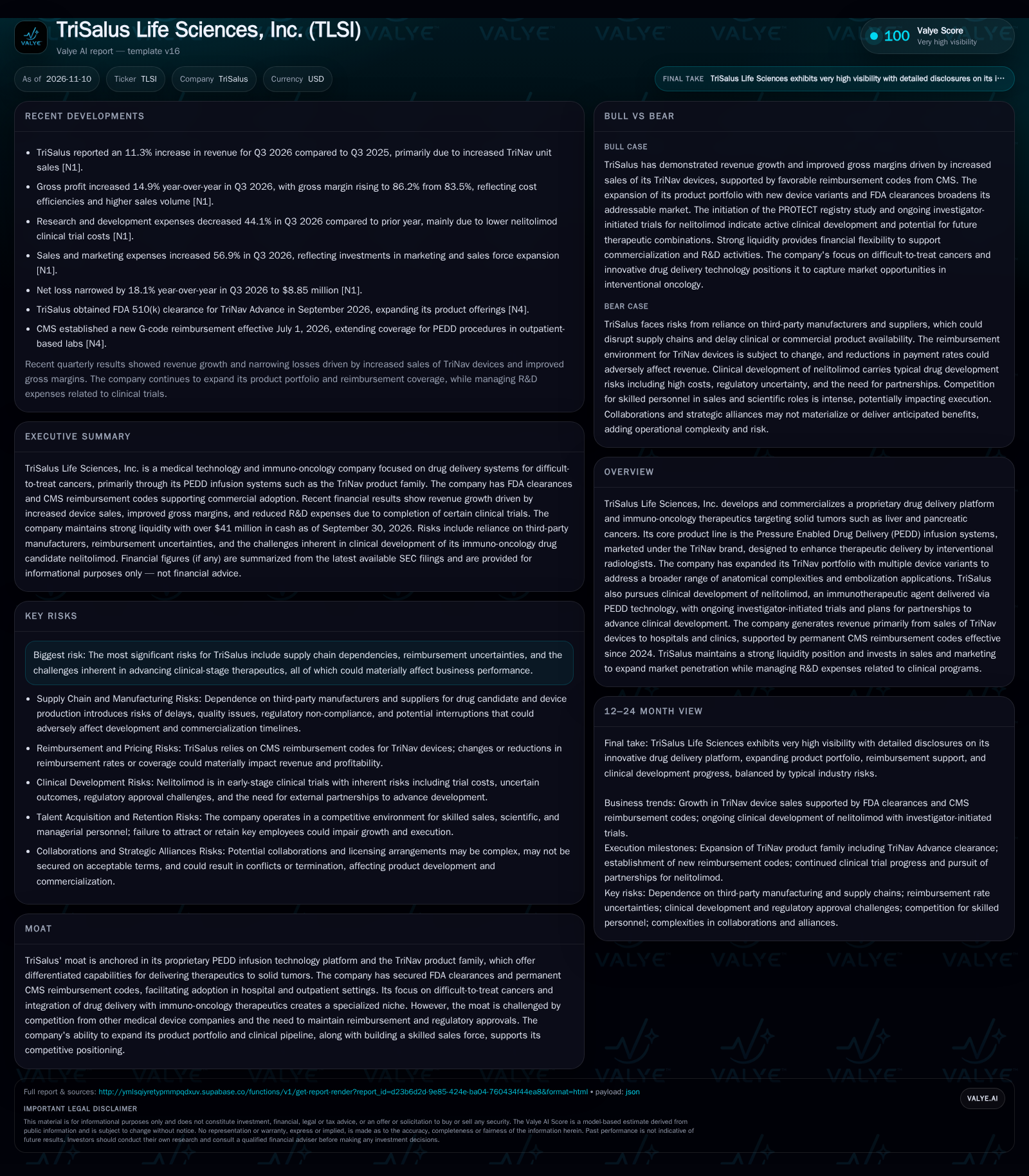
TriSalus Life Sciences is leveraging its Pressure Enabled Drug Delivery (PEDD) technology—anchored by the TriNav product family—to target difficult solid tumors in the liver and pancreas. Recent FDA clearance for TriNav Advance and expanded CMS reimbursement codes have supported double-digit revenue growth and margin expansion. The company is deploying cash to boost its commercial footprint, but future performance will depend on maintaining reimbursement, managing supply chain dependencies, and executing on its clinical pipeline for nelitolimod. Strategic partnerships and further portfolio expansion could accelerate upside, but operational, regulatory, and market risks remain material. [S1] [S2] [N1] [N4]
TriSalus Life Sciences stands at a pivotal point in the commercialization of its Pressure Enabled Drug Delivery (PEDD) systems, targeting the persistent clinical challenge of delivering therapeutics to solid tumors in the liver and pancreas. With the TriNav product family gaining ground through new FDA clearances and expanded CMS reimbursement, the company has translated innovation into accelerating revenue and margin gains. Yet, as TriSalus ramps up its commercial presence and eyes clinical-stage immuno-oncology opportunities, its ability to sustain growth will be tested by execution risks, reimbursement dynamics, and the realities of scaling a hybrid device-therapeutics platform.
Recent FDA Clearance and Reimbursement Expansion Shape TriSalus’ Strategic Position
TriSalus Life Sciences has reported an 11.3% year-over-year revenue increase in Q3 2026 to $12.9 million, driven by higher TriNav device sales. Gross margin rose to 86.2% from 83.5% a year ago due to scale and manufacturing efficiencies. The TriNav Advance received FDA 510(k) clearance in September 2026, broadening the lineup for interventional radiologists. Critically, the CMS established new permanent HCPCS codes for TriNav devices in 2024 and 2025, with a further G-code effective July 1, 2026, expanding reimbursement access for outpatient-based labs—a move that may accelerate adoption and reduce friction for hospital and ambulatory customers. [S2] [N1] [N4]
How TriSalus Generates Value: Device Sales, Reimbursement, and Margin Leverage
TriSalus’ core business model centers on direct sales of its proprietary PEDD infusion systems, primarily under the TriNav brand, to hospitals and clinics. The economics are shaped by a high gross margin profile—now exceeding 86%—which is typical for advanced interventional medical devices with specialized clinical applications. The recent improvement in margin is attributed to both increased unit sales (driving scale economies) and reduced per-unit manufacturing costs, likely from process optimization and supplier negotiations. Revenue growth is currently volume-driven, supported by expanded reimbursement coverage, which lowers barriers for hospital customers to adopt the technology.
Fixed costs include investment in sales and marketing—up 56.9% year-over-year in Q3 2026—as the company expands its sales force and marketing reach. This commercial ramp should, if successful, yield operating leverage as incremental device sales flow through a relatively fixed cost base. R&D spend is now lower due to reduced nelitolimod trial activity, but could rise again if the clinical pipeline is advanced or new device variants are developed. [S2] [N1]
Evaluating TriSalus’ Moat: Technology Differentiation, Reimbursement, and Execution Risks
TriSalus’ competitive position is anchored in its proprietary PEDD technology, which claims improved delivery of therapeutics to solid tumors in anatomically challenging regions. The TriNav product family is differentiated by FDA-cleared device variants addressing diverse anatomical and procedural needs, potentially expanding the addressable market relative to more generic catheters or standard infusion devices. Permanent CMS reimbursement codes and the new G-code for outpatient labs are significant, as reimbursement is a major gating factor for adoption in interventional oncology.
However, the moat is not impenetrable. Competing device makers—ranging from large diversified medtech firms to niche interventional radiology players—may offer alternative solutions, including next-generation embolization devices or drug delivery catheters. The need to maintain reimbursement status, navigate regulatory changes, and ensure consistent supply (given third-party manufacturing dependencies) are ongoing challenges. Additionally, the company’s immuno-oncology ambitions with nelitolimod could either deepen the moat if successful or represent a costly distraction if clinical and partnership risks are not managed.
What a Rapid Commercial Inflection Could Look Like
A favorable scenario for TriSalus would see accelerated adoption of its TriNav PEDD systems as reimbursement expansion translates into increased procedural volumes at both hospital and outpatient sites. If the company’s expanded sales force proves effective, TriSalus could capture share from less specialized devices, driving sustained double-digit revenue growth and further margin expansion as scale efficiencies deepen. Additional FDA clearances for new device variants or successful clinical data from the PROTECT registry could open new indications (e.g., thyroid disease embolization), expanding the addressable market.
A strategic partnership or licensing deal for nelitolimod—potentially leveraging the PEDD platform for targeted immunotherapy delivery—could provide non-dilutive funding and pipeline validation. Confirmation of this scenario would include continued strong revenue growth, stable or rising gross margins, new large hospital or health system contracts, positive registry data, and partnership announcements for the immuno-oncology pipeline.
Sustained Growth with Execution Hurdles and Selective Pipeline Progress
The most plausible trajectory is one of continued, but potentially moderating, revenue growth as TriSalus capitalizes on recent reimbursement wins and commercial investments. Margins may remain high, but incremental expansion could slow as pricing pressure or competition emerges. Sales and marketing costs are likely to remain elevated as TriSalus seeks to entrench its position against larger device players and new entrants. The nelitolimod program may advance slowly, with the company supporting investigator-initiated trials but seeking external partners due to the capital-intensive nature of drug development.
Evidence for this scenario would be steady, single-digit to low double-digit revenue growth, stable or slightly improving gross margins, ongoing but controlled operating losses, and incremental clinical progress or partnership discussions for the pipeline. Falsification would come from sudden reimbursement reductions, major supply chain disruptions, or failure to translate salesforce investments into market share gains.
Where Growth Could Stall: Reimbursement, Supply Chain, or Clinical Setbacks
The adverse case for TriSalus centers on external or execution-driven shocks. A reduction or withdrawal of CMS reimbursement—whether due to policy shifts, coding revisions, or cost-containment pressures—could sharply curtail device adoption and undermine revenue. Supply chain disruptions, given reliance on third-party manufacturers, could delay or limit product availability, frustrating customers and ceding ground to competitors.
On the pipeline side, failure to secure partners or generate positive data for nelitolimod could result in sunk costs without commercial upside. Talent retention issues or missteps in scaling the sales organization could lead to missed revenue targets and operational inefficiency. Evidence for this scenario would include declining or flat revenue, margin compression, rising inventory or backorder levels, negative reimbursement decisions, and clinical or partnership setbacks.
Benchmarks That Will Clarify TriSalus’ Commercial and Clinical Trajectory
Quarterly TriNav device sales volume and revenue growth rates—continued acceleration would support the commercial momentum thesis.
Gross margin trends—sustained or expanding margins would indicate successful scale-up and pricing discipline; compression could signal cost or pricing pressure.
Updates on CMS and private payer reimbursement coverage—any negative changes would be a key early warning for adoption risk.
Sales force productivity metrics, if disclosed—such as new account wins, hospital penetration, or same-customer growth, to assess ROI on commercial investments.
Progress on the PROTECT registry and new device clearances—evidence of expanded indications or portfolio breadth.
Announcements regarding nelitolimod partnerships, licensing deals, or new clinical trial initiations.
Inventory and supply chain performance—any reported delays, backorders, or supplier changes would help test the resilience of operations.
Cash burn and runway disclosures—updates on operating cash flow, capital needs, or planned financing to assess sustainability.
Disclaimer: This is research-only, informational analysis and not investment advice. It may include AI-generated interpretation and general industry context. Always verify important details using primary sources.

Comments