
Intelligent Bio Solutions: FDA Submission, Cartridge Growth, and the Challenge of Scaling Fingerprint Drug Testing
With its recent FDA 510(k) submission for codeine detection and 46% revenue growth on cartridge demand, Intelligent Bio Solutions stands at a commercialization inflection. Yet, persistent net losses, dilution risk, and FDA clearance uncertainty frame a high-stakes path for its non-invasive fingerprint drug screening platform.
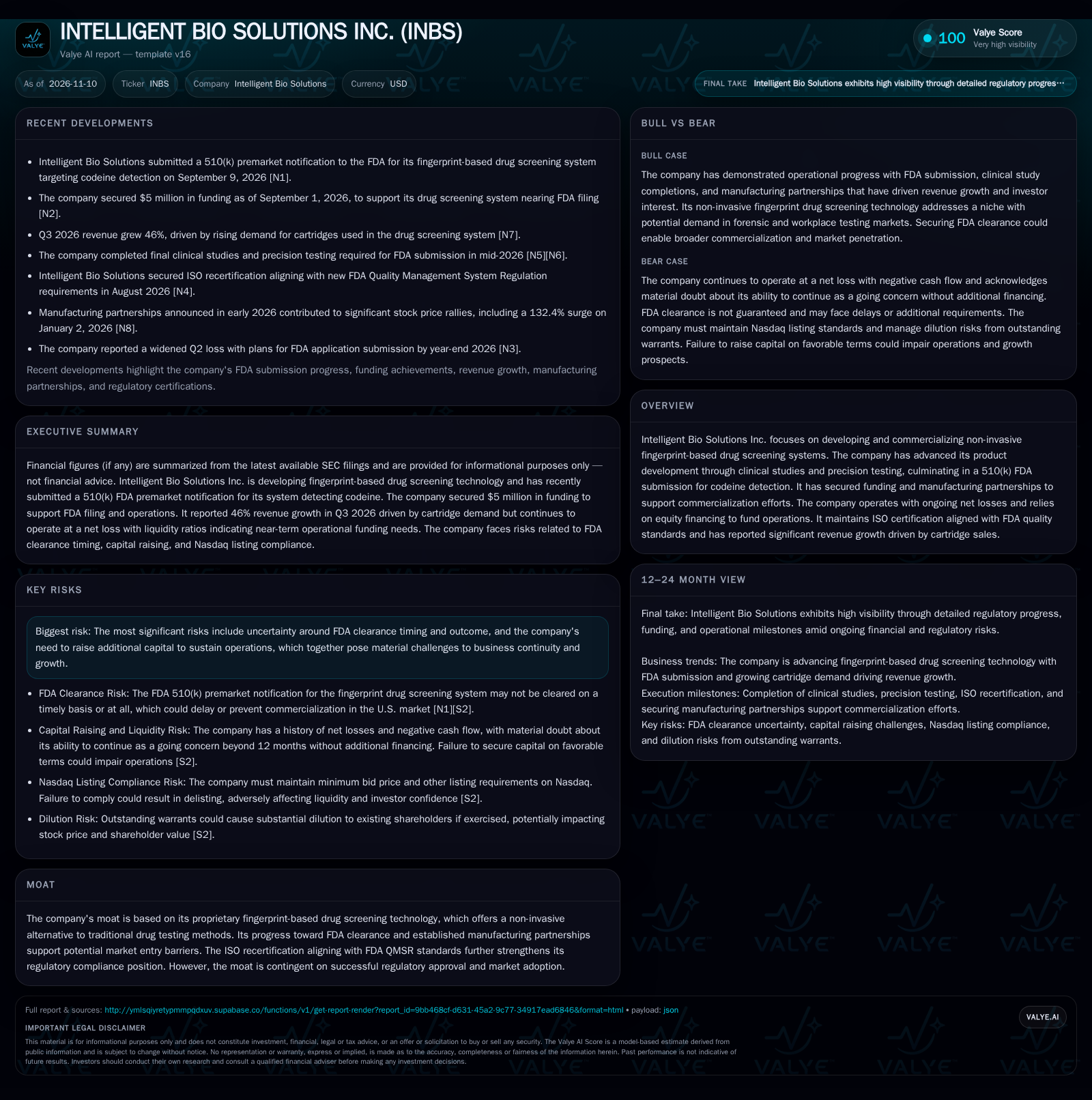
Intelligent Bio Solutions has submitted its fingerprint-based drug screening system for FDA 510(k) review and reported 46% Q3 2026 revenue growth driven by cartridge sales. Despite operational milestones, the company continues to post net losses and faces material risk around its ability to continue as a going concern without new financing. The next phase hinges on FDA clearance, capital access, and market adoption.
Intelligent Bio Solutions Inc. is navigating a pivotal stretch as it seeks to commercialize its fingerprint-based drug screening technology targeting U.S. regulatory approval. The company’s recent 510(k) FDA submission for codeine detection, paired with 46% revenue growth in cartridge sales, signals operational momentum. However, persistent net losses and acknowledged material risks around financing and regulatory clearance create a binary outlook: a successful FDA outcome could unlock a differentiated, non-invasive testing platform, while delays or adverse findings could force difficult capital decisions and threaten business continuity.
FDA Submission, Revenue Surge, and the Tension of Funding
Intelligent Bio Solutions submitted a 510(k) premarket notification to the FDA on September 9, 2026, seeking clearance for its fingerprint-based drug screening system focused on codeine detection [N1]. This marks a critical step toward U.S. market entry, but the outcome and timeline remain uncertain—further information requests or additional submissions could delay or derail approval. Meanwhile, the company reported 46% revenue growth in Q3 2026, attributed to rising demand for cartridges used with its screening system [N7] [S2]. This operational lift is set against continued net losses, with a reported quarterly net loss of $2.66 million and negative cash flow from operations [S2]. As of September 30, 2026, cash and equivalents stood at $5.93 million, bolstered by a $5 million funding round in September [N2] [S2]. [S2]
Economics of a Cartridge-Driven Platform: Potential and Frictions
Intelligent Bio Solutions’ business model centers on a hardware-software platform with recurring consumable sales—specifically, cartridges required for each drug screening test. This model, common in diagnostics, can produce attractive unit economics if cartridge margins are high and installed base utilization is strong. If FDA clearance is granted, initial hardware placements (potentially subsidized or at cost) could drive ongoing cartridge revenue, with gross margins improving as manufacturing scales and fixed costs are absorbed.
However, profitability is not automatic. The company continues to operate at a net loss, indicating that current cartridge sales volumes are insufficient to cover R&D, regulatory, and SG&A expenses [S2]. Scaling cartridge revenue depends on both expanding the installed base and driving high utilization per device. Pricing power may be limited by competition from traditional urine and saliva-based tests, which are often less expensive and widely adopted. Additionally, capital requirements remain high given the need to invest in inventory, manufacturing partnerships, regulatory compliance, and commercial infrastructure. Should FDA clearance be delayed or denied, the company may be forced to raise dilutive equity or risk operational contraction.
Non-Invasive Differentiation Versus Entrenched Testing Alternatives
The company’s proprietary fingerprint drug screening technology offers a key differentiator: non-invasiveness, potentially faster results, and reduced risk of sample adulteration compared to urine or saliva tests. This could appeal to workplace, forensic, and point-of-care markets seeking less intrusive and more convenient drug testing methods. However, Intelligent Bio Solutions faces competition from established drug testing modalities and diagnostic device companies, many with deeper resources, broader product portfolios, and entrenched relationships with labs and employers.
A durable moat would require both regulatory clearance and demonstrated advantages in accuracy, reliability, and total cost of ownership. Switching costs may be moderate—customers could adopt fingerprint screening for specific use cases but may be reluctant to overhaul existing protocols without clear benefits or regulatory mandates. The company’s ISO recertification and alignment with FDA Quality Management System Regulation (QMSR) standards help establish a compliance foundation, but commercial traction will ultimately depend on convincing buyers of the platform’s real-world value, reliability, and economics [N4].
Clearance and Adoption: How Success Could Compound
A favorable scenario hinges on timely FDA 510(k) clearance for codeine detection, validating the clinical and operational readiness of the fingerprint screening platform. This could enable U.S. market entry and accelerate hardware placements, particularly in occupational health, judicial, and healthcare settings where non-invasive testing is valued. If the company can leverage its manufacturing partnerships to meet demand and maintain high cartridge margins, scaling could drive operating leverage and move the business toward profitability.
Confirmation of this scenario would come from positive FDA feedback, rapid initial hardware deployments, repeat cartridge orders from early adopters, and new partnership announcements with major distribution or testing organizations. Evidence that cartridge gross margins are expanding and that utilization rates per installed device are climbing would signal the commercial flywheel is engaging. Should the company secure additional non-dilutive funding or strategic partnerships, this would further validate the upside case.
Incremental Progress Amid Capital and Regulatory Frictions
The most plausible near-term trajectory is one of incremental progress: the company works through the FDA review process, possibly facing requests for additional data or modest delays, while continuing to drive cartridge sales in existing or ex-U.S. markets. [S2]
Evidence supporting this scenario would include modest revenue increases, continued net losses, and periodic capital raises with associated dilution. If the company maintains Nasdaq listing compliance and avoids major regulatory setbacks, it could retain optionality for future growth pending regulatory clearance. Falsification would come from a major regulatory setback, loss of listing, or inability to raise capital in the next 12 months.
Regulatory Delays, Dilution, and the Threat of Going Concern
A negative scenario unfolds if the FDA requests significant new data, rejects the 510(k) submission, or extends the review timeline, stalling U.S. commercialization. In this case, existing cash reserves would be depleted before meaningful revenue gains materialize, forcing the company to pursue urgent and potentially highly dilutive equity financing. Outstanding warrants could further pressure the stock price if exercised at depressed levels [S2].
Should the company fall below Nasdaq’s minimum bid price or other listing requirements, it risks delisting, which would impair liquidity and further constrain capital access. This could trigger a downward spiral: lower investor confidence, higher cost of capital, and possible operational contraction or restructuring. Confirmation of this scenario would be a material going-concern warning, missed payroll or supplier payments, or a public announcement of strategic alternatives or asset sales.
Milestones and Metrics That Will Shape Intelligent Bio Solutions’ Next Chapter
FDA feedback and timeline for the 510(k) submission: Any new information requests, clearance, or rejection will directly impact commercialization prospects.
Quarterly cartridge sales volume and revenue growth: Sustained demand growth would support the platform’s adoption thesis.
Gross margin trends on cartridge sales (if disclosed): Expanding margins would indicate improving unit economics and manufacturing scale.
Cash balance and burn rate: Monitoring operational runway and the timing/terms of additional funding rounds.
Nasdaq listing compliance and minimum bid price status: Delisting would materially affect liquidity and capital access.
Dilution from warrant exercises and new equity issuances: Tracking changes in share count and impact on existing shareholders.
Commercial partnership announcements or new customer wins: Evidence of traction with key market segments would help validate adoption potential.
Expansion into new drug panels or indications: Pipeline progress beyond codeine would indicate platform leverage and market expansion.
Disclaimer: This is research-only, informational analysis and not investment advice. It may include AI-generated interpretation and general industry context. Always verify important details using primary sources.

Comments