
Atossa Therapeutics: Clinical Inflection, Rare Disease Leverage, and the Realities of Oncology Drug Development
Atossa Therapeutics advances (Z)-endoxifen across breast cancer and rare disease indications, with recent FDA designations and capital raises shaping its path. The next phase hinges on clinical validation, capital efficiency, and the company’s ability to translate regulatory incentives into commercial opportunity.
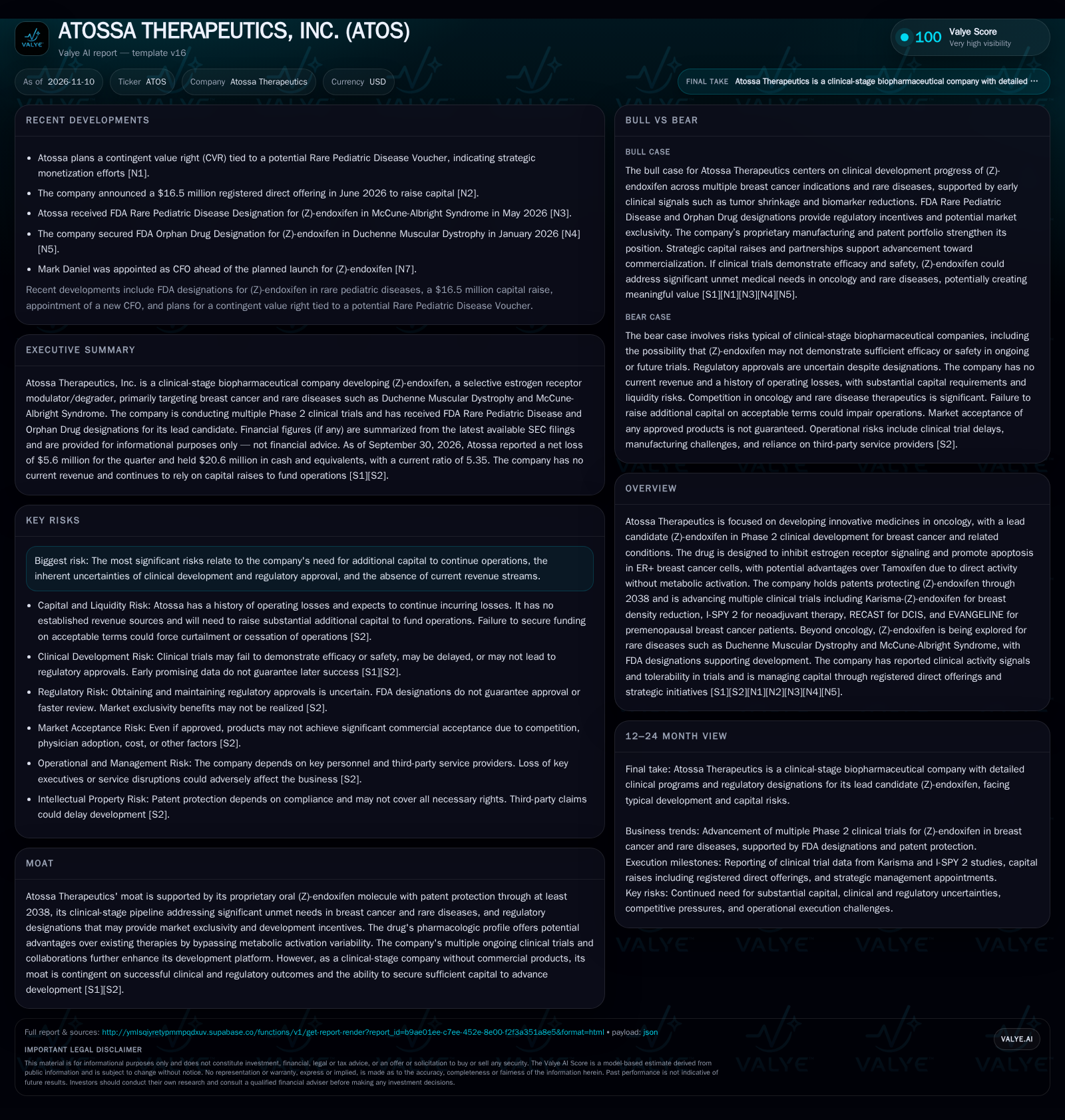
Atossa Therapeutics is a clinical-stage biopharma focused on (Z)-endoxifen for breast cancer and select rare diseases. Recent FDA designations, ongoing Phase 2 trials, and a $16.5M capital raise position the company for a pivotal period. Future value depends on clinical efficacy, regulatory success, and capital access, with patent protection through 2038 supporting potential exclusivity. However, continued losses, no revenues, and execution risks remain material challenges [S1] [S2] [N2] [N3] [N4] [N5].
Atossa Therapeutics stands at a crossroads typical of clinical-stage biopharmaceutical companies: its future will be determined by the interplay of clinical data, regulatory momentum, and the discipline of capital allocation. The company’s lead candidate, (Z)-endoxifen, is being developed for both high-incidence (breast cancer) and rare disease indications, with recent FDA designations potentially accelerating development and supporting market exclusivity. However, Atossa’s persistent operating losses, lack of current revenue, and ongoing reliance on capital markets underscore the risks inherent to its business model. The coming quarters are likely to reveal whether Atossa can convert scientific promise and regulatory incentives into durable value.
Recent FDA Designations, Capital Raise, and Clinical Pipeline: Why This Moment Matters
Atossa Therapeutics’ investment case is currently shaped by four pivotal developments. First, the company’s lead asset, oral (Z)-endoxifen, is advancing through multiple Phase 2 trials for breast cancer and rare diseases, with preliminary data showing anti-tumor activity, biomarker reductions, and tolerability [S1]. Second, Atossa secured FDA Rare Pediatric Disease and Orphan Drug designations for (Z)-endoxifen in Duchenne Muscular Dystrophy (DMD) and McCune-Albright Syndrome (MAS) in 2026, which may provide regulatory incentives such as market exclusivity and eligibility for a Priority Review Voucher [N3] [N4] [N5]. Third, the company raised $16.5 million in June 2026, reporting a cash position of $20.6 million and a current ratio of 5.35 as of September 30, 2026 [S2] [N2]. Fourth, a planned contingent value right (CVR) tied to a potential Rare Pediatric Disease Voucher signals intent to monetize regulatory assets if milestones are achieved [N1]. These facts define Atossa’s near-term risk and opportunity set: the company has meaningful clinical and regulatory momentum, but must deliver clear trial results and manage capital prudently in the absence of revenue.
Translating Clinical Progress into Economic Value: Business Model Dynamics
Atossa’s economics are currently defined by investment outflows, not inflows: the company has no commercial revenue and continues to operate at a net loss, reporting a $5.6 million loss for the quarter ended September 30, 2026, and an accumulated deficit of $270.3 million since inception [S2]. The core economic engine, if clinical and regulatory hurdles are cleared, would likely be a specialty pharmaceutical model: (Z)-endoxifen, as an oral small molecule for ER+ breast cancer and rare pediatric indications, would be positioned for premium pricing, particularly in the U.S. and other major markets with reimbursement frameworks favoring innovative oncology and orphan drugs.
Pricing power in rare diseases could be substantial if (Z)-endoxifen demonstrates strong efficacy and safety, especially given FDA designations that may confer market exclusivity and eligibility for a transferable Priority Review Voucher—a voucher that, if awarded, has historically fetched significant sums in the secondary market. In broader oncology, commercial success would depend on adoption by oncologists, payer acceptance, and differentiation from generic tamoxifen and newer targeted agents.
Fixed costs are dominated by R&D, clinical operations, and regulatory filings, with variable costs potentially low for manufacturing an oral small molecule. However, substantial commercial infrastructure or partnering would be necessary for launch. Capital needs remain high and unpredictable, dependent on trial timelines and regulatory outcomes. If Atossa can advance (Z)-endoxifen to approval and secure reimbursement, operating leverage could be significant—but this is conditioned on clinical success and market uptake.
Competitive Landscape: Differentiation, Substitution Risk, and Barriers to Entry
Atossa operates in intensely competitive segments: ER+ breast cancer is a crowded space with generics (tamoxifen), other SERMs, aromatase inhibitors, CDK4/6 inhibitors, and next-generation oral SERDs in development or on the market. The primary differentiator for (Z)-endoxifen is its direct activity without need for metabolic activation, theoretically reducing interpatient variability and overcoming resistance mechanisms linked to CYP2D6 polymorphisms [S1]. This may be attractive in subpopulations poorly served by tamoxifen, but widespread adoption will depend on clear superiority in clinical outcomes and safety.
In rare diseases like DMD and MAS, competition is less intense but not absent—multiple biotechs are pursuing novel therapies, and regulatory incentives attract well-capitalized entrants. Atossa’s patent estate for (Z)-endoxifen extends through at least 2038, providing a potential barrier to entry if the asset succeeds [S1]. However, larger competitors possess deeper resources, established commercial infrastructure, and more experience navigating regulatory and payer environments. Atossa’s competitive position is thus highly contingent: strong if clinical and regulatory milestones are met, but vulnerable to both late-stage clinical setbacks and rapid innovation by rivals.
If Clinical and Regulatory Dominoes Fall: Unlocking Value Through Efficacy, Exclusivity, and Monetization
The upside scenario for Atossa is predicated on a sequence of favorable events. If ongoing Phase 2 trials of (Z)-endoxifen deliver compelling efficacy and safety—especially in subgroups with unmet need—regulatory pathways could accelerate, supported by Rare Pediatric Disease and Orphan Drug designations. Approval in either breast cancer or a rare disease could unlock premium pricing, market exclusivity, and rapid uptake among targeted patient populations. A Priority Review Voucher, if awarded, could be monetized or used to expedite a future asset, providing non-dilutive capital [N1].
Confirmation would require positive top-line data from late-stage trials, FDA acceptance of filings, and initial commercial traction post-launch (if achieved). Evidence that would falsify this scenario includes failure to demonstrate meaningful clinical benefit, regulatory setbacks, or negative safety signals.
Most Probable Course: Incremental Progress, Ongoing Losses, and a Capital Markets Dependency
The most plausible path forward is one of incremental clinical progress, periodic capital raises, and continued net losses while Atossa advances (Z)-endoxifen through the clinical and regulatory gauntlet. Some trials may produce positive signals, warranting further study, but approval is likely several years away even if interim milestones are met. The company will remain reliant on equity or structured financings to fund operations, with dilution risk for current shareholders [S2] [N2].
This scenario would be confirmed by continued trial enrollment, additional capital raises, and a lack of revenue-generating approvals over the next 12-24 months. Falsification would come from either a major clinical failure (forcing a pivot or wind-down) or, conversely, an unexpectedly rapid and positive regulatory outcome.
When Clinical and Financial Headwinds Converge: Scenarios of Setback or Stagnation
The adverse scenario is characterized by one or more failed or inconclusive clinical trials, regulatory roadblocks, or inability to secure timely additional funding. Negative or equivocal data from ongoing Phase 2 studies could prompt program discontinuation or force Atossa to seek partnerships on unfavorable terms.
This scenario would be confirmed by negative clinical readouts, failure to raise capital, or management guidance signaling a strategic pivot or restructuring. The company’s historical accumulated deficit and lack of established commercial infrastructure magnify the risk of value impairment if clinical and financial momentum falters.
Milestones and Metrics That Will Define Atossa’s Next Chapter
Clinical trial readouts for (Z)-endoxifen in Karisma, I-SPY 2, RECAST DCIS, and EVANGELINE will be decisive; positive data would support regulatory filings and partnering potential.
Progress on FDA interactions: acceptance of filings, feedback on trial designs, and potential for accelerated review or Priority Review Voucher grant.
Updates on cash burn rate and capital-raising activities; a useful metric would be quarterly operating cash outflow if disclosed.
Any announced partnerships or licensing deals for commercialization or co-development, which would signal external validation and resource leverage.
Monitoring for clinical holds, safety signals, or unexpected trial discontinuations.
Evidence of payer or key opinion leader (KOL) engagement ahead of potential commercial launch.
Patent estate updates, including issuance of new claims or challenges to existing patents protecting (Z)-endoxifen.
Disclaimer: This is research-only, informational analysis and not investment advice. It may include AI-generated interpretation and general industry context. Always verify important details using primary sources.

Comments