
How American Integrity Leveraged Technical Expertise to Consolidate Its Florida Property Insurance Lead
American Integrity Insurance Group has skillfully combined data-driven underwriting, disciplined capital management, and targeted geographic expansion to reinforce its position in Florida’s volatile residential property insurance market.
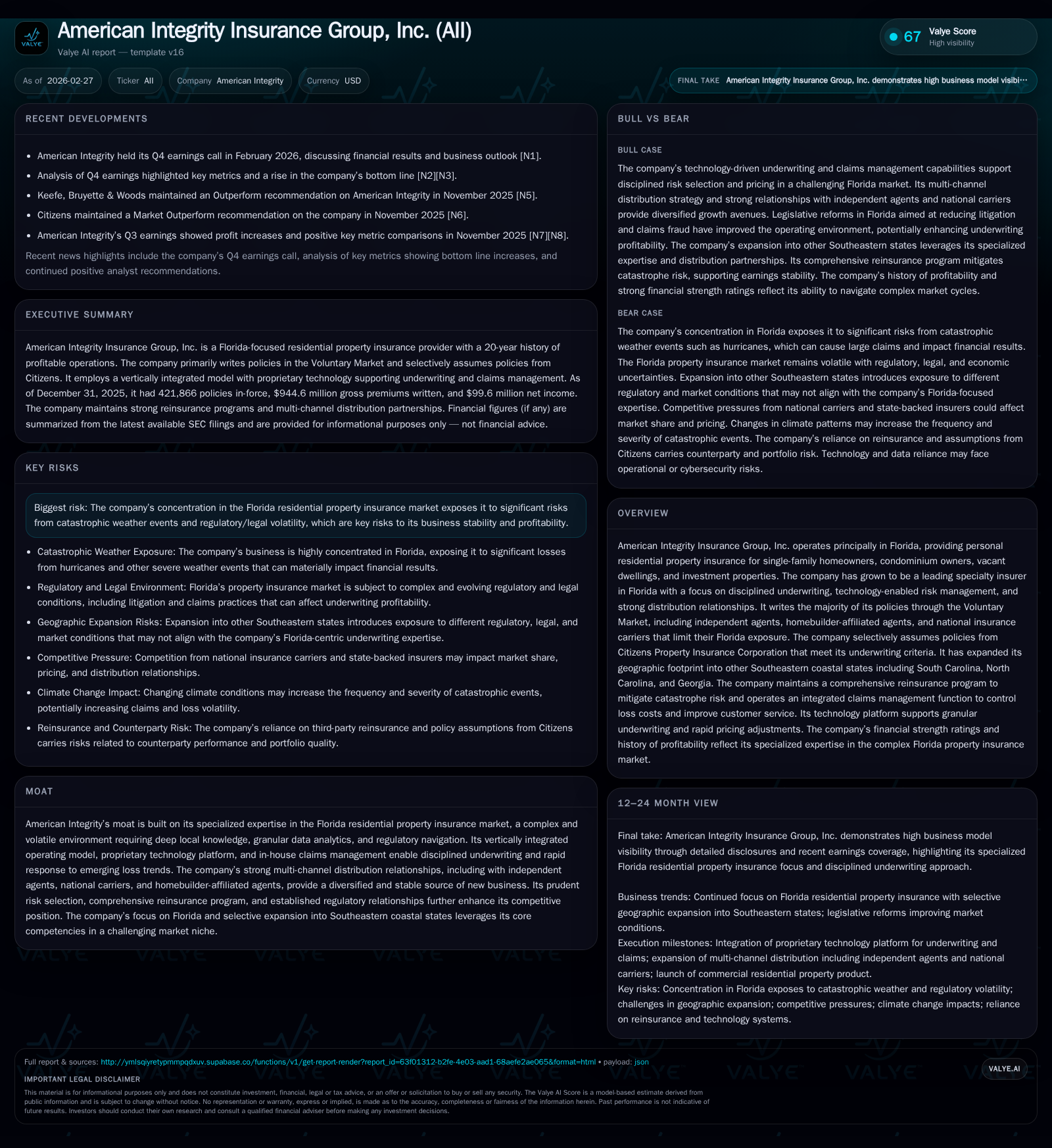
Founded in 2006 amid significant market disruption, American Integrity Insurance Group has grown into a leading Florida-focused personal residential property insurer. Leveraging specialized underwriting expertise supported by proprietary technology and detailed analytics, the company has achieved a consistent premium growth CAGR above 14%, navigating regulatory flux and weather event risks with disciplined capital allocation. Its recent expansion into adjacent Southeastern states builds on these core strengths, while legal reforms and claims environment improvements offer catalysts for sustainable profitability going forward.
Specialized Roots Fueling Historical Growth
Historical performance (annual)
| FY |
|---|
| 2025 |
Source: SEC companyfacts cache [F1].
American Integrity Insurance Group (AII), established in 2006 post the devastating Florida hurricanes of 2004–2005, was founded to capitalize on the resulting market dislocations as many national insurers retreated from the state [S1]. Since then, AII has emerged as a leading admitted carrier specializing predominantly in Florida's challenging personal residential property insurance segment — covering single-family homes, condominiums, vacant dwellings, and investment properties.
AII’s growth trajectory is underpinned by its commitment to deep local market knowledge and analytical underwriting rigor. The company has achieved a compound annual growth rate (CAGR) of approximately 10.4% in policies-in-force (reaching 421,866 by end-2025) alongside a robust 14% CAGR in gross premiums written ($944.6 million for calendar year 2025) [S1]. These figures reflect not only population-driven demand—the second fastest-growing state population nationally—but also AII's capacity to capture premium share amid complex risk environments.
The company's strategy focuses on disciplined underwriting profitability hurdles backed by proprietary data analytics that scrutinize risk through granular census block-level data. This fine-grained analysis allows real-time cat loss estimation and precise pricing adjustments responsive to both physical hazard metrics and behavioral underwriting signals [S28]. Being an admitted carrier means all rates and forms undergo regulatory approval, ensuring compliance but also requiring nimble competitive positioning.
Transformation of Key Growth Drivers over Recent Years
Over recent periods, AII's key growth drivers have shifted with changes in the legal environment and competitive landscape. Notably, Florida's legislative reforms enacted in late 2022 (SB 2A) eliminated one-way attorneys' fees—a significant catalyst reducing frivolous litigation related to non-hurricane claims [S6][S18][S27]. Through these reforms, AII recorded a striking approximate 70% decline in non-hurricane related claim lawsuits between December 2022–December 2023 [S6].
This reduction allowed AII to recalibrate its risk selection framework positively impacting loss severity trends despite the continuing elevation of catastrophe-exposed policy volumes. Competitive pressures also evolved as some national carriers cautiously re-enter or expand coverage while others remain restricted—AII capitalizes on this with its selective voluntary market focus leveraging strong agent relationships rather than dependence on state residual markets solely.
Furthermore, utilization of sophisticated actuarial models combined with monthly monitoring of rate filings across geographies enables agile pricing strategies — integral to navigating required regulatory filings which can disallow excessive or inadequate rates [S4][N1]. Such dynamic adjustments help align underwriting profitability targets amidst cyclical industry forces.
Strategic Expansion into Southeastern Coastal States
Building on core competencies developed in Florida's demanding environment, AII has selectively expanded operations into neighboring Southeastern coastal states: South Carolina, North Carolina (entry announced January 2026), and Georgia [S1][S4].
These markets share similar geographic risk profiles—coastal exposures influenced by hurricanes and severe weather—and thus benefit from AII’s refined underwriting systems. However, regulatory environments differ substantially among these states requiring dedicated market-entry vigilance.
AII employs its voluntary market-focused distribution strategy here as well, leveraging independent agents plus homebuilder-affiliated agencies accustomed to local building codes reflective of newer construction's resilience traits [S10][S24]. The company’s ability to transfer Florida-specific granular data modeling with integrated ratemaking intelligence fosters prudent risk acceptance while pursuing growth opportunities where price adequacy meets return thresholds.
Underwriting Discipline Amid Regulatory and Weather Risks
Central to AII’s enduring success is its vertically integrated model combining end-to-end control over underwriting, actuarial analysis, claims adjudication (via its subsidiary claims services entity), and reinsurance management [S16][S26]. This facilitates rigorous exposure management particularly given Florida’s susceptibility to hurricanes—as well as legislative volatility impacting policy non-renewals or rate adjustment timelines [S5][S9][S15].
The company employs high-standard reinsurance programs exclusively with counterparties rated "A-" or better by AM Best or fully collateralized recoverables ensuring capital protection against catastrophic event accumulations [S24]. Compliance disciplines manifest through annual Own Risk Solvency Assessment (ORSA) filings tailored for firms exceeding $500 million premium writing thresholds—applying stress testing scenarios incorporating legislative changes alongside catastrophe model updates [S18][S21].
Maintaining admitted status obliges frequent regulatory rate filing submissions subject to public scrutiny demanding balance between adequate premium recognition for risk versus market competitiveness. While supportive reforms have subdued claim frequency post-2022 legislation, the persistent rise in claim severity requires continuous refinement of underwriting algorithms integrating real-time third party data feeds alongside internal loss experience analytics [S29].
Distribution Partnerships as a Growth Backbone
A cornerstone of AII’s premium originations lies within its multifaceted distribution network composed mainly of approximately 1,300 independent agents who contribute nearly half of policies-in-force premiums ($479.4 million as of end-2025) [S10][S13][S17]. These agents are selectively appointed based on geographic competence aligned with AII’s underwriting priorities assuring quality business flows without saturating regions.
In addition to independent agents, fruitful partnerships exist with national carriers restricting their Florida exposure—such as Allstate, Liberty Mutual, Farmers—and homebuilder-affiliated agencies tied to major builders like D.R. Horton or Lennar enabling targeted access to new construction markets favored for compliance with modern building codes [S10][S24]. Commission structures are designed competitively yet aligned tightly with underwriting parameters encouraging retention of profitable client segments.
This multi-channel construct not only diversifies new business sources but also mitigates risks inherent in concentrating reliance on assumption policies from Citizens Property Insurance Corporation—a strategy employed selectively only when policies meet strict profitability screens [S23][S25].
Capital Allocation Practices: Returns, Cash Flows, and Shareholder Returns
American Integrity demonstrates conservative yet effective capital stewardship shaped by regulatory constraints typical for admitted carriers operating within catastrophe-prone sectors [F1][S7]. Shareholders’ equity stood at $337 million at year-end 2025 alongside cash & equivalents totaling approximately $204 million supporting liquidity buffers [F1].
The company reported net income of $20.9 million for FY2025 corresponding roughly to a return on equity near 6.2%, reflecting moderate profitability consistent with sector standards adjusted for catastrophe risk exposure [F1]. Operating cash flow after capex produced free cash flow exceeding $133 million reinforcing internal funding adequacy for ongoing growth investments without reliance on external debt; currently no material borrowings are noted but governance allows future indebtedness if opportune [F1][S7].
While explicit dividend or share repurchase programs were not detailed as of latest filings [F1], retained earnings have been consistently reinvested towards product innovation—such as the October 2025 debut of the commercial residential property product line—and enhancement of technological infrastructure crucial for maintaining competitive advantage [S4][N1].
2026 Outlook: What Investors Should Track
Though explicit forward-looking guidance remains limited publicly post-Q4 2025 disclosures [N1][N2], several development vectors merit close observation:
- The commercial residential property segment recently introduced aims to capture condominium associations within Florida’s coastal markets leveraging prior condo expertise—a promising adjunct revenue stream given growing association governance demands [S4];
- Legislative reform momentum will continue influencing claims environment stability; monitoring any potential reversals or additional regulatory impositions is vital given their direct impact on underwriting margins [S6][N1];
- The approaching hurricane seasons pose inherent volatility risk; updated catastrophe modeling outcomes reported quarterly via Pinnacle Analytics should be assessed for implications on loss reserves and reinsurance renewals [N1][S18];
- Rate filing approvals especially amid competitive pressures require tracking for margin recovery or preservation potential;
- Expansion progress into North Carolina coupled with scaling efforts across other Southeastern states will indicate successful transferability of proprietary technical underwriting capabilities beyond Florida’s unique ecosystem.
Risk Mitigation Through Reinsurance and Legal Navigations
The company’s comprehensive reinsurance program stands as a critical pillar safeguarding against extreme weather losses that characterize its core operating geography [S24]. Relationships exclusively maintained with A.M. Best "A-" or better rated reinsurers or fully collateralized contracts reduce counterparty default risk—a paramount consideration post-historic hurricane-related insured losses.
Furthermore, American Integrity actively adapts its ORSA process annually assessing enterprise-level risks including legal contingencies stemming from historically litigious Florida property insurance climate [S18]. Post-2022 legislative reforms ameliorated some prior adverse incentives fueling excessive attorney fee claims by plaintiffs but residual uncertainties remain necessitating proactive reserve calibration.
The evolving legal landscape demands continual engagement with regulators and adherence to enhanced reporting mandates such as those introduced by NAIC amendments governing holding company systems—efforts that improve transparency yet raise compliance costs impacting operational expense structures over time [S21][S29].
This analysis is prepared solely for informational purposes based on available public disclosures as of early 2026; it does not constitute investment advice nor recommendations.
Disclaimer: This is research-only, informational analysis and not investment advice. It may include AI-generated interpretation and general industry context. Always verify important details using primary sources.

Comments