
Allegion's Q2 Strength Highlights Resilient Security Hardware Demand and Integration Challenges
Allegion posts robust Q2 2026 results driven by pricing, volume growth, and acquisitions amid ongoing supply chain and restructuring costs.
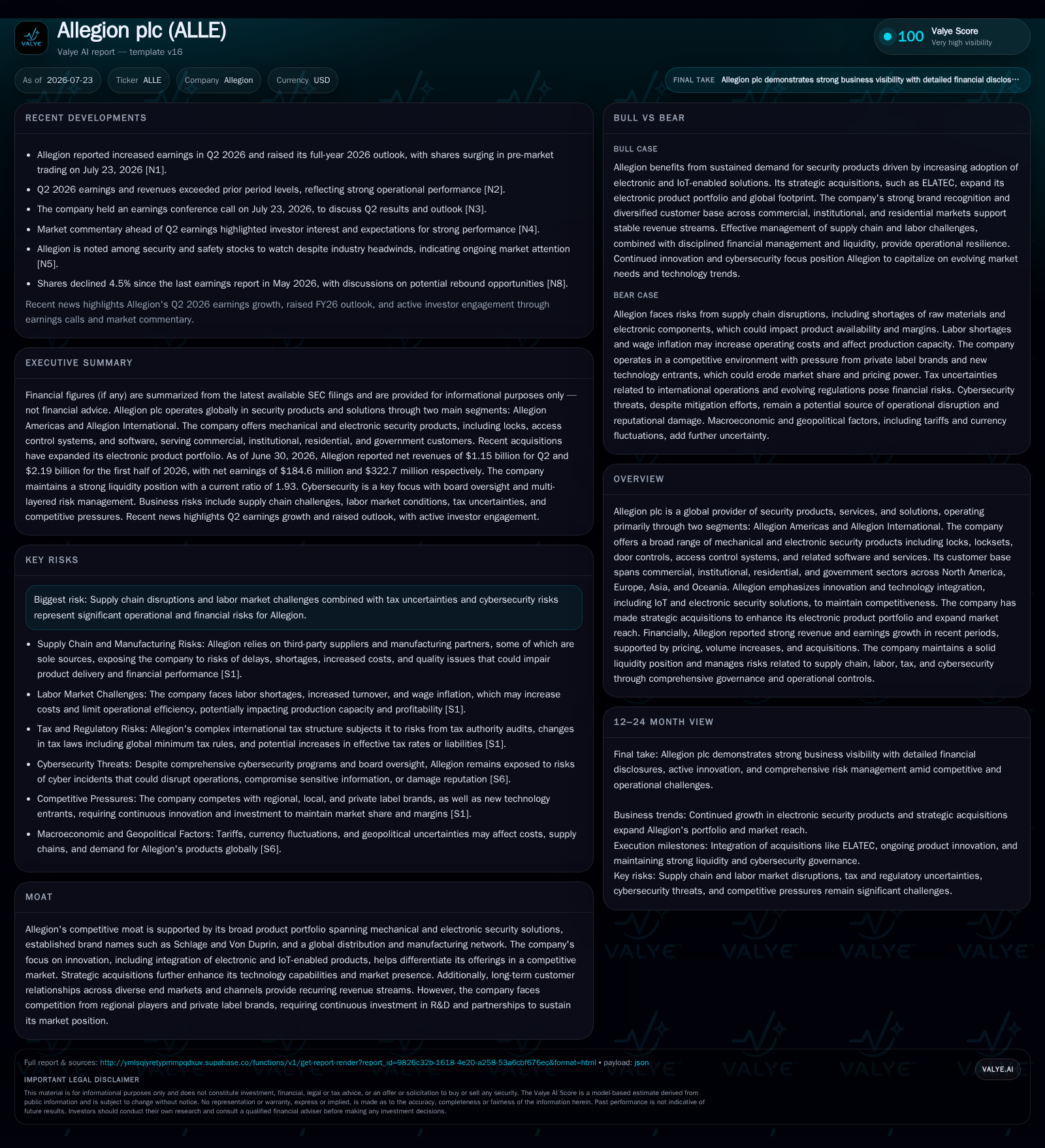
Allegion plc's latest quarterly filing reveals strong operating income growth fueled by favorable volume/product mix, improved pricing, and recent acquisitions, demonstrating resilience in the industrial hardware and security solutions sector. The company's strategic acquisition of Door Components, Inc. expands its product breadth in commercial door hardware, while restructuring efforts seek to optimize costs amid inflationary pressures. Allegion faces ongoing risks from supply chain disruptions, competitive pressures, and tax uncertainties but leverages its broad mechanical and electronic security portfolio to maintain market relevance. Key near-term focus includes successful integration of acquisitions, sustaining margin expansion through pricing and productivity, and navigating geopolitical cost headwinds.
Recent Operating Update
Allegion plc reported strong second-quarter 2026 results on July 23, with net revenues rising approximately 12.7% year-over-year to $1.15 billion, up from $1.02 billion in Q2 2025 [S2]. This growth was driven by higher product sales totaling $958.9 million and expanded service and software revenues of $63.1 million, reflecting sustained demand in commercial and institutional construction markets alongside strategic pricing initiatives
Operating income increased 16% to $254.7 million, lifting the operating margin to 22.1% from 21.5% a year earlier [S2][S9][S15]. This margin expansion was supported by effective price realization and productivity improvements that offset inflationary pressures on raw materials, labor, and logistics. However, the operating results were partially tempered by $8.5 million in restructuring charges related to workforce reductions and integration costs from recent acquisitions, as well as foreign currency headwinds impacting international operations
In March 2026, Allegion completed the acquisition of Door Components, Inc [S4]. (DCI) for approximately $70 million, expanding its commercial door hardware portfolio within the Allegion Americas segment. DCI specializes in custom, quick-ship hollow metal doors and frames serving industrial, commercial, and institutional customers primarily in the U.S., complementing Allegion’s existing mechanical locksets and door hardware offerings
The company continues to navigate supply chain challenges, including material shortages and freight cost inflation, by leveraging strategic supplier contracts and manufacturing productivity enhancements. These efforts aim to mitigate cost pressures while maintaining product availability and customer service levels [S1][S20].
Business Model Overview
Allegion operates globally through two main segments: Allegion Americas and Allegion International. It designs, manufactures, and distributes a broad portfolio of mechanical locks, locksets, door controls (such as exit devices), and electronic access control systems enhanced with IoT-enabled security features. The company also offers access management software and aftermarket services including installation, maintenance, and system upgrades [S1][S2].
Revenue is predominantly generated from product sales, which represent roughly 90% of total net revenues, with the remainder coming from services and software contracts that provide recurring revenue streams [S2][S9]. This mix supports operating margin stability by adding annuity-like revenue components less sensitive to construction market cyclicality
Allegion’s pricing power is underpinned by strong brand recognition—particularly through mechanical lock brands such as Schlage and Von Duprin—and its innovation in electronic access control solutions that address growing demand for integrated, smart building security systems. The company’s extensive distribution network includes wholesale distributors, specialty installers, OEMs, and direct institutional partnerships, enabling broad market reach across commercial, institutional, residential, and government customers.
The integration of mechanical and electronic security platforms allows Allegion to cross-sell complementary products and services, positioning it favorably against competitors focused on either mechanical or electronic niches alone.
Industry Structure and Competitive Position
Within the industrial hardware and security solutions sector, Allegion competes with global peers such as Assa Abloy and dormakaba, both of which offer integrated mechanical and electronic security products. The competitive landscape also includes regional manufacturers and private label brands that often compete on price or specialized product features.
Allegion’s scale provides procurement advantages that help mitigate volatility in raw material costs, a significant industry challenge given recent inflationary trends in metals and electronic components. Its broad installed base and recurring aftermarket service revenues create customer switching costs that support retention despite intensifying competition [S1]
Supply chain disruptions and labor shortages remain industry-wide risks, but Allegion’s focus on supply chain management and productivity improvements aims to sustain operational continuity. Currency fluctuations continue to exert pressure on margins due to the company’s multinational footprint [S20].
Growth Drivers
Key structural trends supporting Allegion’s growth include:
- Adoption of IoT-Enabled Security Solutions: Increasing demand for connected access control systems integrated with cloud-based management platforms drives upgrades to electronic locks and security ecosystems.
- Commercial Construction and Remodeling: Growth in office, healthcare, and institutional building projects fuels demand for both new mechanical hardware and advanced electronic security installations.
- Regulatory Compliance: Enhanced building codes and safety regulations increase baseline demand for fire exit devices and restricted access solutions.
- Replacement Cycles: Aging infrastructure prompts retrofit projects replacing legacy mechanical locks with integrated electronic systems offering improved auditability and user control.
- Strategic Acquisitions: The acquisition of DCI expands Allegion’s addressable market within complementary architectural hardware categories.
- Expansion of Aftermarket Services: Growing installation, maintenance, and software licensing contracts provide recurring revenue streams that stabilize margins and reduce exposure to construction cyclicality.
Risks and Watchpoints
Several factors warrant monitoring given their potential impact on Allegion’s operating results:
- Macroeconomic Cyclicality: Demand is sensitive to fluctuations in construction and remodeling activity, which vary regionally based on economic conditions.
- Supply Chain and Labor Constraints: Continued shortages or cost inflation in raw materials, components, and labor could pressure margins despite mitigation efforts.
- Competitive Pricing Pressure: Regional competitors and private label brands may challenge pricing power, especially if cost pass-through to customers is limited.
- Tax and Regulatory Uncertainty: Complex international tax structures expose Allegion to audit risks and potential liabilities that could affect net profitability [S1].
- Technology and Cybersecurity Risks: Expansion into software and IoT-enabled products increases exposure to cybersecurity vulnerabilities and potential remediation costs.
- Acquisition Integration Risks: Successful assimilation of acquisitions like DCI is critical to realizing expected synergies and margin accretion.
What to Watch Next
Key near-term indicators to assess Allegion’s operational trajectory include:
- Trends in order backlog, particularly from large commercial and institutional projects, signaling demand momentum.
- New product launches emphasizing IoT-enabled electronic access control innovations reflecting R&D effectiveness.
- Progress and cost impact of restructuring initiatives aimed at operational simplification.
- Currency exchange rate movements affecting international earnings and margin profiles.
- Integration milestones and revenue contributions from the Door Components acquisition.
- Raw material and freight cost trends influencing gross margin sustainability.
- Changes in effective tax rates driven by international tax developments or discrete audit outcomes.
Financial Profile Discussion
As of June 30, 2026, Allegion reported cash and cash equivalents of approximately $356 million against total debt of about $2.04 billion, resulting in net debt near $1.68 billion [F1][S2]. The company maintains a healthy current ratio of approximately 1.93x, indicating solid short-term liquidity and working capital coverage
The debt profile is primarily composed of fixed-rate senior notes, complemented by a revolving credit facility providing up to $1 billion in flexible funding capacity [S11][S13][S27]. Allegion remains in compliance with all debt covenants, supporting financial flexibility to fund acquisitions, capital expenditures, and shareholder returns
Overall, the balance sheet strength underpins Allegion’s ability to pursue strategic growth initiatives while managing inflationary cost pressures through pricing and productivity improvements.
This analysis is based solely on information publicly disclosed by Allegion plc as of July 23, 2026 [S2][S3][S4] combined with general industry knowledge relevant at that time. It does not constitute investment advice or research views.
Disclaimer: This is research-only, informational analysis and not investment advice. It may include AI-generated interpretation and general industry context. Always verify important details using primary sources.

Comments