
WEX’s Debt-Fueled Fleet Management Expansion and Repurchase Strategy Shape 2026 Outlook
WEX leverages technology-driven fleet payment solutions amid elevated leverage and strategic share buybacks.
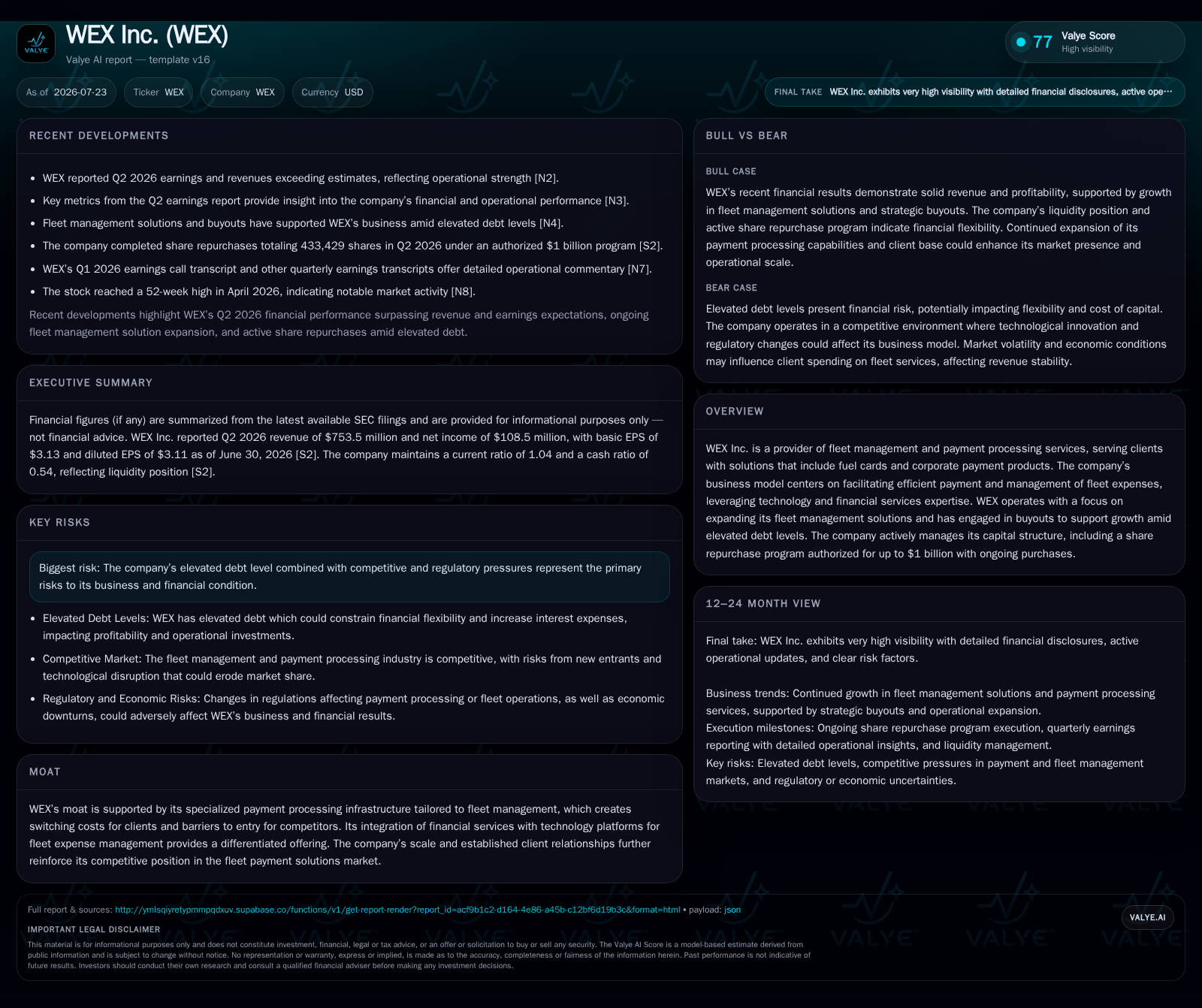
In its latest quarterly filing, WEX Inc. reported operational resilience in its fleet management and payment processing services despite elevated debt levels that continue to influence capital allocation priorities. The company’s business model, rooted in integrated fuel cards and corporate payment platforms, generates revenue from transaction and finance fees, benefiting from strong client retention and switching costs. Growth is supported by strategic acquisitions and increasing commercial fleet complexity, though competitive, regulatory, and leverage risks merit close monitoring. WEX’s share repurchase program signals confidence but adds pressure on cash flow management going forward.
Recent Operating Update: Resilience Amid Elevated Leverage
WEX Inc.’s Q2 2026 10-Q filing highlights continued operational strength in its core fleet management and payment processing businesses, with stable transaction volumes supporting growth in fee income despite macroeconomic headwinds [S2]. The company’s integrated fuel card and corporate payment platforms generate revenue primarily through transaction fees and finance fees tied to credit products extended to commercial fleet operators [S1]. As of June 30, 2026, WEX reported total debt of approximately $3.6 billion, offset by cash and equivalents of about $1.16 billion, resulting in net debt near $2.45 billion and a current ratio of 1.04, indicating tight liquidity buffers amid elevated leverage [F1].
During Q2 2026, WEX repurchased over 433,000 shares at an average price of $138.43 per share under a new authorization permitting up to $1 billion in share repurchases with no expiration date, signaling management’s commitment to capital return alongside growth investments [S2]. Executives also adopted Rule 10b5-1 trading plans to enhance transparency around insider transactions [S2].
Business Model: Fee-Based Fleet Payment Solutions with Embedded Switching Costs
WEX operates at the intersection of financial services and technology, delivering specialized payment processing and fleet management solutions tailored to commercial fleet operators’ fuel and expense management needs [S1]. Its core offerings include fuel cards and corporate payment products that facilitate efficient transaction workflows and embed expense controls within a unified payment platform. Revenue is generated primarily from transaction fees charged per dollar spent on these payment instruments, combined with finance fees derived from credit extended to clients [S1].
The company’s platform integrates account servicing capabilities, providing detailed reporting and analytics that enhance client retention by creating operational switching costs. These costs arise from the complexity of integrating WEX’s payment solutions into fleet operations and expense management processes, making client churn less likely. WEX typically serves sizable commercial operators whose fleet expenses constitute significant cost centers, driving demand for efficiency and control [S1]. This specialization differentiates WEX from generalist payment processors and fintech firms lacking fleet domain expertise.
Industry Structure and Competitive Positioning
WEX competes within a financial services ecosystem that includes payment processors, fleet management solution providers, corporate card issuers, and fintech innovators. Peers such as FleetCor operate similar fleet-focused payment networks, though differences exist in scale, geographic reach, and product breadth. WEX’s competitive moat is supported by its proprietary technology infrastructure tailored to fleet-specific expense management, which is not easily replicated by newer entrants focused solely on corporate payments or fintech user experience enhancements.
Entrenched client relationships, often secured through multi-year contracts, contribute to high net revenue retention rates, bolstered by cross-selling opportunities across WEX’s product portfolio [S1]. These factors create barriers to customer churn and provide pricing power to raise fees in line with delivered value. However, competition remains active from fintech disruptors innovating on corporate card issuance and traditional banks expanding electronic payment services targeting fleet operators.
Growth Drivers: Fleet Complexity and Integrated Payments Demand
Structural industry trends underpin WEX’s growth outlook. Commercial fleets are expanding in size and operational complexity, driven by growth in logistics and transportation sectors. This expansion increases demand for telematics-enabled expense oversight tools integrated into payment platforms, a capability WEX continues to develop [S1]. Regulatory trends favoring electronic payments and rising fuel prices further incentivize clients to adopt tightly managed spending controls facilitated by WEX’s solutions.
Strategic acquisitions have been instrumental in broadening WEX’s service offerings and market presence. Recent buyouts, partially funded through leverage, have enhanced capabilities in data analytics and customer servicing—areas critical for increasing wallet share among existing clients and attracting new accounts [N9], [S15]. The adoption of cloud-based services enables scalable integration, deepening customer stickiness by embedding WEX’s platform more thoroughly into fleet operations.
Risks and Watchpoints: Leverage Pressure and Competitive Evolution
Despite operational momentum, WEX faces risks primarily related to its elevated leverage, which constrains financial flexibility and heightens sensitivity to interest rate fluctuations [S2], [S12]. Debt servicing obligations consume significant cash flow, limiting the company’s ability to pursue acquisitions or invest aggressively in technology without additional refinancing or deleveraging.
Competitive pressures arise as traditional banks modernize corporate card offerings with electronic payment functionalities that could encroach on WEX’s niche, while fintech competitors innovate on user experience and platform capabilities, challenging legacy models. Regulatory changes affecting payment processing fees or compliance requirements introduce uncertainty that could impact contract economics.
Technology platform security is a critical concern amid rising cyber threats targeting financial service providers. Any significant disruption could undermine client trust and materially impair service delivery.
What to Watch Next: Transaction Volumes and Capital Allocation Execution
Key near-term indicators include transaction volume trends, which directly influence fee income trajectories, and net revenue retention rates, which reflect client loyalty amid competitive pressures [S6], [N3]. The success of recent acquisition integrations will also be pivotal in validating growth strategies financed amid elevated debt.
On the capital allocation front, monitoring the pace and scale of share repurchases under the $1 billion authorization will provide insight into management’s confidence and priorities. Balancing cash deployment between debt reduction and shareholder returns will be critical, especially given the leverage profile. Refinancing activities or shifts in debt maturity schedules could materially affect WEX’s financial risk posture.
Financial Profile Discussion
As of June 30, 2026, WEX held approximately $1.16 billion in cash and equivalents against $3.6 billion in total debt, resulting in net debt near $2.45 billion and a current ratio of 1.04, indicating limited liquidity buffers [F1]. These metrics underscore the importance of effective cash flow management and refinancing strategies to maintain operational flexibility.
This analysis synthesizes the latest SEC filings and secondary sources to evaluate WEX Inc.’s operational position within the financial services-focused fleet payment solutions industry. It highlights how elevated leverage shapes capital allocation and growth strategies, while technology integration and embedded switching costs support durable client relationships amid evolving regulatory and competitive landscapes.
Disclaimer: This is research-only, informational analysis and not investment advice. It may include AI-generated interpretation and general industry context. Always verify important details using primary sources.

Comments