
StoneBridge Acquisition II: SPAC Thesis Hinges on Sourcing and Executing a Cross-Border Deal Before Deadline
With $57.5 million in trust and a focus on high-growth sectors across APAC and EMEA, StoneBridge Acquisition II faces a familiar SPAC clock: execution risk, target competition, and the challenge of creating post-merger value for public shareholders.
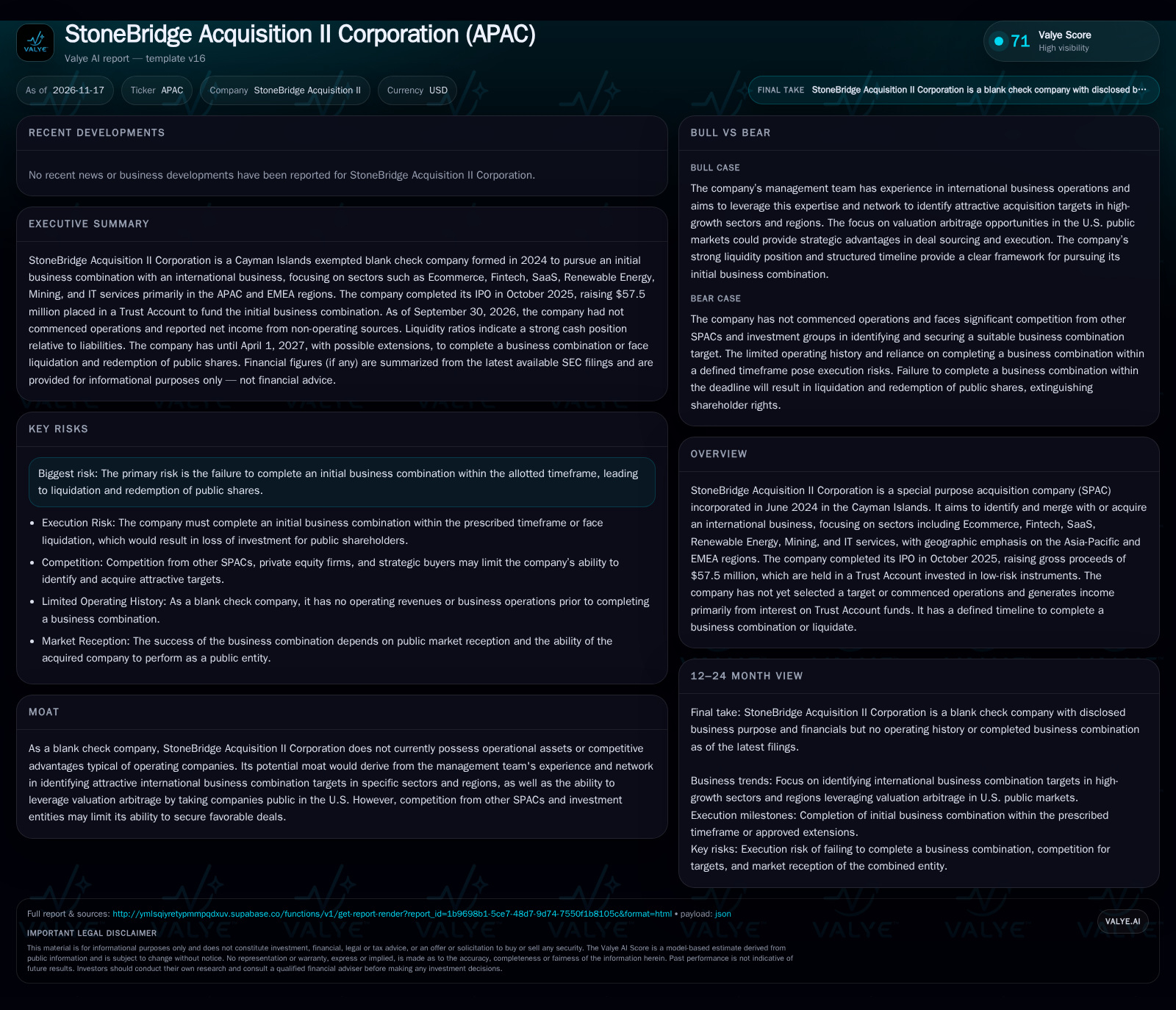
StoneBridge Acquisition II is a newly public SPAC with $57.5 million in trust, targeting international businesses in sectors like Ecommerce, Fintech, SaaS, Renewable Energy, Mining, and IT/IT-enabled services. The company has yet to announce a business combination, and its investment thesis rests on management’s ability to secure an attractive cross-border deal—before the April 2027 deadline or face liquidation. SPAC market competition, valuation discipline, and target selection will be critical to long-term value.
StoneBridge Acquisition II Corporation is a blank check company with $57.5 million in trust, seeking to merge with an international business in sectors like Ecommerce, Fintech, SaaS, Renewable Energy, Mining, or IT services. With a defined 18- to 24-month window from its October 2025 IPO to identify and close a deal, the SPAC’s future hinges entirely on its ability to source, negotiate, and consummate a business combination that can unlock value in the U.S. public market. The next year will test the management team’s network, deal discipline, and ability to stand out in a crowded field of global SPACs and investment vehicles.
IPO Proceeds, Timeline, and the Absence of a Target: Where StoneBridge Stands Today
As of November 2026, StoneBridge Acquisition II Corporation has completed its IPO, raising $57.5 million via the sale of 5,750,000 units, with all net proceeds held in trust and invested in U.S. government treasuries or money market funds [S2]. The company has not yet selected a business combination target or commenced operating activities, and its reported net income of $402,916 for the latest period is attributable solely to interest earned on trust assets [S2]. The SPAC faces an 18-month deadline (April 1, 2027), extendable by up to six months, to close a merger or acquisition, after which it must liquidate and return the trust proceeds to shareholders [S2]. With its units, shares, and rights listed on Nasdaq, StoneBridge is positioned as a vehicle for cross-border public listings—but its trajectory will be defined by the next deal, not the current balance sheet.
How a SPAC Like StoneBridge Creates—or Destroys—Shareholder Value
StoneBridge Acquisition II’s business model is fundamentally transactional: the company generates no revenue from operations until a business combination is completed. Until then, its economics are limited to interest on trust account assets, which are designed to preserve capital rather than generate meaningful returns. The real value creation (or destruction) occurs through the selection, valuation, and negotiation of an acquisition target. If the chosen company is acquired at an attractive price, has a credible growth story, and is well-received by public investors, StoneBridge can unlock value for shareholders through share appreciation and potential warrant/rights conversion. Conversely, overpaying for a target, poor execution, or adverse market conditions can lead to post-merger underperformance—a common SPAC pitfall.
SPAC operating leverage is extremely high: fixed costs are modest prior to a deal, but post-combination expenses can ramp quickly depending on the acquired entity’s scale and capital needs. The funding model is capital-efficient until a transaction, but post-merger capital structure (including potential PIPE financing, debt, or equity dilution) becomes critical. The economics for original SPAC investors are also shaped by redemption rates and the ability to retain cash in trust through the merger process—a dynamic that can impact the target’s balance sheet and growth capacity.
Sourcing Advantage or Commodity SPAC? Assessing StoneBridge’s Edge in the Crowded Acquisition Market
StoneBridge operates in a highly competitive SPAC landscape, where hundreds of blank check companies and private equity funds are vying for a limited pool of attractive targets—especially in high-growth verticals like Ecommerce, Fintech, and SaaS. While the company’s stated focus on international businesses in APAC and EMEA and its intent to exploit valuation arbitrage via U.S. public listings offer a differentiated sourcing thesis, these advantages are theoretical until a specific deal is announced.
The management team’s international experience and network may provide access to proprietary deal flow or local-market insights, but such advantages are difficult to quantify in advance. Ultimately, StoneBridge’s competitive position will be determined by its ability to identify a target with strong fundamentals, negotiate favorable terms, and avoid the pitfalls of overbidding or adverse selection. The absence of a binding target at this stage means that StoneBridge’s moat is potential rather than actual, and its competitive edge—if any—will only become clear at the deal announcement and execution stage.
Unlocking Arbitrage: How a Well-Chosen Target Could Drive Outperformance
The most favorable scenario for StoneBridge is the identification and execution of a business combination with a high-growth international company that is undervalued in its home market but can command a premium in the U.S. public markets. Such a transaction could exploit valuation arbitrage, attract PIPE investors, and generate strong post-merger trading, benefiting both original SPAC shareholders and the acquired company’s stakeholders.
This upside would be confirmed by the announcement of a compelling target in a sector with robust secular growth, evidence of strong financials and management, and limited redemptions at the merger vote. Additional confirmation would come from a successful PIPE raise (if pursued), positive public market reception, and the achievement of post-merger growth milestones. Falsification would occur if the announced target is met with high redemption rates, weak PIPE interest, or post-merger underperformance relative to sector peers.
Most Likely Trajectory: Sourcing a Target Amid Intense Competition and Execution Risks
The most plausible outcome is that StoneBridge identifies a viable business combination candidate in its stated sectors and regions, but faces significant competition from other SPACs and private investors. The deal is likely to be completed close to the deadline, with moderate redemptions and a need for supplementary financing. Post-merger performance may be mixed, reflecting both the quality of the target and broader market conditions for de-SPAC’d companies.
Evidence supporting this scenario would include a late-stage deal announcement, measurable but not overwhelming shareholder redemptions, and the need for PIPE or other external capital to close. Confirmation would come from a successful merger closing, the target’s initial public market performance tracking sector benchmarks, and manageable integration or reporting challenges. Falsification would occur if the SPAC fails to announce a deal, faces overwhelming redemptions, or is forced to liquidate due to inability to close within the allotted timeframe.
Deal Deadlines and Competitive Pressures: How the SPAC Thesis Can Unravel
The most adverse scenario is that StoneBridge is unable to source or close a business combination before the April 2027 deadline (or the six-month extension, if used). This could result from a combination of factors: intense competition for targets, unattractive deal economics, macro volatility, or failure to secure PIPE or shareholder support. In this case, the company would be forced to liquidate, returning the trust proceeds to shareholders and extinguishing any further upside.
This scenario would be confirmed by an absence of deal announcements deep into 2027, public filings indicating failed negotiations or PIPE shortfalls, and a final liquidation notice. Falsification would require a credible deal announcement and progress toward closing well ahead of the deadline.
Milestones That Will Define Whether StoneBridge Delivers Shareholder Value
Announcement of a definitive business combination agreement, including the sector, geography, and valuation multiples of the target.
Level of shareholder redemptions at the business combination vote—a key indicator of investor confidence and trust account cash retention.
PIPE (private investment in public equity) commitments, if any, and the terms/scale of such financings (if disclosed).
Public market performance of the post-merger entity relative to sector benchmarks and peer de-SPACs (would help test the thesis).
Progress toward regulatory and shareholder approvals, as indicated by SEC filings and proxy materials.
Any extensions to the original deal deadline and the disclosed rationale or impediments.
Management’s ability to articulate and deliver on post-merger growth milestones, such as revenue targets or geographic expansion (if disclosed).
Material changes in SPAC market sentiment or regulatory environment impacting deal closure or post-merger trading.
Disclaimer: This is research-only, informational analysis and not investment advice. It may include AI-generated interpretation and general industry context. Always verify important details using primary sources.

Comments