
Avient’s Turnaround Struggles Highlight the Challenges of Specialty Materials Innovation
Avient Corporation’s 2025 financials reveal revenue growth alongside squeezed profitability, underscoring operational challenges and sector-specific risks.
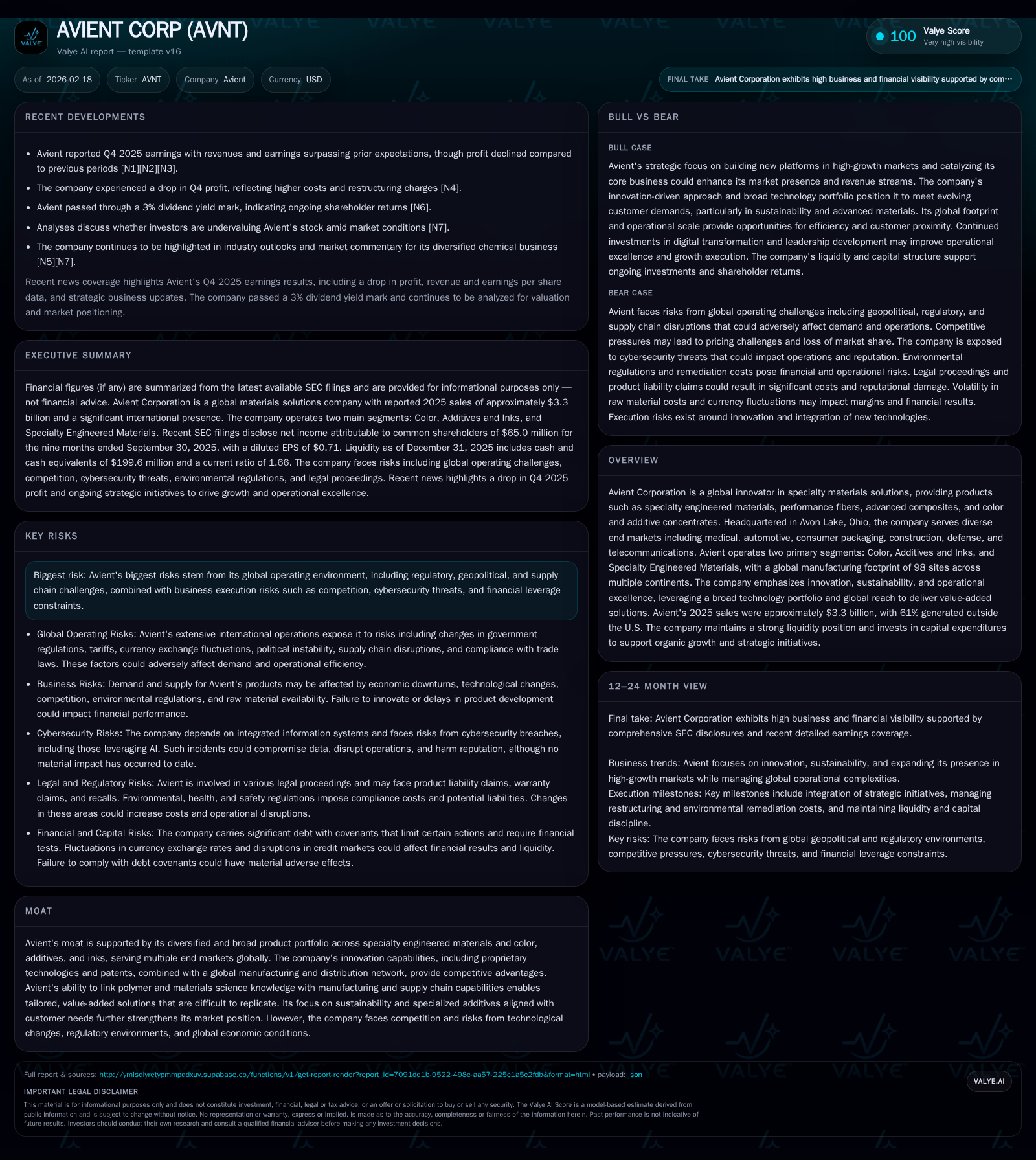
Avient Corp, a global specialty materials innovator, reported modest revenue growth of 1.7% in 2025 but faced a sharp contraction in operating income (-38.2%) and net income (-51.7%), signaling margin pressures amid raw material cost inflation and execution hurdles. The company’s capital structure remains solid with substantial liquidity and proactive debt prepayment, yet persistent geopolitical and regulatory headwinds pose ongoing risks to the diversified business footprint. While Avient’s innovation pipeline and sustainability initiatives offer growth potential, investors should monitor margin recovery, supply chain stability, and quarterly performance milestones for signs of operational resilience.
From Stable Sales to Profit Volatility: A Snapshot of Avient’s Recent Financial Performance
In fiscal year 2025, Avient Corporation delivered revenue of approximately $3.26 billion—a year-over-year increase of about 1.7%—signifying continued demand across its diverse industrial end markets such as medical devices, automotive components, consumer packaging, construction materials, defense applications, and telecommunications infrastructure [F1][S22]. This top-line stability unfolded against a backdrop of significant earnings volatility: operating income plummeted by a steep 38.2% from $329.3 million in 2024 down to $203.5 million in 2025, while net income contracted by over half (51.7%) to just under $82 million [F1].
This divergence between revenue growth and profit erosion highlights that Avient faced pronounced margin pressures during the year. The compression reflects an uneven ability to implement price increases for proprietary specialty polymers and additives amidst rapid raw material cost inflation—a common dynamic within engineered materials markets where feedstock prices can outpace contract repricing frequency or pass-through mechanisms [N1][S1]. Furthermore, increased operational expenses including incentive compensation costs recorded notably in Q4 exacerbated profitability challenges [N1]. These factors collectively pushed Avient into a profit squeeze despite ongoing sales expansion.
Historical performance (annual)
| FY | Net ($mm) | CFO ($mm) | OpInc ($mm) | Capex ($mm) | Net YoY |
|---|---|---|---|---|---|
| 2025 | 82 | 302 | 204 | 107 | -51.7% |
| 2024 | 170 | 257 | 329 | 122 | +123.9% |
| 2023 | 76 | 202 | 197 | 119 | -89.2% |
| 2022 | 703 | 398 | 243 | 106 |
Note: Omitted columns lack sufficient annual XBRL coverage in the provided tags (need ≥2 annual points): Rev. Source: SEC companyfacts cache [F1].
Capital returns and efficiency (annual)
| FY | Div ($mm) | Buybacks ($mm) | FCF ($mm) |
|---|---|---|---|
| 2025 | 99 | 195 | |
| 2024 | 94 | 0 | 135 |
| 2023 | 90 | 0 | 82 |
| 2022 | 87 | 36 | 293 |
Source: SEC companyfacts cache [F1].
Note: Revenue historical data prior to FY2018 is not directly comparable due to differing reporting periods; operating cash flow YoY computed for available years; buybacks omitted due to lack of recent activity
Dissecting the Decline: Operational and Market Drivers Behind Avient’s Profit Squeeze
The disproportionate erosion of profitability relative to sales gains reflects industry-specific cost push factors compounded by operational execution challenges detailed during the Q4 earnings call commentary [N1] as well as analyst reports [N2][N3]. Key drivers include:
Raw Material Inflation: Specialty polymers depend heavily on petrochemical feedstocks whose input prices surged disproportionately in late cycles vs prior years. Avient's ability to pass these rising costs through was muted by slower contract resets and competitive pricing pressures.
Segment Performance Variability: Both primary segments—Color, Additives and Inks along with Specialty Engineered Materials—contributed differently to margin contraction. The latter segment’s composites development is capital-intensive with longer product cycles affecting near-term returns [S22].
Supply Chain Disruptions: Persistent global logistical constraints increased freight and working capital requirements impacting manufacturing efficiencies [S1][N1].
Increased Incentive Compensation & Restructuring Charges: These one-time or variable costs surged toward year-end as per company disclosures impacting operating expenses unfavorably relative to stabilized sales volume [N1][S21].
Competitive Pricing Dynamics: The specialty additives market is marked by concentrated raw material suppliers limiting upward price flexibility for producers like Avient given global competition.
Together these factors conspired to pinch operating margins even as Avient grew revenues modestly.
Growth Outlook Under Crosswinds: Innovation, Sustainability, and Competitive Pressures
Looking ahead into calendar year 2026, Avient’s growth prospects are layered with complexities shaped by innovation-driven aspirations tempered against external market realities:
Innovation Pipeline: The company emphasizes advanced composites research targeting lightweighting solutions demanded by transportation and defense customers seeking enhanced performance-to-weight ratios [S22]. Ongoing development at Innovation Centers in the US and Europe underscores this strategy.
Sustainability-Focused Additives: Regulatory pressure on environmental impact aligns with increasing demand for bio-based polymers and sustainable colorant technologies—areas where Avient is channeling R&D resources [N4][S1]. Such offerings carry potential pricing premiums but require continuous development investment.
Competitive Landscape: Global competition includes firms unconstrained by western regulatory regimes (e.g., less stringent chemical safety laws), pressuring global pricing structures particularly in Asia-Pacific markets where inorganic growth opportunities also exist.
Customer Demand Uncertainty: Macroeconomic headwinds affecting end-markets such as automotive manufacturing volumes or packaging consumption could cap volume expansion given cyclicality typical in specialty materials sectors.
Management articulates cautious optimism contingent on mitigating raw material volatility while accelerating new product commercialization as key growth levers moving forward [N4].
Global Footprint Risks: Regulatory and Geopolitical Headwinds Impacting Avient’s Operations
With approximately 61% of sales generated outside the United States across multiple continents (Americas excluding US/Canada; Europe; Asia), the company's vast geographic footprint exposes it to a complex web of risks documented extensively in SEC risk disclosures [S1]:
Trade Policy Volatility: Changes such as tariffs or altered trade agreements could adversely impact import/export cost structures especially for polymer resins sensitive to global commodity flows.
Regulatory Compliance Complexity: Adherence to evolving chemical regulations (e.g., REACH in Europe), data privacy laws (GDPR), anti-corruption statutes (FCPA/U.K Bribery Act), requires robust governance efforts potentially increasing overhead.
Political & Economic Instability: Operations in emerging markets face risks from labor unrest or sudden policy shifts which may disrupt supply chains or sales channels.
Intellectual Property Risks: Reduced IP protection abroad could erode competitive advantage around proprietary formulations or technology platforms.
These externalities necessitate diligent risk management balancing local agility with central control — essential for durable international operations.
Liquidity and Leverage: Analyzing Avient’s Capital Structure and Debt Management
Avient maintained a strong liquidity position going into early 2026 with nearly $511 million cash on hand complemented by an unutilized revolving credit facility availability of approximately $490 million [S8], culminating in total liquidity around $1 billion as of December 31st, 2025.
During fiscal year 2025 the company proactively reduced leverage by voluntarily prepaying $150 million against its senior secured term loan debt following a refinancing that trimmed borrowing costs by about 25 basis points via SOFR-linked interest reductions [S4][S6]. Annual interest expense saw marginal relief despite stable principal balances near $2 billion overall debt outstanding.[F1]
Covenant compliance remains intact with customary restrictions on asset disposals or additional indebtedness preserving balance sheet flexibility.[S9] Capital expenditure spend declined slightly year-over-year from ~$122 million in FY24 to ~$107 million in FY25 focused largely on supporting organic growth initiatives plus select strategic investments consistent with innovation priorities [F1][S27].
Overall cash flow dynamics showed improvement: operating cash flow increased roughly +17%, yielding about $195 million free cash flow after capex — ample coverage for debt service obligations plus dividends paid totaling just under $99 million annually without any share repurchases since early-2023 signaling conservative capital return prioritization amid earnings pressure.[F1]
Shareholder Returns: Dividend Consistency Amid Absent Buybacks
Despite earnings softness during FY25 Avient has maintained disciplined shareholder remuneration policies exhibiting steady dividend rises each year reflecting management confidence in cash generation capacity.[F1][N7]
Notably share repurchase programs have been suspended since FY23 which removes an immediate source of stock price support but preserves financial flexibility amid uncertain macro conditions.[F1] Dividend yields edged above the psychologically important threshold of three percent per recent market commentary highlighting income appeal within the industrial specialty chemicals sector context.[N7]
This approach suggests management prefers managing leverage conservatively while awaiting clearer operational turnaround signals before resuming more aggressive buybacks.
Milestones to Watch: Signals That Could Shift Avient’s Trajectory in 2026
With explicit forward guidance limited,[N4] market observers will focus closely on several performance metrics over coming quarters:
- Quarterly revenue growth trends signaling sustained demand momentum amid economic variability;
- Operating margin recovery indicating effective raw material cost management or successful pricing actions;
- Progress updates regarding new product launches from innovation centers tied to composites or sustainable additives;
- Developments in regulatory landscape affecting raw material sourcing or product approval timelines;
- Oscillations in global supply chains impacting delivery lead times or costs particularly given ongoing pandemic aftershocks;
- Cash flow consistency reinforcing balance sheet strength allowing continued dividends without constraining strategic investments.
Given specialty materials’ inherent cyclicality combined with tougher competitive environments this mixed set of catalysts will shape investor sentiment vis-à-vis Avient's long-term growth narrative.[N4]
Disclaimer: This report is intended solely for informational purposes regarding Avient Corporation’s business performance and sector dynamics based on public filings and credible news sources up to February 18th, 2026. It does not constitute investment advice or recommendations.
Disclaimer: This is research-only, informational analysis and not investment advice. It may include AI-generated interpretation and general industry context. Always verify important details using primary sources.

Comments