
Innospec Inc.'s Growth Challenges and Innovation Focus Amid Regulatory and Market Pressures
Innospec balances diverse specialty chemical portfolios with mounting regulatory risks and competitive headwinds as it pursues innovation and global expansion.
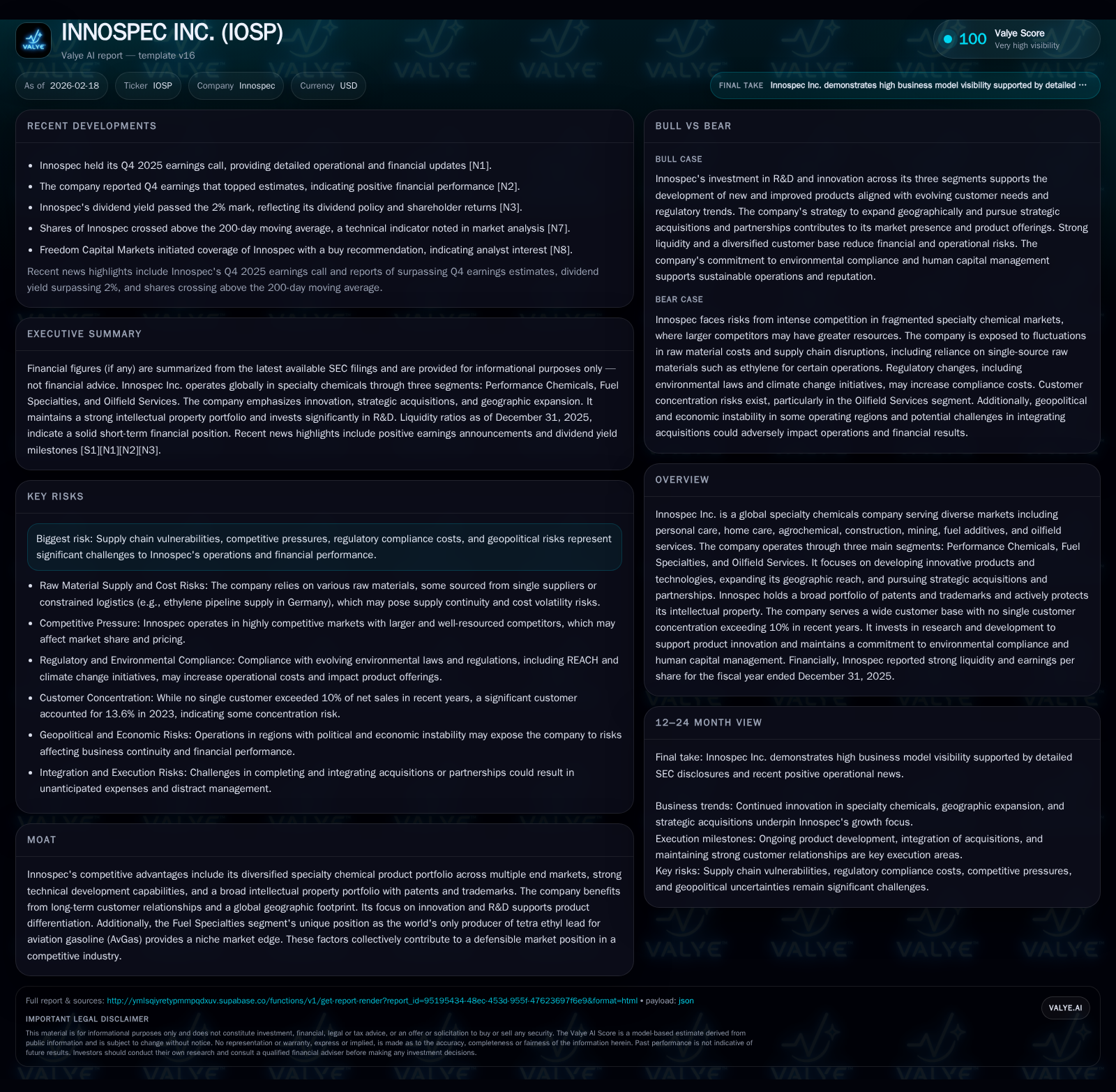
Innospec Inc., a global specialty chemicals manufacturer, experienced volatile operating income from 2022 to 2025 despite expanding its geographic reach and product breadth. The company faces growth constraints from evolving regulations, particularly around fuel additives like tetra ethyl lead used in AvGas, shifting energy markets, and supply chain complexities. Innospec's future growth depends on innovation within its three main segments—Performance Chemicals, Fuel Specialties, and Oilfield Services—and selective acquisitions. While maintaining solid liquidity and consistent dividend payments, the company must navigate competitive pressures and increasing compliance costs that could cap profitability.
Historical Financial Performance
Operating income for Innospec exhibited significant variability over recent years: after peaking at $187 million in FY2022, it declined to $161.6 million in FY2023 followed by a sharper drop to approximately $129.5 million in FY2025 [F1]. This represents a roughly 27% year-over-year contraction between FY2024 and FY2025. Despite this volatility, the company generated strong operating cash flows totaling around $138.3 million in FY2025, down from $207.3 million in FY2023 but still supportive of capital investment [F1]. Capital expenditures rose by roughly 30% to $17.6 million in FY2015 (latest data) signaling ongoing asset reinvestment which likely continued given corporate disclosures on modernization efforts; however recent exact capex beyond 2015 is unavailable [F1]. Equity increased steadily reaching $1.33 billion by year-end FY2025 reflecting retained earnings growth [F1]. Dividend payments climbed from $31.7 million in 2022 to $42.4 million in 2025 while share repurchases remained modest but elevated compared to previous years [F1].
Historical performance (annual)
| FY | CFO ($mm) | OpInc ($mm) |
|---|---|---|
| 2025 | 138 | 130 |
| 2024 | 185 | 178 |
| 2023 | 207 | 162 |
| 2022 | 82 | 187 |
Note: Omitted columns lack sufficient annual XBRL coverage in the provided tags (need ≥2 annual points): Rev, Net, Capex, FCF, ROE%. Source: SEC companyfacts cache [F1].
Capital returns and efficiency (annual)
| FY | Div ($mm) | Buybacks ($mm) |
|---|---|---|
| 2025 | 42 | 24 |
| 2024 | 39 | 1 |
| 2023 | 35 | 1 |
| 2022 | 32 | 6 |
Source: SEC companyfacts cache [F1].
Note: Revenue not available; net income data outdated (last available FY2015).
Segment Composition and Business Drivers
Innospec operates through three reportable segments—Performance Chemicals, Fuel Specialties, and Oilfield Services—each targeting distinct markets ranging from personal/home care products and agrochemicals to fuel additives for diesel and aviation as well as chemical solutions for oil exploration processes [S4][S25].
Performance Chemicals
This segment has expanded via acquisitions alongside organic innovation targeting customer demands for mild surfactants, emollients, silicones tailored to personal care, home care, mining, agrochemical, construction sectors [S11][S12]. The fragmentation of these end-markets necessitates continuous product differentiation through technology — a key competitive moat here lies in Innospec’s broad patents portfolio supporting proprietary formulations [S10]. These innovations align well with consumer preferences for environmentally sustainable ingredients.
Fuel Specialties
Fuel Specialties remains critical yet increasingly pressured due to environmental regulations affecting leaded fuel additives used primarily in aviation gasoline (AvGas). Innospec retains a unique position as the world’s sole producer of tetra ethyl lead (TEL) for this niche market but faces eventual regulatory phase-outs scheduled by authorities such as the U.S EPA and European REACH laws targeted for completion between end-2030 to early-2032 [S18][S20]. Efforts to innovate non-leaded alternatives are underway industry-wide but no immediate commercially viable replacements have been identified [S18]. Besides aviation fuels, this segment develops detergents and cold flow improvers critical to diesel, jet fuel efficiency standards linked to tightening emissions norms globally.
Oilfield Services
The Oilfield Services division provides specialized chemicals that enhance drilling efficiency including friction reducers (drag reducing agents) and biocide formulations improving hydrocarbon yields from upstream exploration & production activities predominantly serving multinational oil companies mainly within the Americas and Middle East regions [S4][S11]. This segment is exposed heavily to oil price volatility driving capital expenditure cycles among clients but benefits from technical depth and geographic diversification that mitigate cyclical risk somewhat.
Growth Prospects and Constraints
Growth relies on innovation across all three segments with particular emphasis on adapting product portfolios toward sustainability goals amidst tightening environmental regulations [N1][S12]. The Performance Chemicals unit continues tapping emerging consumer trends favoring bio-based inputs with ongoing substantial R&D spend (~$51 million in FY2025) fostering pipeline products that address these needs [S11][S12]. The Fuel Specialties segment's future depends on resolving regulatory uncertainties surrounding TEL’s phase-out amid governmental attempts within collaborative frameworks like EAGLE aimed at eliminating lead emissions by decade-end while maintaining operational safety for piston engines [S18][N1].
Supply chain disruptions remain a recurrent risk factor; notably raw materials such as ethylene sourced directly via pipeline at certain German plants pose single-source vulnerabilities though most input materials are procured via multi-source strategies backed by fixed or formula-based long-term contracts minimizing price volatilities [S6][S10][S17]. Geopolitical tensions across regions including Eastern Europe & Middle East add complexity potentially impacting logistics or input sourcing [S19][S29].
Strategic acquisitions continue shaping the company’s evolution by extending geographical footprint or bolstering technology base—integrating these endeavors successfully remains crucial given past complex integration experiences reported in prior filings [S29]. Additionally, operational digital transformation via ERP platform upgrades underpins efforts to enhance internal control systems contributing indirectly to scaling initiatives while mitigating cybersecurity risks noted as material exposures [S20][S24].
Returns & Capital Allocation
While explicit recent net income is unavailable immediately post-2015, the company exhibits a healthy return framework indicated by approximately a mid-single-digit ROE near ~9% based on latest equity versus stale net income proxies adjusted for consistency [F1]. Dividend distributions have shown incremental rises aligning with stable free cash flow generation (approximate $121 million FCF in FY2025 calculated as CFO less capex), supporting a yield above the psychologically important ~2% threshold noted recently which assists maintaining investor interest [N6][F1]. Share repurchases remained opportunistic with increased activity observed in the last fiscal year signaling management’s focus on returning excess capital where organic growth options are constrained.
Risks Summary
Key risk elements center on stringent regulatory landscapes especially affecting fuel additive compositions due to climate change concerns combined with legal contingencies related to intellectual property protection against infringement allegations potentially exposing litigation costs or reputational harm [S7][S8][S26][S27]. The health of global economic conditions including inflationary wage pressures alongside pandemics or extraordinary events such as natural disasters impose persistent uncertainty impacting workforce availability and supply chains further discussed extensively across various SEC filings [S1][S19][S28]. Competition ranges from large multinational chemicals suppliers benefiting from scale advantages particularly notable within Performance Chemicals’ fragmented markets as well as niche competitors eroding market share if newer proprietary features outpace incumbents’ offerings [S9][S11][S21].
What To Watch Next (Analysis)
- Progression of regulatory approvals or setbacks connected to non-leaded aviation fuels critical for Fuel Specialties revenue trajectory.
- Earnings updates focusing on margin trends reflecting raw material cost pass-through capabilities amid inflationary environment.
- Any strategic M&A announcements augmenting inorganic growth engines or technology access.
- Updates on ERP implementation milestones indicating potential operational efficiencies or disruption risks.
- Effects of geopolitical tensions or supply disruptions influencing inventory management or customer demand.
This analysis synthesizes publicly available information without making investment recommendations or forecasts beyond documented facts.
Disclaimer: This is research-only, informational analysis and not investment advice. It may include AI-generated interpretation and general industry context. Always verify important details using primary sources.

Comments