
Devon Energy’s $8.4B Debt and $5B Buyback Shape Post-Merger Growth Trajectory
Devon Energy’s recent merger, capital structure, and commodity hedging underpin stable cash flow amidst industry volatility.
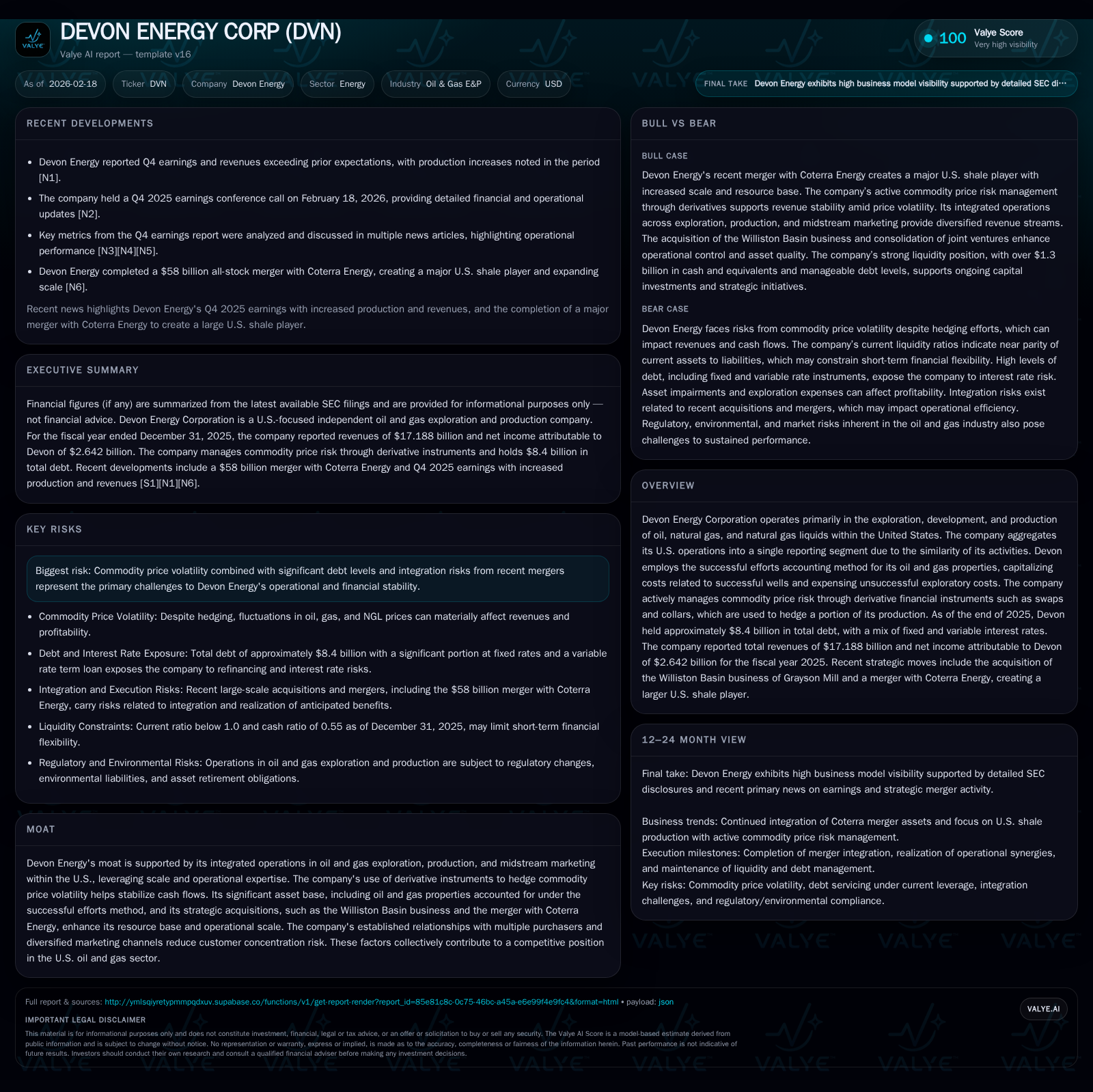
Devon Energy Corporation, a major U.S.-focused oil & gas exploration and production company, has shown solid revenue growth from $15.3B in 2023 to $17.2B in 2025, driven by scale gains from recent acquisitions including the Grayson Mill Williston Basin assets and Coterra Energy merger. The company’s moat is reinforced by operational scale, integration of midstream marketing, and a disciplined hedging strategy that dampens commodity price swings. Devon maintains a significant debt load of approximately $8.4 billion, primarily fixed-rate instruments averaging 5.7%, balanced by robust operating cash flows exceeding $6.7 billion in 2025 and an active capital return program including a $5 billion share repurchase authorized through mid-2026. Future growth hinges on successful integration of acquisitions, efficient capex deployment, and managing commodity price and regulatory risks.
Overview
Devon Energy Corporation (DVN) operates primarily across the U.S., engaged in oil, natural gas, and NGL exploration, development, production, and marketing. Its operations have been consolidated into a single segment reflecting common activities with consistent successful efforts accounting methods—capitalizing costs associated with successful well developments while expensing unsuccessful exploratory costs [S1].
The company maintains an integrated footprint combining upstream E&P with midstream marketing operations, bolstering its competitive moat alongside scale advantages from notable acquisitions including Grayson Mill’s Williston Basin assets (completed September 2024) and the transformational merger with Coterra Energy finalized recently [S2][N12][N13]. This strategic expansion broadens Devon's resource base markedly.
Historical Performance
Devon posted revenues of $17.19 billion in FY2025, up from $15.94 billion in FY2024 and $15.26 billion in FY2023—a compound trajectory reflecting roughly +7.8% Year-over-Year (YoY) increase from last year [F1][S18]. Net income was $2.64 billion in FY2025 albeit down around -8.6% YoY compared to the prior year’s $2.94 billion [F1]. The narrowing bottom line likely reflects margin pressures amid fluctuating commodity prices despite volume growth.
Operating cash flows (CFO) were robust at approximately $6.71 billion for FY2025 with a moderate increase (+1.7% YoY), sustaining strong liquidity alongside disciplined capital expenditure cuts (capex declined by roughly 44%) [F1][S18]. This approach suggests a more efficiency-driven growth posture after heavy acquisition investments.
Historical performance (annual)
| FY | Rev ($bn) | Net ($bn) | CFO ($bn) | Rev YoY | Net YoY |
|---|---|---|---|---|---|
| 2025 | 17.2 | 2.6 | 6.7 | +7.8% | -8.6% |
| 2024 | 15.9 | 2.9 | 6.6 | +4.5% | -22.8% |
| 2023 | 15.3 | 3.7 | 6.5 | -20.4% | -37.7% |
| 2022 | 19.2 | 6.0 |
Note: Omitted columns lack sufficient annual XBRL coverage in the provided tags (need ≥2 annual points): OpInc, Capex, FCF. Source: SEC companyfacts cache [F1].
Capital returns and efficiency (annual)
| FY | Div ($mm) | Buybacks ($mm) | ROE% |
|---|---|---|---|
| 2025 | 1050 | 17.0 | |
| 2024 | 143 | 1057 | 19.9 |
| 2023 | 1858 | 979 | 31.1 |
| 2022 | 875 | 718 | 53.9 |
Source: SEC companyfacts cache [F1].
* Capex amounts are approximations due to limited multi-year comparison data.
Capital Structure & Returns
As of December 31, 2025, Devon carried approximately $8.4 billion of total debt comprised mostly of fixed-rate debentures averaging interest rates near 5.7%, complemented by a variable-rate $1 billion Term Loan priced at SOFR+spread (interest rate at around 5.4%) [S1][S15]. The company is comfortably within covenant limits with a conservative debt-to-capitalization ratio near 24.8% [S5].
Liquidity remains solid with over $1.38 billion in cash equivalents on hand at year-end [F1]. Despite sizable outstanding debt linked to recent acquisitions like Grayson Mill ($5 billion transaction partially funded by equity issuance and debt), Devon demonstrates prudent leverage management.
Capital allocation strongly favors shareholders: the Board has authorized a substantial share repurchase program totaling $5 billion set to expire June 30, 2026 [S4]. In FY2025 alone about $1 billion was spent on buybacks alongside dividends which were raised early that year to a fixed quarterly rate of $0.24 per share plus variable dividends dependent on cash flow results [S4][S13].
With net income-to-equity ratios implying a return on equity around 17%, Devon balances attractive returns while maintaining heavy investment flexibility via free cash flow generation estimated around $6.68 billion in fiscal year terms after capex deductions [F1].
Operating Strategy & Risk Management
Devon's operational risk profile hinges on commodity price volatility intrinsic to upstream energy businesses plus integration complexities following its major mergers [S17][N12]. To mitigate price swings impacting revenue certainty, the firm employs an active commodity hedging program using derivatives including swaps and collars with net sensitivity figures indicating that a ±10% move in forward price curves would shift net outcomes by roughly $150 million [S1][S8].
Production expenses encompass lease operating expenses ($1.92 billion), gathering/processing ($830 million), taxes (~$814 million), and DD&A approaching ~$3.6 billion illustrating capital intensity within mature basin development [S18].
Legal contingencies center chiefly on environmental regulatory matters evidenced by multiple notices of violation related to air emissions spanning North Dakota and Texas/New Mexico jurisdictions over recent years [S17], featuring ongoing engagements with EPA but no presently material financial liabilities disclosed aside from accrued reserves.
Growth Outlook & Milestones
Future growth factors rest squarely on Devon’s ability to capitalize on its enlarged asset base post-mergers—including synergistic cost savings or enhanced recovery from the Williston Basin Grayson Mill acquisition—and leveraging expanded midstream infrastructure for broader marketing capabilities [N12][N13]. Production increases reported recently support this theme although detailed volume guidance is undisclosed; market watchers should monitor quarterly production updates for visibility.
Capex discipline coupled with stable hedging strategies suggest Devon will continue prioritizing cash flow maximization paired with shareholder returns under current commodity cycle conditions [N2][N9][S18]. Potential headwinds derive from residual integration risks or sudden shifts in natural gas/oil prices potentially limiting margin expansion.
Conclusion
Devon Energy exhibits resilient mid-sized E&P company characteristics fortified through large-scale mergers that expanded its reserve base and operational breadth within the U.S.. Confronted with volatile commodity environments and regulatory vigilance, the firm leverages financial discipline—a notable debt footprint managed conservatively—and sophisticated hedging alongside an assertive capital return policy placing shareholder value front-and-center.
Stakeholders should focus closely on execution progress regarding integration synergies and production ramp trends coupled with further disclosures around forward-looking capex spend and dividend policies beyond mid-2026 timelines.
Disclaimer: This analysis is for informational purposes only and does not constitute investment advice or recommendations.
Disclaimer: This is research-only, informational analysis and not investment advice. It may include AI-generated interpretation and general industry context. Always verify important details using primary sources.

Comments