
Bain Capital Specialty Finance’s Strategic Approach to Growth, Debt, and Dilution Risks
BCSF leverages its Bain Capital Credit affiliation to pursue middle-market specialty finance opportunities while navigating capital structure limitations and dividend commitments.
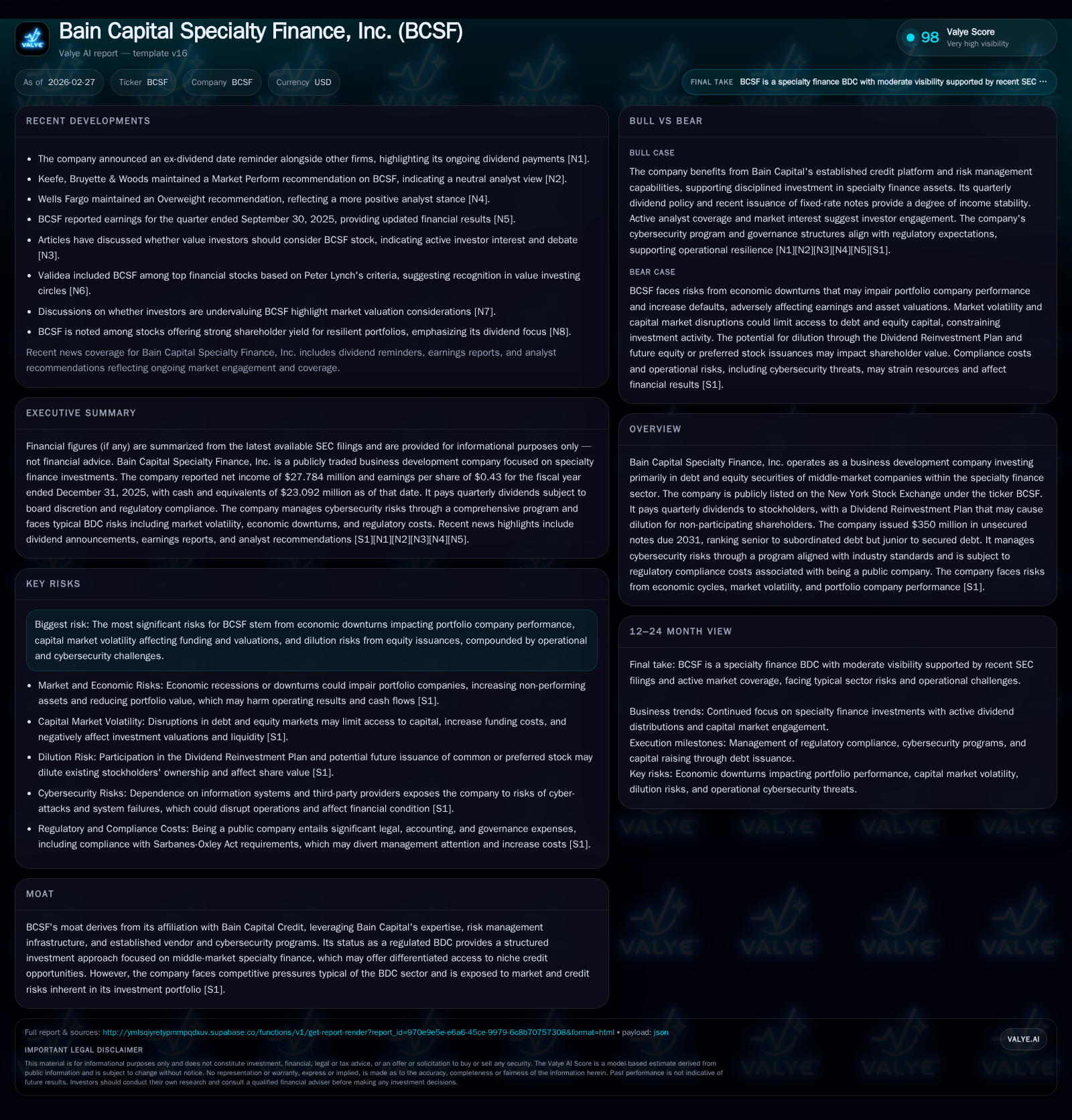
Bain Capital Specialty Finance, Inc. (BCSF) commands a niche in middle-market specialty finance through its affiliation with Bain Capital Credit, capitalizing on disciplined underwriting and market expertise. Despite a 25.5% net income rebound in fiscal 2025 and a recovering operating cash flow after prior volatility, BCSF faces ongoing challenges from capital market volatility, asset coverage regulation under the 1940 Act, and equity dilution risk tied to its Dividend Reinvestment Plan. The company’s $350 million unsecured notes due 2031 represent a significant component of its senior unsecured debt, underscoring refinancing and liquidity dynamics amid competitive pressures in business development companies (BDCs). Going forward, monitoring investment deployment pace, dividend sustainability, and regulatory developments will be critical to understanding BCSF’s trajectory.
Historical Earnings Trajectory and Operating Cash Flow Recovery
Bain Capital Specialty Finance experienced notable swings in profitability metrics over the recent four-year period as reflected in SEC filings and companyfacts data [F1]. Net income declined from a peak of $43.5 million in FY2022 to $22.1 million in FY2024 before rebounding by 25.5% year-over-year to $27.8 million in FY2025—a clear signal of operational recovery following an earnings trough. Operating cash flow dynamics were even more volatile: after a negative $316.8 million CFO figure in FY2022—likely reflecting mark-to-market valuation fluctuations common within specialty finance portfolios—BCSF swung back into positive CFO territory with $219.3 million in FY2023 before settling at $29.5 million positive in FY2025 [F1]. This progression points to transient earnings impacts from valuation adjustments under accounting practices typical of debt securities portfolios concentrated in non-public middle-market credits.
The company's sizable dividend payments reflect its prioritization of stable shareholder returns despite underlying earnings variability: annual dividends paid rose steadily from approximately $99.4 million in FY2023 to $145.8 million in FY2025 [F1]. Equity base has been relatively stable near the $1.1 billion mark during this timeframe.
Historical performance (annual)
| FY | Net ($mm) | CFO ($mm) | Net YoY |
|---|---|---|---|
| 2025 | 28 | 30 | +25.5% |
| 2024 | 22 | -27 | -28.7% |
| 2023 | 31 | 219 | -28.6% |
| 2022 | 44 | -317 |
Source: SEC companyfacts cache [F1].
Capital returns and efficiency (annual)
| FY | Div ($mm) | ROE% |
|---|---|---|
| 2025 | 146 | 2.5 |
| 2024 | 114 | 1.9 |
| 2023 | 99 | 2.7 |
| 2022 | 3.9 |
Source: SEC companyfacts cache [F1].
Note: Operating cash flow figures reflect substantial volatility attributable primarily to mark-to-market revaluations common in specialty finance portfolios.
Investment Portfolio Composition and Middle-Market Credit Exposure
BCSF strategically invests primarily in debt and equity securities of middle-market companies within the specialty finance sector [S1][S23][S29]. Typical assets include a blend of senior secured loans, subordinated debt instruments, and occasionally direct equity participations characteristic of business development company (BDC) investment patterns focusing on niche credit exposures inaccessible broadly.
Middle-market lending subjects the portfolio to economic cycle sensitivity; portfolio companies often experience greater susceptibility to downturns given their size constraints relative to large caps [S14]. Bain Capital Credit's underwriting discipline serves as a competitive moat by enabling detailed borrower assessment capabilities backed by extensive risk management infrastructure [S1]. This framework likely mitigates but does not eliminate downside exposure.
The portfolio mix emphasizing subordinate tranches balances yield capture against increased default risk probabilities stemming from leverage nuances typical of middle-market capital structures.
Capital Structure Stresses: Debt Maturity Profile and Liquidity Considerations
A defining factor shaping BCSF's flexibility is its outstanding unsecured notes issuance: $350 million of unsecured notes bear an interest rate of 5.95%, maturing March 2031 [S4][S6][S11]. These notes have seniority over subordinated debt yet are structurally junior to any secured financings the company maintains or may introduce.
Asset coverage ratios mandated under Section 18(a)(1)(A) of the Investment Company Act of 1940 impose regulatory leverage ceilings—requiring minimum asset coverage ratios of at least 200% post-incurrence of indebtedness unless approved for reduced coverage—which constrain BCSF’s capacity to lever further without additional stockholder approvals [S6][S11].
Economic volatility renders refinancing efforts during market stress periods challenging given potentially elevated cost-of-capital demands or curtailed lender appetite [S6]. Covenant restrictions within indentures could limit strategic actions if asset values decline or if covenant breaches occur due to macroeconomic shocks impacting portfolio asset valuations [S7].
Liquidity management strategies include using the note proceeds strategically—for instance, repaying secured indebtedness—to improve overall capital structure robustness [S11]. However, ongoing banking sector strain introduces external risks affecting borrowing costs and counterparties’ creditworthiness [S9].
Dividend Policy Dynamics and Shareholder Dilution Risks
An important trade-off exists between BCSF’s commitment to quarterly dividend distributions versus preserving shareholder value amidst potential dilution risk resulting from its Dividend Reinvestment Plan (DRIP) [S1][S5][S10][S12][S20].
When NAV per share falls below market price inclusive of estimated fees—or if NAV drops below approximately 95% of market price—the DRIP mechanism issues newly minted shares valued at NAV or at a discount relative to the market price, causing ownership dilution for shareholders who opt out [S1][S12].
This dynamic presents a classic conundrum for BDCs seeking stable yield distributions without undermining book value per share organically; shareholders opting out may see diminished stake percentages over time.
Additionally, potential preferred stock issuance remains an available but dilutive tool that could adversely affect common stock valuation given senior dividend rights, liquidation preference hierarchies, and cumulative dividend obligations [S12][S20]. Under the Investment Company Act framework, preferred shares are treated as "senior securities" impacting available leverage ratios.
Cybersecurity Governance and Regulatory Compliance Framework
BCSF benefits materially from the structured cybersecurity governance embedded via Bain Capital Credit's firm-wide program overseen by an experienced Chief Information Security Officer (CISO), holding industry-standard CISSP certification alongside advanced academic credentials [S1].
Regular Board engagement ensures strategic oversight with periodic updates on threat landscape evolutions provided by internal compliance officers and external cybersecurity advisors molding cyber risk mitigation policies aligned tightly with frameworks such as the National Institute of Standards and Technology Cybersecurity Framework (NIST CSF) [S21].
This robust posture reduces operational risk related to system failures or cyber-attacks that could otherwise jeopardize distribution capacity or information integrity [S22]. Compliance burdens including Sarbanes-Oxley requirements also add operational costs but enhance investor confidence through strengthened internal controls over financial reporting [S13][S20].
Market Risks Impacting Portfolio Performance and Funding Access
Market risk factors constitute ongoing headwinds for BCSF's operations including macroeconomic recession cycles affecting portfolio company repayment capacity—and thus elevating default risks—as well as capital markets dislocations hindering timely refinancing or new originations [S1][S2][S6][S17].
Geopolitical tensions evidenced by sanctions regimes (e.g., Russia-Ukraine conflict), tariff uncertainties under shifting U.S trade policy directives, inflationary pressures prompting central bank interventions all compound uncertainty around portfolio valuations and access to credit pools [S2][S15].
Heightened interest rates influence borrowing costs directly impacting portfolio companies' cost structures which can curtail growth prospects or precipitate covenant breaches resulting in loan impairments or restructuring needs [S19]. Volatility also flows into mark-to-market fair value adjustments intrinsic to BCSF’s accounting treatment applying fair-value frameworks even where investments are held until maturity [S7].
Such factors underscore a delicate balancing act between prudent credit risk management via Bain Capital's stewardship and unpredictable systemic shocks beyond management control.
Future Outlook: Investment Pipeline and Strategic Milestones to Monitor
With no explicit forward guidance disclosed in recent filings or official announcements [S3][S1][S5], stakeholders should focus on key observable indicators over coming quarters including:
- Pace and composition changes within new investments especially targeted toward resilient middle-market sectors;
- Management responses around refinancing maturities notably how proceeds from unsecured note issuance are deployed toward secured debt reductions enhancing structural liquidity;
- Dividend payment stability vis-à-vis NAV trends informing dilution risk intensity;
- Potential resolutions regarding proposed preferred stock issuances which would alter the capital structure hierarchy;
- Evolving regulatory compliance demands pertaining both to cybersecurity governance and public company obligations;
- Macroeconomic signals particularly relating to interest rate outlooks impacting portfolio underwriting assumptions.
Given inherent volatility across deal origination environments plus structural constraints imposed by BDC regulations—investing attention here promises critical insights into BCSF’s strategic resilience amidst credit market uncertainties.
This analysis synthesizes publicly filed SEC documents ([S#]) together with companyfacts financial metrics ([F1]) without offering investment advice or forecasts beyond presented disclosures. All numerical data derives explicitly from cited official filings as of latest fiscal period ending December 31, 2025.
Disclaimer: This is research-only, informational analysis and not investment advice. It may include AI-generated interpretation and general industry context. Always verify important details using primary sources.

Comments