
Butterfly Network: Assessing Technological Edge and Financial Sustainability
Butterfly Network leverages proprietary Ultrasound-on-Chip™ innovations while contending with persistent losses and supply chain challenges.
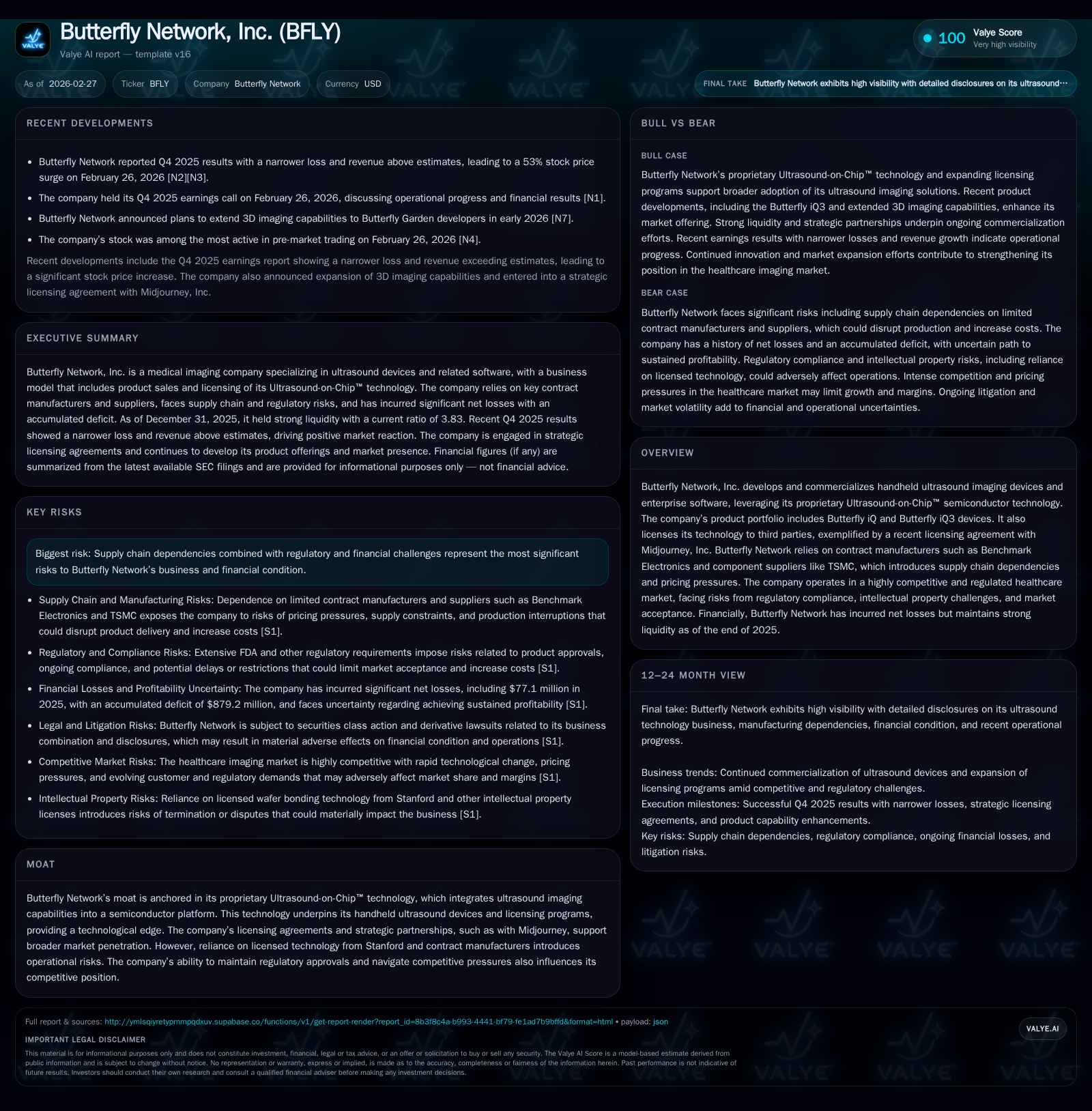
Butterfly Network, Inc. stands out for its pioneering Ultrasound-on-Chip™ technology embedded in handheld ultrasound devices and related enterprise software. Despite revenue growth and technological advancements, the company has yet to achieve profitability, facing ongoing operating losses that have moderately improved from 2022 through 2025. Significant supply chain dependencies on contract manufacturers and semiconductor suppliers present pricing and production risks, amplified by a complex regulatory environment and ongoing litigation. Strong liquidity cushions these risks, but monitoring operational scale-up and regulatory developments remains crucial to assessing future viability.
Technological Foundation: Ultrasound-on-Chip™ as Butterfly Network’s Moat
Butterfly Network’s core innovation lies in its proprietary Ultrasound-on-Chip™ technology, a semiconductor platform that miniaturizes ultrasound imaging hardware into an integrated circuit. This breakthrough enables the company's flagship handheld devices — including Butterfly iQ and the newer Butterfly iQ3 — offering increased portability and accessibility compared to traditional bulky ultrasound machines. The chip-based architecture not only reduces production complexity but also differentiates Butterfly’s products by combining scalability with advanced imaging capabilities.
This platform also fuels Butterfly’s licensing strategy; the firm has extended its technology beyond end-user devices through agreements such as the recent licensing deal with Midjourney, Inc., enabling third parties to develop specialized applications leveraging the chip technology [N1]. However, the reliance on licensed intellectual property from Stanford University introduces operational dependencies alongside contract manufacturing partnerships that add risk vectors.
Historical Financial Performance: Operating Losses Narrow but Persist
A review of Butterfly’s financials from fiscal years 2022 through 2025 reveals a notable trend of narrowing operating losses amid continued investment in product development and commercialization:
Historical performance (annual)
| FY | Net ($mm) | CFO ($mm) | OpInc ($mm) | Capex ($mm) | Net YoY |
|---|---|---|---|---|---|
| 2025 | -77 | -13 | -86 | 3 | -6.3% |
| 2024 | -72 | -42 | -74 | 3 | +45.8% |
| 2023 | -134 | -99 | -146 | 6 | +20.8% |
| 2022 | -169 | -169 | -193 | 18 |
Source: SEC companyfacts cache [F1].
Capital returns and efficiency (annual)
| FY | FCF ($mm) | ROE% |
|---|---|---|
| 2025 | -16 | -39.3 |
| 2024 | -44 | -42.9 |
| 2023 | -105 | -60.8 |
| 2022 | -187 | -51.9 |
Source: SEC companyfacts cache [F1].
Operating income improved significantly from a loss of $193 million in 2022 to around $86 million in 2025 [F1], indicating better cost control and revenue scaling but still far from breakeven profitability. Net losses have similarly declined but remain substantial with no clear timeline for positive net income as per the company’s disclosures [S1]. Operating cash flow improved dramatically yet fails to reach positive territory, with free cash flow roughly negative $16 million after capex spending in the latest reported fiscal year [F1].
2025 Results Snapshot: Revenue Beats but Profitability Remains Elusive
The fourth quarter of fiscal year 2025 illustrated the dual narrative that characterizes Butterfly's current state: revenue exceeded market expectations driven by expanding device sales and enterprise software subscriptions; however, net losses persisted albeit at a reduced magnitude relative to prior periods [N1][N2][N4][S3].
Despite this positive top-line momentum, operating expenses related to R&D expansions, sales efforts, and regulatory compliance continue to pressure margins. This juxtaposition underscores Butterfly's ongoing transition phase where scaling commercialization must eventually outpace investment-induced losses for sustainable profit generation.
Supply Chain Dependencies: Risks from Contract Manufacturing and Pricing Pressures
Butterfly outsources assembly of its hardware products primarily to Benchmark Electronics while sourcing semiconductor components from Taiwan Semiconductor Manufacturing Company (TSMC) [S1]. This arrangement benefits from specialization but exposes Butterfly to several supply chain risks:
- Pricing pressures: Supplier cost increases driven by raw material constraints or capacity tightness may compel Butterfly to either absorb costs thus reducing margins or pass them on through price hikes risking customer demand erosion.
- Production continuity: Any disruptions at Benchmark or TSMC facilities due to labor issues, geopolitical tensions, natural events or regulatory interventions could impair Butterfly's ability to deliver products timely.
- Standby capacity: Limited standby manufacturing sites increase vulnerability if primary suppliers experience downtime.
These dynamics necessitate rigorous supplier management and contingency planning critical for maintaining operational stability amid a complex global manufacturing environment.
Regulatory Compliance and Litigation Risks: Implications for Market Position
Operating within healthcare device markets subjects Butterfly to extensive FDA oversight regarding manufacturing quality systems, pre- and post-market product surveillance, labeling accuracy, and promotional conduct [S4–S10]. Missteps can trigger enforcement actions ranging from warning letters to costly recalls impacting reputation and financial health.
Marketing claims are closely monitored; comparative advertising poses the risk of false or misleading claims lawsuits under statutes like the Lanham Act [S4][S5]. Moreover, fraud-and-abuse laws constrain sales incentives towards healthcare providers — any violation potentially resulting in fines or license actions.
The company currently faces multiple securities class action lawsuits related to alleged misrepresentations regarding technology efficacy and business prospects following its business combination merger [S6][S9][S16]. Intellectual property litigation risk is prominent due to patent disputes common within medical device sectors where competitors aggressively defend proprietary technologies [S8][S18].
Additionally, data privacy regulations across jurisdictions—such as HIPAA in the U.S.—impose strict controls over protected health information handled by Butterfly’s platforms which must be vigilantly managed against cyber threats [S11][S12][S19].
Collectively these factors reflect a challenging legal landscape necessitating robust compliance safeguards as integral to business continuity.
Outlook and Growth Drivers: Commercialization and Licensing Initiatives
Going forward, Butterfly intends to accelerate commercial adoption of its most recent generation of handheld devices (Butterfly iQ3), backed by enterprise software enhancements offering augmented diagnostic capabilities [N1][N2][S1]. The company’s strategy hinges on expanding into new customer segments including hospitals, clinics, emergency responders, and potentially emerging markets where portable ultrasound access remains limited.
Licensing deals extend reach beyond direct sales; collaborations like the Midjourney agreement illustrate efforts to monetize technology via ecosystem partnerships beyond initial device deployments . If successful scaling occurs without proportionate cost increase, this could foster profitability over time.
However, competition from incumbent medical imaging manufacturers coupled with reimbursement environment uncertainties impose natural caps on potential growth velocity.
Capital Allocation Review: Cash Reserves, Returns, and Shareholder Distributions
Liquidity metrics remain a strong point for Butterfly entering fiscal year-end 2026: cash & equivalents stood at approximately $150 million while current assets were nearly $249 million versus current liabilities around $65 million yielding a healthy current ratio of about 3.83x—a comfort given ongoing operating deficits [F1].
Return on equity remains negative near -39%, reflective of sustained cumulative net losses against shareholder equity base [F1]. No dividends or share repurchase programs have been indicated so far consistent with reinvestment focus typical for growth-stage medtech firms facing profit hurdles.
Capital expenditure levels have moderated recently relative to earlier years indicating possible stabilization of asset investments concurrent with path toward efficiency improvements [F1]. Management appears prioritizing preservation of financial flexibility while advancing commercialization milestones.
Monitoring Points: What to Watch in Upcoming Earnings and Milestones
Absent explicit forward guidance beyond qualitative commentary [N1][N2], investors should attentively monitor several key indicators including:
- Top-line revenue momentum quarter-over-quarter reflecting device unit volume increases and software subscription uptake.
- Improvement in gross margin percentage signaling potential easing of pricing pressures or manufacturing scale benefits.
- Progress in mitigating supply chain bottlenecks particularly vis-à-vis Benchmark Electronics and TSMC dependencies.
- Regulatory milestone achievements such as FDA approvals for expanded indications or new product iterations.
- Resolution outcomes or developments concerning ongoing securities class actions or patent litigations influencing clarity over contingent liabilities.
- Cash consumption trends aligned with operating cash flow improvements translating into nearing positive free cash flow trajectories.
Tracking these parameters will illuminate whether Butterfly Network advances toward sustainable profitability while solidifying its technological advantages amid competitive healthcare device markets.
This analysis synthesizes publicly available company filings alongside recent earnings calls and validated financial data snapshots without extending speculative forecasts or investment recommendations.
Disclaimer: This is research-only, informational analysis and not investment advice. It may include AI-generated interpretation and general industry context. Always verify important details using primary sources.

Comments