
BioCorRx Inc.: Extreme Liquidity Shortfall and Negative Revenue Signal Critical Uncertainty
BioCorRx Inc. faces an acute liquidity crisis and operational losses, with negative revenue and liabilities vastly exceeding assets. The absence of disclosed business model details leaves its future reliant on unproven turnaround or restructuring scenarios.
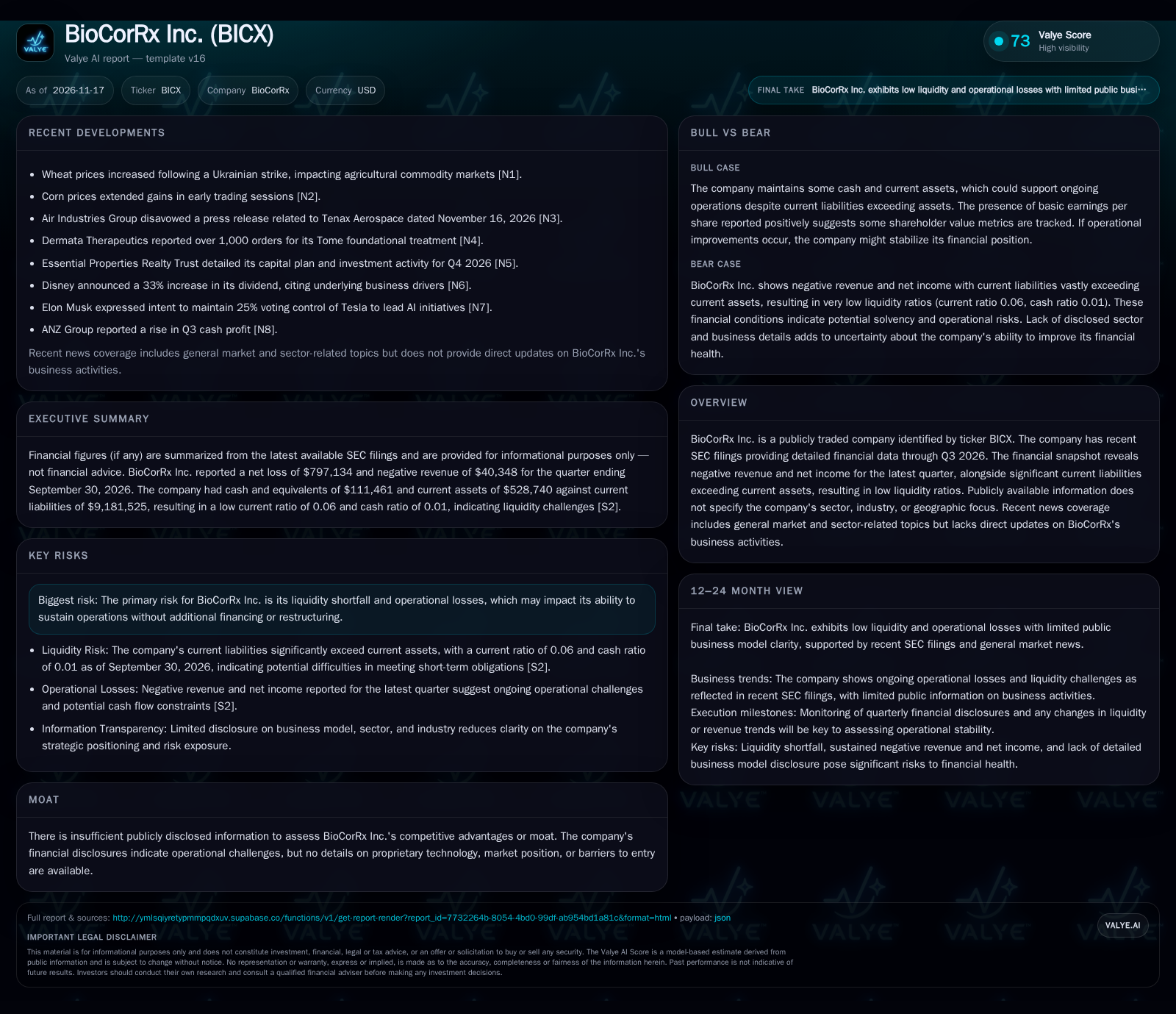
BioCorRx Inc. reported negative revenue and a net loss for Q3 2026, alongside a severe liquidity shortfall—current liabilities outstrip assets by a wide margin. With no recent operational disclosures or sector clarity, the company’s ability to continue as a going concern is in question unless it secures external funding or executes a turnaround.
BioCorRx Inc. is in a precarious financial position, as its latest SEC filing reveals negative revenue and a substantial net loss for Q3 2026, with current liabilities outstripping assets by over $8.6 million. With no recent operational disclosures or clarity on its sector, BioCorRx’s prospects now depend on either dramatic operational improvement, outside capital, or restructuring—each fraught with execution risk.
Acute Financial Distress: Latest Quarter Exposes Deep-Rooted Liquidity and Revenue Challenges
BioCorRx Inc.’s Q3 2026 financials are defined by negative revenue of -$40,348 and a net loss of -$797,134, highlighting ongoing operational difficulties [S2]. The company’s cash and equivalents stood at just $111,461, with current assets totaling $528,740. In stark contrast, current liabilities reached $9,181,525, producing a current ratio of 0.06 and a cash ratio of 0.01—well below what is typically considered sustainable for an operating business [S2]. The company reported cash and liquidity metrics for the period; these figures do not by themselves establish operating runway, investment capacity, financial flexibility, or financing capacity. Notably, the negative revenue figure suggests not merely poor sales, but possible product returns, contract reversals, or unresolved revenue recognition issues. There are no recent business developments, sector disclosures, or operational updates, leaving stakeholders with limited visibility into the company’s underlying operations or turnaround prospects.
Moreover, the negative revenue figure, which is highly atypical, could reflect underlying issues such as aggressive revenue recognition reversals or significant product return rates that exacerbate cash flow constraints. Without transparency on these factors, predicting the timing or likelihood of a liquidity crisis becomes challenging, increasing the risk premium for any potential investors or creditors.
Elusive Business Model and Structural Losses: How (and If) BioCorRx Could Generate Value
With negative revenue and sustained net losses, BioCorRx’s current economics are unsustainable. The absence of sector or product detail makes it difficult to analyze the company’s underlying revenue model, pricing structure, or variable versus fixed cost base. If BioCorRx is a biotech or medical device company, as its name and historical context might suggest, revenue generation typically depends on product sales, licensing, or service contracts. Negative revenue, however, is uncommon and may indicate substantial returns, refunds, or adverse settlements outpacing gross sales.
The company’s high current liabilities relative to assets suggest either significant short-term borrowing, accrued payables, or unresolved obligations—potentially from R&D, litigation, or operational debt. Without a clear commercial engine or evidence of recurring revenue, the path to positive operating leverage is highly uncertain. The company may require a near-total overhaul—such as debt restructuring, asset sales, or external capital injection—to remain viable.
Absent clarity on the revenue model, it is also difficult to assess the company’s cost structure dynamics and scalability potential. For instance, if BioCorRx operates in a sector with high fixed costs such as clinical trials or manufacturing, sustained negative revenue would rapidly deplete cash reserves, making cost containment imperative but difficult. Conversely, if the business model relies more on variable costs linked to sales volume, then negative revenue could indicate a collapse in demand or contract cancellations, which would undermine any efforts to scale. The company’s ability to pivot to a more sustainable cost base or diversify revenue streams would be critical to restoring financial health, but this remains speculative without disclosed operational details.
Opaque Market Standing: Unknown Sector and Unclear Peer Landscape
Because BioCorRx has not disclosed its sector, industry, or market focus, its competitive positioning is wholly indeterminate. If the company operates in a highly regulated field such as pharmaceuticals or medical devices, barriers to entry, IP protection, and clinical results would typically shape competitive advantage. However, there is no information on proprietary technology, regulatory milestones, or customer relationships. This makes it impossible to assess whether BioCorRx faces entrenched incumbents, disruptive new entrants, or pricing pressure from generics or substitutes.
Absent sector clarity, the company may also lack the scale, distribution, or capital resources required to withstand competitive shocks. If BioCorRx’s business model depends on proprietary treatments or interventions, the negative revenue could signal failed commercialization, product returns, or contract disputes—each of which would undermine any moat. In short, the company’s competitive position is undefined and likely weak given its financial profile.
The lack of disclosed market positioning also obscures the company’s potential to leverage competitive advantages such as intellectual property, regulatory exclusivity, or established distribution channels. In industries with high entry barriers, incumbents often enjoy pricing power and customer loyalty that can stabilize revenues even during downturns. If BioCorRx lacks such advantages, it may be vulnerable to commoditization, price erosion, or rapid market share loss. Additionally, without clarity on the competitive landscape, it is impossible to evaluate whether BioCorRx’s technology or products are differentiated or commoditized, which directly impacts its ability to negotiate favorable contracts or partnerships essential for turnaround efforts.
Turnaround Play: What a Successful Rescue or Strategic Pivot Would Require
An upside scenario for BioCorRx would likely require a multi-pronged intervention: immediate access to external funding (via equity, debt, or strategic partnership); reduction or restructuring of current liabilities; and a credible operational pivot to restore positive revenue. This could involve renegotiating supplier terms, divesting non-core assets, or securing a licensing deal to generate upfront cash.
Confirmation of this scenario would require disclosure of new financing (e.g., capital raise, debt facility, or partnership), a marked reduction in current liabilities, and a return to positive reported revenue in subsequent filings. Evidence of new customer contracts, product launches, or sector-specific regulatory milestones would further support the plausibility of a turnaround. Falsification would occur if the company fails to secure new funding, liabilities increase, or negative revenue persists.
Continued Strain: Sustained Losses and Ongoing Liquidity Pressures Remain the Likely Trajectory
Given the magnitude of its current liabilities and persistent negative revenue, the most plausible scenario is that BioCorRx continues to operate under severe financial strain. Without evidence of new funding or operational improvement, the company may remain unable to meet obligations, risking default, creditor actions, or forced restructuring.
The base case would be confirmed by continued negative or minimal revenue, further net losses, and static or worsening liquidity ratios in future SEC filings. A lack of disclosure on operational progress or sector focus would further reinforce this trajectory. Any reversal—such as new product sales, strategic investment, or material liability reduction—would challenge this scenario.
Cascading Failure: Insolvency, Legal Actions, or Delisting Risk if No Intervention Occurs
In the absence of new capital or operational improvement, BioCorRx faces a plausible downside scenario involving insolvency or forced liquidation. The company could default on its obligations, triggering legal actions by creditors, asset seizures, or bankruptcy proceedings. Persistent negative revenue may also attract regulatory scrutiny regarding accounting practices or disclosure quality.
Confirmation would come from further deterioration in financials, bankruptcy filings, or delisting notices.
Milestones That Could Shift BioCorRx’s Trajectory
Disclosure of new financing arrangements—equity, debt, or strategic partnerships—would be critical to assessing near-term solvency.
Movement in reported revenue from negative to positive, or at least a clear explanation for negative revenue, would clarify operational viability.
Updates on current liabilities—whether they are reduced, restructured, or otherwise managed—would provide insight into default risk.
Public disclosure of sector, products, or business model specifics would help evaluate competitive positioning and market potential.
Evidence of new customer contracts, licensing agreements, or product launches (if disclosed) would indicate possible revenue traction.
Changes in management, board composition, or auditor commentary could signal strategic shifts or governance concerns.
Any regulatory filings, legal proceedings, or delisting notices would be material to the company’s status as a going concern.
Disclaimer: This is research-only, informational analysis and not investment advice. It may include AI-generated interpretation and general industry context. Always verify important details using primary sources.

Comments