
Baker Hughes in 2026: Balancing Market Volatility, Strategic Expansion, and Sustainability Ambitions
Baker Hughes navigates a turbulent energy market with robust financial results, a transformational merger, and a firm commitment to carbon reduction.
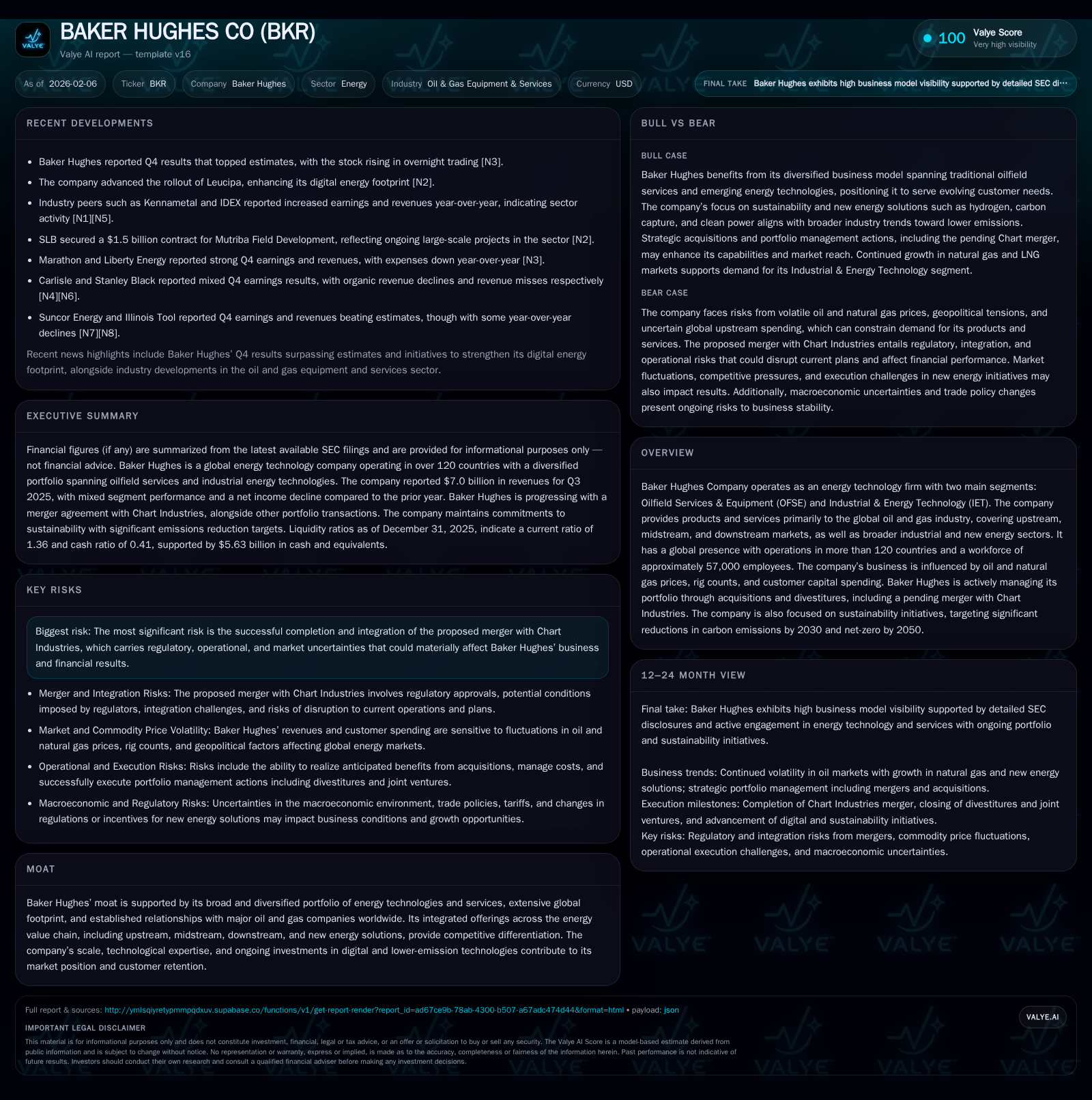
Despite headwinds from global oil market volatility and cautious upstream spending, Baker Hughes reported solid Q4 and full-year financial results exceeding expectations. The company pushes forward with its pending mid-2026 merger with Chart Industries, aiming to strategically broaden its energy technology footprint amid uncertain regulatory and integration challenges. Concurrently, Baker Hughes intensifies focus on sustainability targets, including net-zero emissions by 2050, while leveraging its broad technology portfolio and global scale to maintain competitive advantage within a shifting energy landscape.
Momentum Amid Market Headwinds: Q4 and Full-Year Financial Pulse
Baker Hughes closed 2025 with a financial performance that outpaced market expectations despite continuing softness in upstream oil activities. The company reported net income of $2.588 billion for the full year ending December 31, 2025 [F1], reflecting operational resilience amid sectoral volatility. Revenue growth was modest but positive in Q3 2025 (+1%), driven primarily by gains in the Industrial & Energy Technology segment [S2]. Notably, these results were delivered against a backdrop of global supply uncertainties, including rising OPEC+ output and geopolitical complexities that have moderated oil price trajectories.
The strong overall income figure underscores effective cost management strategies, structural efficiency initiatives, and favorable currency movements that partly offset volume declines in traditional oilfield services [N13]. This balance between enduring cash flow generation and adaptive operational agility sets the tone for Baker Hughes’ positioning as it advances into 2026.
Charting Growth through Strategic Acquisitions and Divestitures
Central to Baker Hughes’ transformation agenda is the pending acquisition of Chart Industries, anticipated to close mid-2026 pending regulatory approvals [S2]. This transaction represents a strategic bet on expanding the company’s footprint in cleaner energy technologies such as liquefied natural gas (LNG), hydrogen storage, and cryogenic equipment — critical enablers of the energy transition.
Complementing this are smaller yet targeted portfolio moves: acquisition of Continental Disc Corporation (CDC) in August 2025 enhances specialized manufacturing capabilities while divestitures like Precision Sensors & Instrumentation streamline focus [S2]. The concurrent formation of a Surface Pressure Control joint venture with Cactus further signals an orientation toward collaborative innovation within core competencies.
However, these moves are not without risk — integration complexity surrounding Chart looms large among uncertainties related to regulatory scrutiny, cultural alignment, cost synergies realization, and potential distraction from ongoing operations [S1]. Successfully navigating these will be pivotal for unlocking anticipated strategic value.
Dual Engines of Revenue: OFSE in Flux vs IET’s Rising Tide
Revenue analysis reveals contrasting trajectories across Baker Hughes’ two segments. Oilfield Services & Equipment (OFSE) experienced an 8% revenue decline year-over-year in Q3 2025 driven largely by decreased international upstream activity [S2]. This softness mirrors broader industry trends of constrained global upstream capital expenditure as producers maintain caution amid volatile pricing.
Conversely, Industrial & Energy Technology (IET) surged by approximately 15%, propelled principally by strength in Gas Technology Equipment (GTE) and Gas Technology Services (GTS). This reflects growing demand underpinning natural gas markets worldwide—benefitting from positive LNG contracting trends and sustained interest in low-emission fuels [S2].
This bifurcation evidences the company’s evolving revenue mix where growth from advanced industrial technologies partially offsets cyclical pressures in traditional oilfield services.
Decoding Risks: The Complexities of Merging with Chart Industries
The proposed merger with Chart Industries invites a spectrum of operational, regulatory, financial, and reputational risks that could materially affect outcomes. Per filings [S1], key uncertainties include securing governmental clearances under potentially stringent conditions, timing risks around deal closure targeted for mid-2026, and transaction costs impacting near-term margins.
Integration challenges span alignment of corporate cultures, harmonization of product portfolios and sales channels, realization of targeted revenue synergies and EBITDA enhancements. Distractions potentially affecting Baker Hughes’ existing business momentum are also noted risks.
Regulatory scrutiny may impose divestitures or operational constraints hampering expected benefits — an element elevated given the sensitive technologies involved in energy transition sectors. Legal proceedings risk post-announcement further complicate landscape stability. Collectively these factors inject heightened caution into what otherwise is viewed as strategic necessity.
Sustainability at Scale: Baker Hughes’ Path to Net-Zero by 2050
Baker Hughes articulates ambitious climate targets aiming for significant carbon emission reductions by 2030 alongside net-zero aspirations by 2050 [valye_report_excerpt]. Investment relevance extends across geothermal energy development, carbon capture utilization and storage (CCUS), hydrogen fuel technologies, among others.
Yet the path is complicated by uneven global policy momentum as some jurisdictions temper transition efforts amid economic or energy security concerns [S1]. The partially decelerated pace of renewables adoption combined with sustained demand for traditional hydrocarbons introduces sectoral tension impacting clean energy investment returns.
The company’s scalable approach integrates sustainability deeply into both legacy operations improvements and emerging clean technologies development — locking climate objectives into long-range business planning despite transitional market ambiguity.
Competitive Moat in a Fragmented Energy Technology Landscape
Baker Hughes leverages its vast global presence spanning over 120 countries alongside a broad product-service portfolio stretching upstream to downstream across oil & gas plus new energy sectors [valye_report_excerpt]. These dual pillars create friction for competitors attempting to replicate comprehensive integrated solutions alongside technological innovation grounded firmly within customer ecosystems.
Its substantial investments in digital infrastructure enhance operational efficiency while delivering differentiated customer value through analytics-driven services. Technical expertise nurtured over decades sustains defensible pricing power even as market fragmentation intensifies competitor activity.
This multifaceted moat supports retention amidst shifts toward cleaner energy modalities while maintaining relevance within incumbent hydrocarbon infrastructure markets.
Macro Drivers: How Global Energy Trends Shape Rider Expectations
External forces profoundly shape Baker Hughes’ operating environment. OPEC+ production strategies directly influence upstream spending rhythms which have slowed recently due to producer caution around inventory buildup [S2]. Geopolitical tensions inject unpredictability into supply chains impacting capital deployment decisions.
Amid crude oil uncertainties stands comparatively robust natural gas demand outlook buoyed by electrification trends globally and LNG export commitments—sectors where Baker Hughes’ IET segment benefits materially. Concurrently evolving regulations around emissions represent both opportunity zones for new products/service offerings as well as compliance cost centers.
Understanding these macro drivers remains critical for aligning R&D prioritization as well as commercial go-to-market tactics over coming years.
Innovation Pipeline: Integrating Digital and Clean Energy Technologies
Investment focus centers on advancing proprietary clean energy solutions while digitally transforming core operations [S1]. Joint development agreements underpin collaboration models fittingly suited to accelerate breakthrough technology emergence though carry commercial viability uncertainties.
Despite risks inherent in R&D pipeline payoff timing or market adoption rates, maintaining leadership mandates continuous advancement especially within geothermal systems optimization, CCUS technological enhancements and emerging hydrogen infrastructure components.
Through this lens innovation becomes both defensive—protecting relevance—and offensive—targeting new growth avenues aligned with global decarbonization trajectories.
Capital Allocation and Shareholder Returns in a Transitioning Industry
Financial stewardship balances reinvestment prospects against consistent shareholder remuneration philosophies. In Q3 2025 alone Baker Hughes returned $227 million via dividends demonstrating commitment to steady cash flow distribution even amid capital intensive phase [S2].
Stock repurchase programs coupled with insider trading plans structured under SEC Rule 10b5-1 reflect calibrated governance designed to optimize market timing risk exposure while supporting share price stability [S1].
As transformation investments accelerate especially post-Chart merger closure anticipated capital deployment strategies will likely recalibrate dynamically responding to integration progress alongside evolving macroeconomic conditions.
This analysis integrates publicly filed data points up to early February 2026 without providing investment advice or recommendations. It aims to contextualize Baker Hughes’ current operational posture within broader industry dynamics for informed internal discourse.
Disclaimer: This is research-only, informational analysis and not investment advice. It may include AI-generated interpretation and general industry context. Always verify important details using primary sources.

Comments