
Badger Meter’s Strategic Shift: From Classic Water Meters to Smart, Interoperable Solutions
Badger Meter leverages its century-old expertise in metering hardware by integrating software and communication services amid accelerating demand for smart water management.
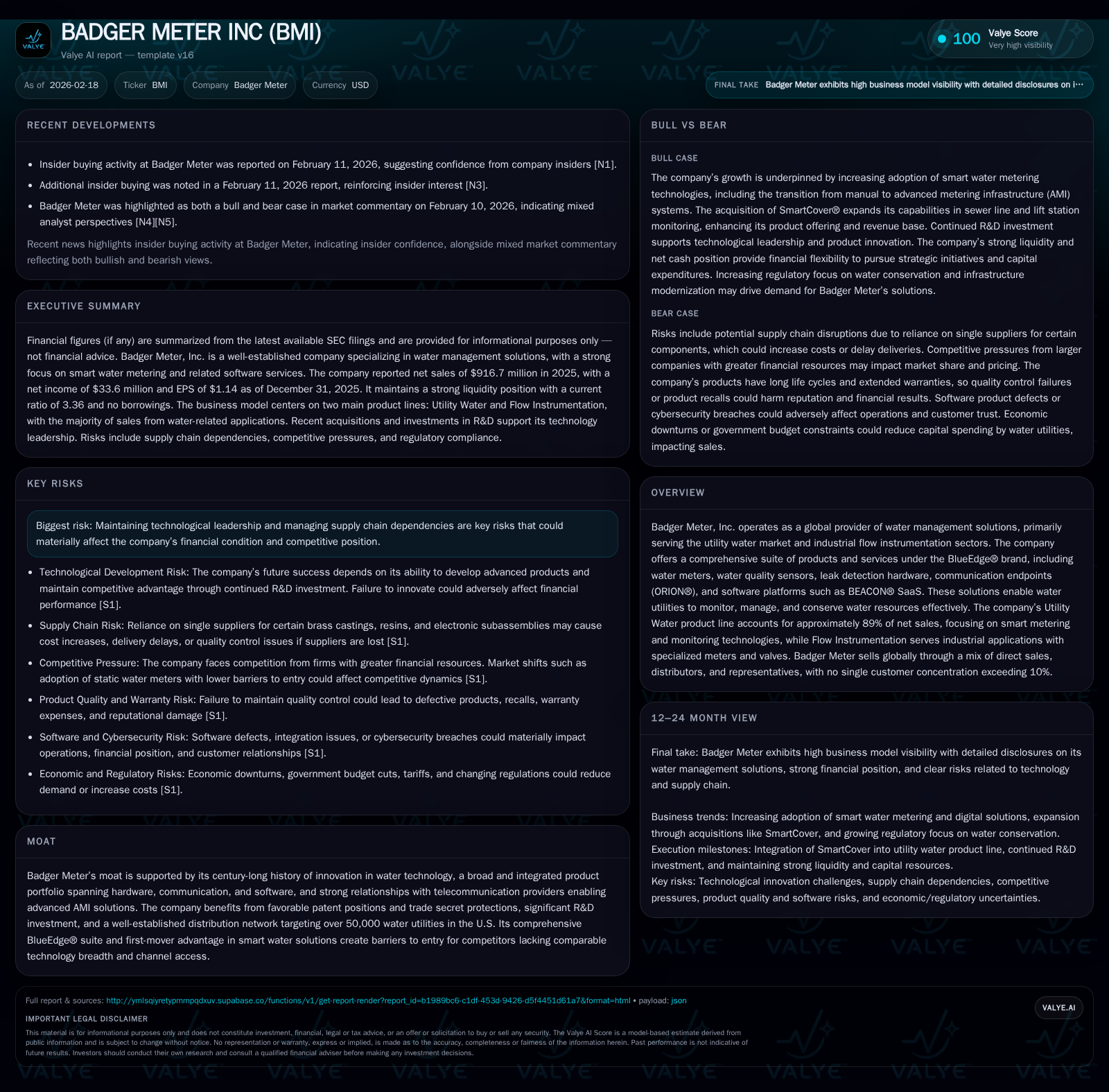
Badger Meter has transformed from a traditional water meter manufacturer into a provider of comprehensive smart water solutions through its BlueEdge® platform. The company’s revenue growth has been driven by the expanding adoption of AMI technologies and augmented SaaS offerings, supported by strategic acquisitions such as SmartCover for sewer monitoring. While operating margins have benefited from the shift toward higher-margin digital products, maintaining technological leadership and managing raw material supply constraints remain critical risks. With growing market penetration and supportive insider signals, Badger Meter is well positioned to capitalize on infrastructure modernization and climate-driven water management pressures.
Legacy Roots and Recent Growth Drivers
Founded in 1905, Badger Meter has built a solid foundation from its reputation for producing durable and accurate mechanical water meters. Over time, the company transitioned towards integrating advanced digital technologies that enable detailed measurement and data collection essential for modern water utilities' operational efficiency [S1][S23]. This transformation is reflected materially in its financial performance: operating income grew from approximately $87.3 million in 2022 to $183.4 million in 2025—a compound annual growth that underscores acceleration fueled by expanding adoption of smart metering solutions [F1].
The shift towards AMI systems and ultrasonic meters, which offer persistent accuracy reducing non-revenue water losses, indicates customer preference for higher performance instrumentation beyond classic mechanical meters—a trend central to driving recent sales growth within the Utility Water product line—which accounted for nearly 89% of net sales in 2025 [S23][S24]. These advancements have complemented steady gross margin expansions even amidst inflationary raw material pressures.
Transition to AMI and Digital Water Solutions: A Market Overview
Badger Meter operates amid a landscape where more than half of U.S. water utilities seek granular data visibility to optimize infrastructure usage and regulatory compliance. The company estimates approximately 40% penetration of AMI radio solutions among U.S. municipal connections [S1][S23], placing it at the forefront as utilities upgrade from manual or automatic meter reading (AMR) toward fully networked AMI systems.
This transition enables more frequent data capture—moving from monthly or manual reads to near real-time metrics—allowing enhanced leak detection, dynamic pressure management, and nuanced consumption pattern analysis that target reduction of "non-revenue water," which often represents significant utility losses [S23]. Industrial customers also leverage advanced flow instrumentation for process automation and cost control applications [S15]. The move away from purely mechanical meters towards static ultrasonic models adds another layer of technological sophistication while raising barriers for competitors lacking proven long-term reliability [S21].
Revenue Mix Evolution: Software Gains and Hardware Integration
Integral to Badger Meter’s evolving business model is the synergy between hardware (meters, quality sensors) and the BEACON® SaaS platform along with ORION® communication endpoints [S10][S24]. These combined offerings deliver actionable insights on operational parameters enhancing water conservation outcomes.
While exact segmental SaaS revenue figures are not explicitly disclosed in filings, management describes this recurring revenue stream as "margin accretive," reflecting broader industry digital transformation trends [S10]. This integrated approach supports differentiated offerings compared to peers who may provide segmented or standalone elements.
Impact of the SmartCover Acquisition on Product Offering and Market Reach
Supporting its broadening portfolio beyond metering endpoints, Badger acquired SmartCover® Systems in January 2025 for approximately $184 million [S1], marking entry into sewer line and lift station monitoring—a critical domain linking flow measurement with network health maintenance.
SmartCover's intangible assets include developed technology valued at about $59.6 million alongside customer relationships worth approximately $26 million plus goodwill representing brand strength premium [S1]. This acquisition expands exposure beyond traditional utility meters into predictive maintenance solutions using real-time hydrogen sulfide sensing and overflow alerts that complement existing pressure/leak detection assets [S15][S24].
This movement towards holistic water cycle management aligns with industry expectations around sustainability mandates seeking end-to-end leakage control not only at distribution but collection points.
Capital Deployment Strategy: Balancing Acquisitions, Dividends, and Buybacks
Badger Meter exhibits disciplined capital allocation balancing reinvestment with shareholder returns. Operating cash flow grew robustly to $183.7 million in 2025 from $155 million in the prior year while capital expenditures moderately increased to $14 million aligned with capacity expansions and R&D efforts [F1][S5][S13].
Dividends rose consistently from $24.9 million in 2022 to over $43.5 million in 2025 reflecting confidence in cash generation stability with modest buybacks totaling $15 million executed during FY25 after minimal repurchases historically indicating a conservative approach [F1][S4]. The company also maintains no net debt with a substantial liquidity buffer facilitated by a $150 million revolving credit facility expiring mid-2026 preserving financial flexibility for opportunistic acquisitions or working capital needs [S4][S7].
Financial Performance Snapshot: Operating Metrics and Cash Flow Trajectories
Historical performance (annual)
| FY | Net ($mm) | CFO ($mm) | OpInc ($mm) | Capex ($mm) | Net YoY |
|---|---|---|---|---|---|
| 2025 | 34 | 184 | 183 | 14 | +9.3% |
| 2024 | 31 | 155 | 158 | 13 | +24.3% |
| 2023 | 25 | 110 | 118 | 12 | +40.9% |
| 2022 | 18 | 82 | 87 | 6 |
Note: Omitted columns lack sufficient annual XBRL coverage in the provided tags (need ≥2 annual points): Rev. Source: SEC companyfacts cache [F1].
Capital returns and efficiency (annual)
| FY | Div ($mm) | Buybacks ($mm) | FCF ($mm) |
|---|---|---|---|
| 2025 | 44 | 15 | 170 |
| 2024 | 36 | 0 | 142 |
| 2023 | 29 | 0 | 98 |
| 2022 | 25 | 0 | 77 |
Source: SEC companyfacts cache [F1].
Note: Revenue details are not available from provided tags.
The approximate Return on Equity stood at about 4.7% for fiscal year ending December 31, 2025—a figure reflecting capital-intensive operations typical within utility instrumentation sectors but balanced by strong cash flows supporting consistent investment capacity without leverage buildup [F1].
Risks to Technological Leadership and Supply Chain Resilience
Key risk exposures include ongoing technology evolution particularly regarding cellular networks powering ORION endpoints since these radios depend on third-party telecom infrastructure subject to sun-setting protocols beyond company control potentially requiring timely development cycles for compatibility upgrades [S21][S6]. Additionally, raw materials sourcing poses operational risks because some crucial components like brass castings and microprocessors come from single-source suppliers creating points of supply vulnerability exposed by geopolitical tensions or pandemic-related disruptions [S16][S25].
Product quality remains paramount given extended durability expectations; any lapses could damage reputation leading to costly recalls or warranty expenses that could depress profitability [S21]. Intellectual property protection also requires vigilant management due to increasing software reliance amid cybersecurity threats including those intensified by AI technologies [S22]. Overall competitive intensity remains moderate-to-high with multiple incumbents vying across segments but Badger’s integrated BlueEdge platform coupled with entrenched utility relationships partially insulates against commoditization risks [S18][S20].
The Road Ahead: Strategic Outlook on Industry Trends and Company Positioning
Future growth drivers hinge upon accelerating advancement in infrastructure modernization initiatives prompted by aging utilities, tighter environmental regulations targeting sustainable resource usage, and climate resilience imperatives escalating demand for comprehensive leak detection, pressure management, quality monitoring platforms integrated within smart city frameworks globally [S1][N11].
Badger Meter’s comprehensive BlueEdge® suite leverages software-enabled analytics tied directly to flow measurement hardware offering holistic lifecycle engagement—a credible moat given first-mover status validated by strong patent protection and telecommunication partnerships including AT&T/Verizon ensuring early adaptation to emergent wireless technologies vital for future-proofing their AMI offerings [S23][N9][N10]. Insider purchase activity reported recently signals confidence among internal stakeholders regarding outlook amid ongoing innovation investments underpinning sustained competitive differentiation [N9][N10].
Monitoring indicators will include AMI adoption rates surpassing current ~40%, successful integration outcomes post-SmartCover acquisition broadening serviceable markets beyond traditional metering domains, continuous R&D milestone achievements addressing telecom evolution challenges alongside sustained margin contributions from SaaS recurring revenues.
This analysis synthesizes publicly available SEC disclosures along with recent news coverage but does not constitute investment advice or recommendations.
Disclaimer: This is research-only, informational analysis and not investment advice. It may include AI-generated interpretation and general industry context. Always verify important details using primary sources.

Comments