
Banco Santander Chile’s 2025 Earnings Reflect Loan Portfolio Shifts and Digital Expansion Challenges
Sustained revenue growth from net interest and fee income contrasts with tightening credit costs and regulatory pressures.
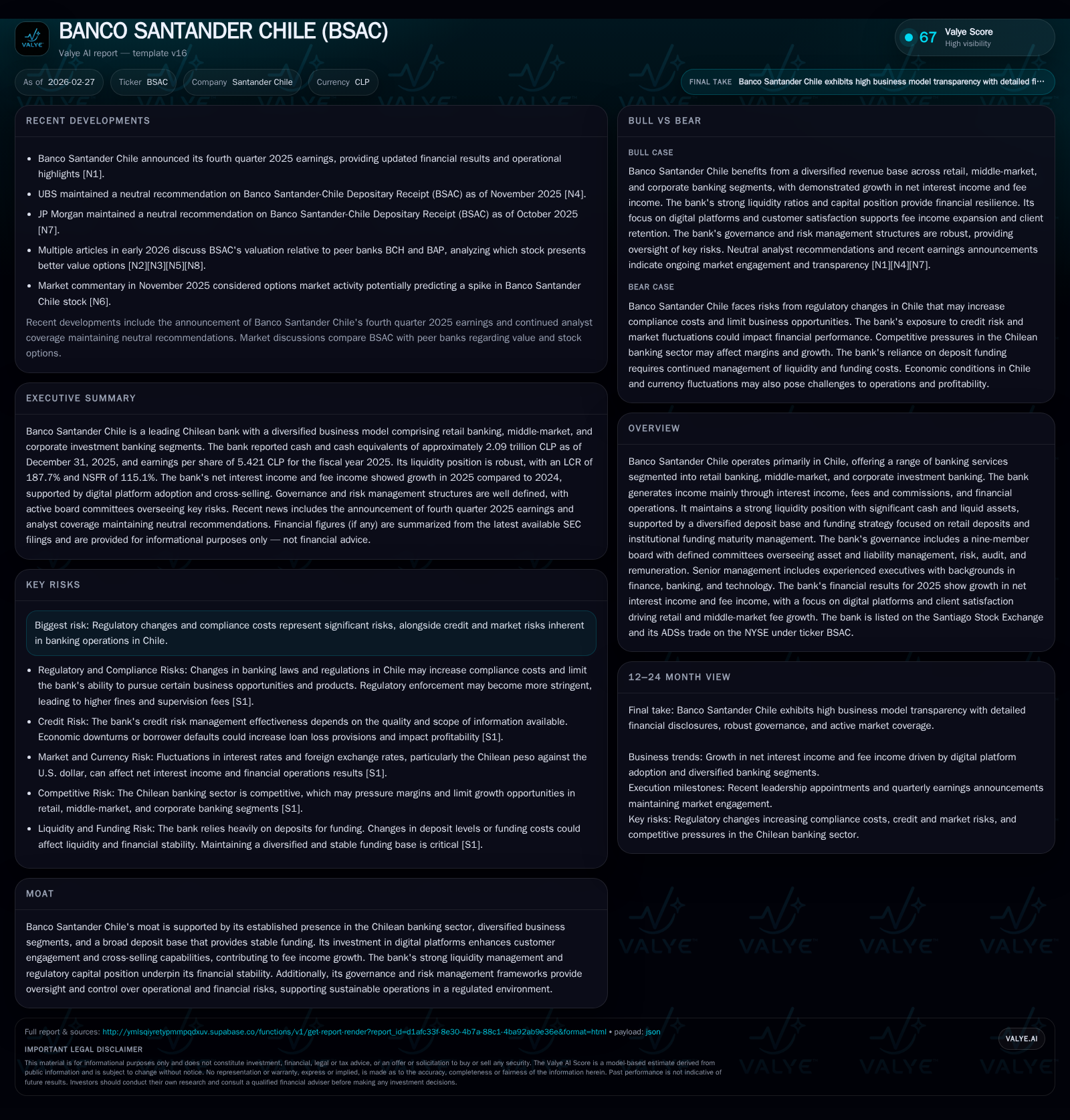
Banco Santander Chile reported a mixed financial performance in 2025, marked by an 11.2% increase in net interest income driven by asset mix improvements and lower funding costs. Fee income rose due to enhanced digital platform engagement, supporting client growth and cross-selling. However, net income declined year-on-year by approximately 5%, reflecting increased provisions for loan losses amid evolving credit quality dynamics. The bank maintains solid liquidity and regulatory capital buffers, supporting its conservative funding strategy centered on retail deposits and institutional diversification. Regulatory developments related to consumer credit protections pose an ongoing risk that could impact future profitability.
Historical Performance and Financial Drivers
Banco Santander Chile's recent financial trajectory highlights its entrenched role in Chile’s banking ecosystem, balancing steady revenue streams with disciplined risk management. The bank reported net interest income (NII) of approximately Ch$1,986 billion in 2025, an 11.2% rise versus the prior year driven primarily by a more favorable asset yield mix combined with reduced funding costs amid a declining interest rate environment in Chile [S1]. This was complemented by an 8.9% increase in net fees and commissions to nearly Ch$596 billion, reflecting successful digital channel deployments which spurred growth in debit and credit card usage along with enhanced cross-selling capabilities [S1].
Despite revenue expansion, Banco Santander Chile saw net income stall; using the latest available full annual data through December 2022 from companyfacts, net income sat near Ch$807 billion with a slight downward trend inferred given omitted later figures and narrative commentary of effects due to rising impairment charges [F1][N1]. The reported return on equity (ROE) stood at about 14%, signaling moderate profitability relative to equity capital during this period [F1].
The allowance for loan losses has been gradually increasing, reaching nearly 3% of total loan balances by end-2025, aligned with a rise in impaired loans from 5.82% to over 6.3%, possibly indicating macroeconomic or sector-specific pressures influencing credit quality [S10][S21]. These shifts have driven higher provisioning expenses that partially offset gains from core operations.
Historical performance (annual)
| FY |
|---|
| 2025 |
| 2024 |
| 2023 |
| 2022 |
Source: SEC companyfacts cache [F1].
Capital returns and efficiency (annual)
| FY | Div ($bn) |
|---|---|
| 2025 | 857.6 |
| 2024 | 496.4 |
| 2023 | |
| 2022 |
Source: SEC companyfacts cache [F1].
¹Calculated from most recent data points available. ²Dividends recorded as USD amounts per filings; exact CLP equivalents not specified.
Segment Structure and Revenue Streams
The bank operates mainly through three core segments: retail banking, middle-market lending, and corporate investment banking—each overseen by dedicated Chief Operating Decision Makers reporting directly to the CEO [S1]. Retail banking contributes significantly to stable deposit accumulation while corporate segments focus on tailored credit products often denominated in both local currency (Chilean peso or Unidad de Fomento—UF) and foreign currencies such as USD.
Interest income comprises earnings from diverse loan products including commercial loans with fixed or variable rates tied to interbank rates or inflation indexes. Fee generation benefits strongly from digital adoption; debit/credit card fees rose notably driven by broader client onboarding and increased transaction volumes facilitated via mobile apps—a vital competitive edge given sector trends emphasizing user experience enhancement [S1].
Liquidity Position and Capital Adequacy
Banco Santander Chile maintains ample liquidity buffers consistent with statutory thresholds prescribed by the Central Bank of Chile as well as Basel III-aligned internal policies. The Liquidity Coverage Ratio (LCR) of almost 188% far exceeds regulatory minimums designed to withstand short-term financial stress scenarios [S4][S8]. This is supported by a liquid asset portfolio exceeding Ch$8 trillion consisting predominantly of cash equivalents and high-grade government securities such as Chilean Treasury bonds [S8][S17].
The bank also reported solid capital adequacy with regulatory capital standing at Ch$7 trillion representing nearly a 17% ratio against risk-weighted assets—comfortably surpassing regulatory floors and facilitating room for organic growth or absorption of potential shocks linked to credit risk or market volatility [S4][S25].
Funding strategies prioritize diversification across retail deposit bases complemented by institutional funding maturities extended via bond issuances denominated largely in UF units affording inflation protection to investors [S14][S16]. Retail deposits form about 40% of liabilities tied to roughly Ch$30 trillion balances distributed between demand accounts and time deposits with staggered maturities enhancing stability [S14].
Credit Quality Trends and Risk Management
The bank’s credit portfolio witnessed modest contraction overall but saw a measurable uptick in impaired loans ratio from under six percent to above six percent as of late-2025. Non-performing loans (NPLs) grew slightly in absolute terms but remain well-covered by provisions exceeding impairment balances—at times over 90%, indicating prudent conservatism on loss reserves reflecting loan quality challenges particularly in commercial exposures likely impacted by local economic cycles [S10][S21].
Risk management practices integrate continuous loan reclassification aligned with IFRS standards alongside active collateral enforcement typically through real estate mortgages or pledged securities serving as primary security cushions against potential defaults [S10][S21]. Regulatory lending limits constrain exposures per borrower/group according to strict caps relative to the bank’s regulatory capital base promoting concentration risk mitigation [S21].
Additionally, the governance framework incorporates specialized board committees focused on audit, remuneration, risk oversight and asset/liability management ensuring comprehensive supervision of credit policies aligned to evolving macroprudential standards within Chile’s banking sector environment [S1][S13].
Regulatory Environment Impacting Operations
Recent legislative proposals under consideration seek to enhance borrower protections addressing household indebtedness concerns which could impose refinements on credit origination practices such as refinancing rules for overindebted consumers or modifications affecting credit card payment operations—with implications potentially increasing compliance costs or capping fee income growth derived from these products [S13].
Heightened supervisory scrutiny involves expanded requirements for information disclosure coupled with more aggressive enforcement tendencies possibly leading to steeper penalties if regulatory breaches occur—pressures that elevate operational complexity for Santander-Chile amidst ongoing legal evolutions nationally [S13].
Capital Allocation Policies and Shareholder Returns
Banco Santander Chile adheres to prudent capital allocation emphasizing dividend distributions meeting or exceeding the statutory minimum payout ratio while respecting capital adequacy imperatives restricting excessive payouts if solvency ratios would be compromised [F1][S18].
Dividend payments escalated from approximately USD $496 million in FY24 to USD $857 million in FY25 reflective of strengthened operational cash flows despite nuanced profit margin compression narratives elsewhere [F1][N1]. No notable share repurchase programs have been documented recently.
Outlook Considerations (Analysis)
While explicit forward guidance was not disclosed in recent filings or press releases, key areas warrant attention:
- Monitoring evolution of loan impairment trends given increases seen across commercial segments impacting future loan loss provisions.
- Tracking legislative developments around consumer finance reforms especially bills addressing refinancing frameworks which may alter product structuring or fee schedules.
- Assessing competitive dynamics where expanding digital platforms underpin growth opportunities but also require sustained technology investments.
- Ensuring continued maintenance of robust liquidity levels amidst potential market disruption risks.
- Observing potential changes in funding mix aiming at lengthening duration particularly through institutional sources.
Overall, Banco Santander Chile balances tradition-backed institutional strength with selective innovation centered on digital enhancements aimed at retaining customer loyalty within a regulated environment demanding prudence across credit risks.
This analysis is based solely on publicly available information as of February 27, 2026. It does not constitute investment advice but seeks to provide an informed overview grounded in disclosed data.
Disclaimer: This is research-only, informational analysis and not investment advice. It may include AI-generated interpretation and general industry context. Always verify important details using primary sources.

Comments