
Consumers Bancorp: Regional Lending Mix and Asset Quality Influence Profitability in a Changing Macro Environment
Consumers Bancorp Inc /OH/ reports steady quarterly earnings and maintains a diversified loan portfolio, but its outlook is shaped by credit risk, regional economic concentration, and the interplay of interest rates and asset quality. The bank’s performance hinges on risk management execution as industry headwinds intensify.
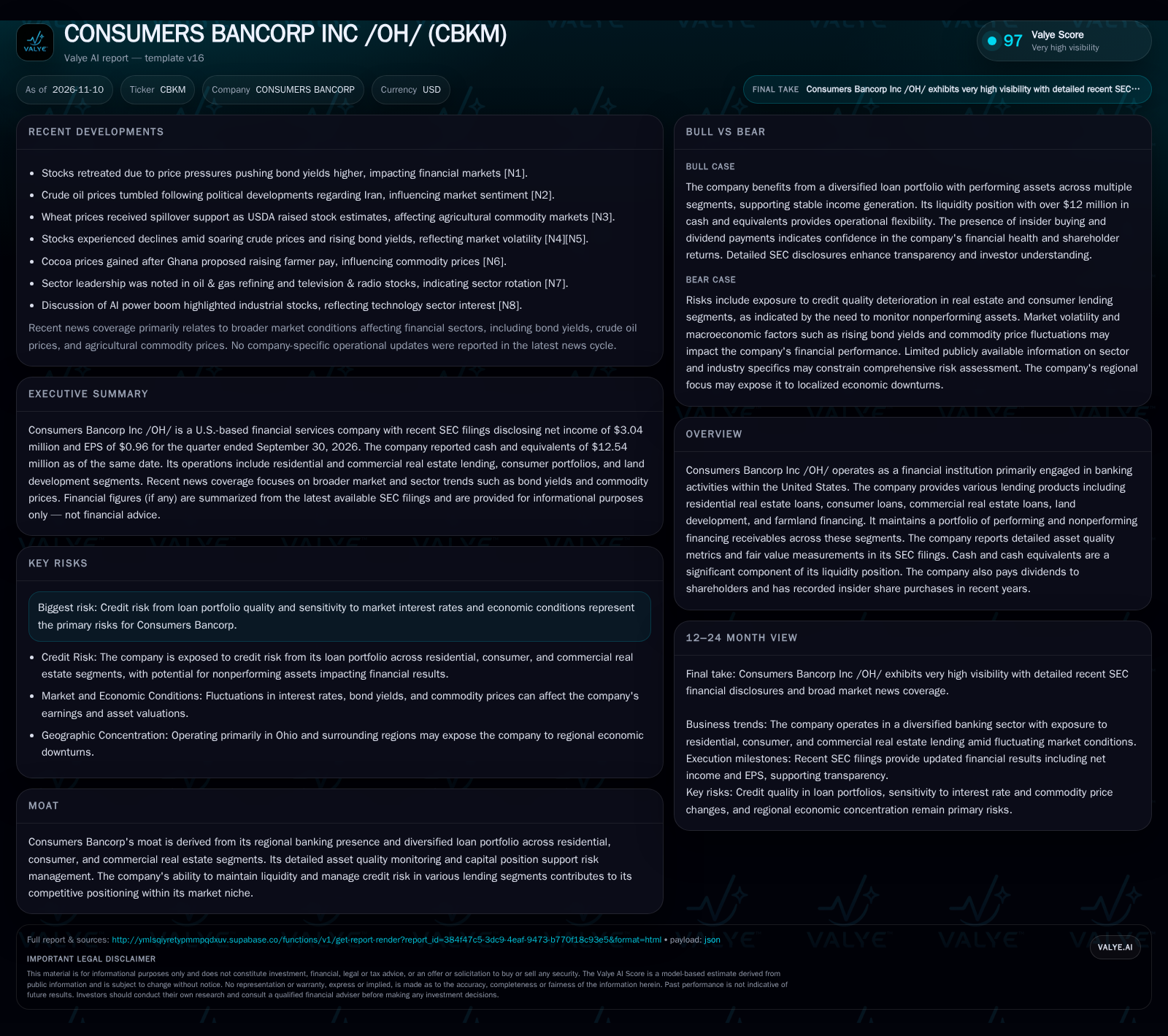
Consumers Bancorp recently reported $3.04 million in quarterly net income and $0.96 EPS, supported by a diversified loan book across residential, commercial, and consumer segments. Monitoring asset quality metrics and loan growth dynamics will be critical to assessing the sustainability of current returns. [S2]
Consumers Bancorp Inc /OH/ enters late 2026 with solid profitability and a diversified loan portfolio, reporting $3.04 million in net income and $0.96 in EPS for the recent quarter. Its capital position and focus on multiple lending segments provide some insulation from sector shocks, but the bank’s fortunes remain tied to credit quality management and regional economic conditions. As interest rates and macro volatility persist, the key question is whether Consumers Bancorp’s asset quality discipline and risk management can sustain returns without outsized exposure to deteriorating credit or regional concentration.
Recent Earnings Overview, Lending Diversity, and Liquidity Position
Consumers Bancorp Inc /OH/ reported net income of $3.04 million and earnings per share of $0.96 for the quarter ended September 30, 2026 [S2]. The bank’s cash and cash equivalents stood at $12.54 million as of the same date [S2]. Its lending activities span residential and commercial real estate, consumer, land development, and farmland segments, with detailed asset quality disclosures in regulatory filings [S1] [S2]. The company reported cash and liquidity metrics for the period; these figures do not by themselves establish operating runway, investment capacity, financial flexibility, or financing capacity.
Lending Composition and Margin Trends Impacting Profitability
Consumers Bancorp’s core economics are driven by net interest income from its diversified loan portfolio—primarily residential and commercial real estate, consumer loans, and farmland lending. Revenue is inherently sensitive to the spread between interest earned on loans and paid on deposits (net interest margin), which can tighten if funding costs rise faster than loan yields. The mix of fixed versus variable-rate loans, asset duration, and deposit base stability will influence how quickly the bank can reprice assets and manage margin compression.
Operating leverage in regional banking is typically modest, with a largely fixed branch and personnel cost base offset by growth in loan volumes. If loan growth slows or credit losses rise, fixed costs can pressure efficiency ratios.
Capital needs in banking are cyclical: periods of loan growth require retained earnings or new capital to support risk-weighted asset expansion, while downturns test reserve adequacy.Insider transaction activity was reported in the cited source; this activity does not by itself establish insider confidence.
The balance between fixed-rate and variable-rate loan portfolios critically affects Consumers Bancorp’s sensitivity to interest rate fluctuations. A higher proportion of fixed-rate loans can insulate the bank from immediate repricing risk but may lead to margin compression if funding costs rise and loan yields remain static. Conversely, a larger share of variable-rate loans allows for more rapid adjustment of yields in response to rate hikes but exposes borrowers to payment shocks, potentially increasing credit risk. The bank’s ability to strategically manage this loan composition, including potential hedging strategies or selective repricing, will influence its net interest margin stability and overall profitability.
Scale, Relationship Banking, and Local Risk Factors in Regional Markets
Consumers Bancorp’s competitive positioning rests on its regional focus, diversified lending, and ability to monitor asset quality closely. Within the Midwest and smaller community banking peer set, advantages often stem from customer relationships, local underwriting knowledge, and responsiveness to borrower needs. However, these strengths are offset by limited geographic diversification—exposing the bank to local economic cycles, sectoral downturns (e.g., agriculture, regional real estate), and the risk that larger or more tech-enabled banks could outcompete on digital services or pricing.
The rise of direct digital banking, fintech lenders, and consolidation among regional banks creates a shifting landscape. Competitive pressure can manifest in higher deposit costs, tighter loan pricing, or lost share in growth segments. Switching frictions in banking—such as relationship inertia, local knowledge, and service customization—can provide some insulation, but are not insurmountable if larger players or digital-first entrants aggressively pursue the same customer base.
The regional banking landscape’s competitive dynamics are increasingly shaped by technological adoption and customer expectations for digital service delivery. While Consumers Bancorp’s local relationship banking model offers advantages in underwriting nuance and client retention, failure to invest adequately in digital platforms could erode competitive positioning over time. If larger banks or fintech competitors capture market share through superior digital experiences or pricing agility, Consumers Bancorp may face pressure to increase deposit rates or reduce lending spreads, compressing margins. However, if the bank leverages its local knowledge to tailor digital offerings that complement its relationship banking strengths, it could sustain or even enhance customer loyalty and profitability.
Loan Growth and Margin Improvement Potential with Stable Asset Quality
A favorable scenario would see Consumers Bancorp maintain strong asset quality metrics across its loan book, with nonperforming assets remaining low and credit losses contained. In this environment, stable or growing loan demand—especially in commercial or agricultural segments—could support both top-line growth and operating leverage as fixed costs are spread over a larger asset base.
If interest rate volatility subsides and the bank is able to reprice loans upward faster than deposit costs rise, net interest margins could improve. Evidence for this scenario would include declining nonperforming loan ratios, expanding loan balances, and positive trends in reported net interest margin.
Falsification would occur if asset quality weakens, loan growth stalls, or margin compression persists despite stable rates.
In an environment where loan demand strengthens, particularly in resilient sectors such as agriculture or essential commercial real estate, Consumers Bancorp could realize meaningful operating leverage gains. Growth in loan volumes would not only increase net interest income but also dilute fixed operating expenses, improving efficiency ratios. Furthermore, if the bank successfully maintains disciplined credit underwriting amid rising rates, it could avoid elevated loan loss provisions, preserving profitability. An additional positive factor would be the stabilization or reduction of deposit funding costs, which would enhance net interest margin. Continuous monitoring of loan portfolio segmentation and credit trends would help validate this favorable trajectory.
Expected Outcomes: Profitability Stability Amid Credit and Rate Sensitivities
The most plausible scenario is one of continued modest profitability, with Consumers Bancorp leveraging its diversified loan mix to offset volatility in any single lending segment. Net interest margin may face incremental compression as deposit costs rise and competition for creditworthy borrowers intensifies, but active risk management and local market presence help sustain returns.
Loan growth may decelerate if regional economic activity slows or if borrowers become more risk-averse amid macro uncertainty. Asset quality is likely to remain stable if no major regional shock occurs, but pockets of stress could emerge in commercial real estate or agriculture if commodity prices or local economic conditions deteriorate.
Evidence supporting this scenario includes stable EPS, moderate changes in loan loss provisions, and asset quality metrics that do not show significant deterioration. A material shift in nonperforming loans, deposit outflows, or sudden margin contraction would challenge this baseline.
Profitability Risks from Credit Quality Decline or Regional Economic Weakness
A negative turn would likely be driven by a combination of rising nonperforming assets, credit losses, and shrinking loan demand—especially if the regional economy falters or specific lending segments (e.g., commercial real estate, agricultural loans) experience shocks. In this scenario, Consumers Bancorp could face increased loan loss provisions, higher funding costs if depositors seek yield elsewhere, and margin compression that erodes profitability.
Further challenges could arise if regulatory scrutiny tightens in response to sector-wide credit stress, requiring higher capital buffers or constraining dividend payments. Evidence of this scenario would include a rapid increase in nonperforming asset ratios, negative trends in net interest margin, and reductions or suspensions in shareholder returns.
Evaluating Consumers Bancorp’s Resilience Across Economic Cycles
Nonperforming assets as a percentage of total loans—particularly trends by segment—would test asset quality management and credit risk discipline.
Net interest margin and its sensitivity to further changes in deposit or funding costs, if disclosed, would clarify earnings power under rate volatility.
Loan growth rates by category (residential, commercial, consumer, agricultural) would indicate whether the bank is capturing new business or losing ground to competitors.
Deposit inflows/outflows and mix (core vs. time deposits), if disclosed, would reveal franchise stability and funding resilience.
Provision for loan losses and reserve coverage ratios would signal management’s assessment of emerging credit risk.
Efficiency ratio trends—how well expense growth is managed relative to revenue—would help evaluate operating leverage.
Insider transaction activity was reported in the cited source; this activity does not by itself establish insider confidence.
Regional economic indicators (e.g., unemployment, real estate activity, commodity trends) would provide context for localized credit risk exposure.
Disclaimer: This is research-only, informational analysis and not investment advice. It may include AI-generated interpretation and general industry context. Always verify important details using primary sources.

Comments