
Groupon’s Marketplace Model at a Crossroads: Can Technology Investment Outpace Pressures on Profitability?
Groupon’s modest revenue growth and persistent net losses highlight the tension between platform modernization, competitive intensity, and structural profitability.
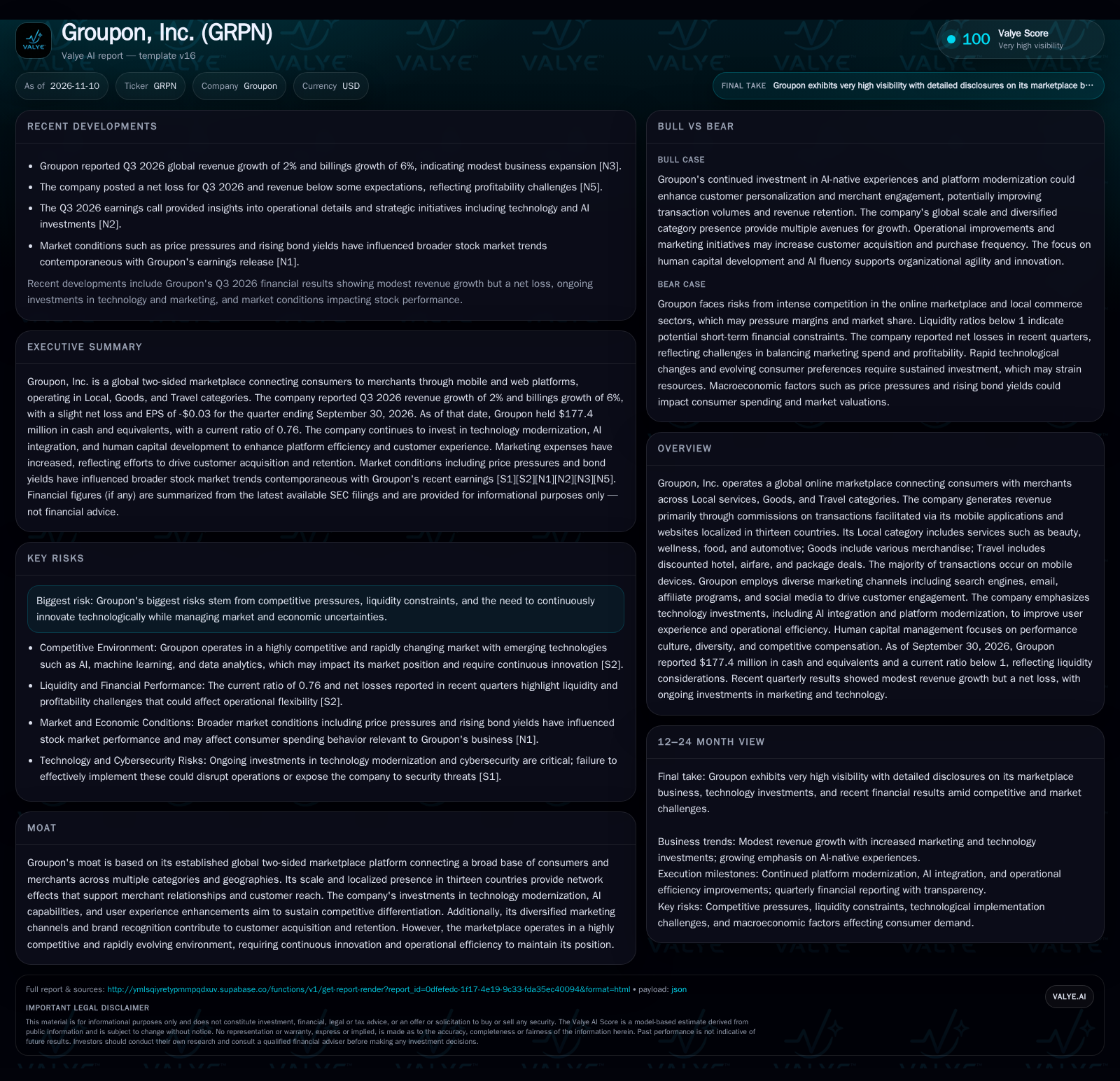
Groupon reported 2% global revenue growth and a net loss for Q3 2026, with a current ratio below 1 and increasing marketing spend. The company is investing heavily in AI and platform improvements to boost engagement and merchant value. With competitive pressures intensifying and liquidity thin, Groupon’s ability to translate product innovation into higher transaction volumes and better economics is now the fulcrum for its next phase.
Groupon stands at a strategic crossroads. Despite a modest uptick in global revenue and billings in Q3 2026, the company continues to report net losses and faces liquidity pressures, with current assets falling short of current liabilities. The push to modernize its platform—anchored in AI, mobile-first experiences, and operational efficiency—suggests a bid to reignite engagement and drive volume, but the path to sustainable profitability remains uncertain. As competition in the online marketplace intensifies and consumer preferences evolve rapidly, Groupon’s future will hinge on its ability to turn technology investment and marketing spend into lasting improvements in both sides of its marketplace.
Q3 2026 Snapshot: Slender Growth, Persistent Losses, and Liquidity Headwinds
Groupon reported global revenue of $125.45 million for Q3 2026, reflecting 2% year-over-year growth, while billings increased by 6% [N3] [S2]. Despite these modest top-line gains, the company posted a net loss of $0.81 million for the quarter, with basic and diluted EPS of -$0.03 [S2]. [S2] Marketing expenses rose year-over-year, signaling increased investment in customer acquisition and retention [S2]. The Q3 2026 results missed some revenue expectations, and the company continues to face profitability challenges [N5].
Marketplace Economics: Commission-Driven Revenue Meets Rising Operating Costs
Groupon’s core business model revolves around facilitating transactions between consumers and local merchants, generating revenue primarily through commissions on Local services, Goods, and Travel categories [S1]. The platform’s economics are shaped by transaction volume, commission rates, and the mix of higher-margin Local experiences versus typically lower-margin Goods and Travel. With 84% of transactions occurring on mobile, optimizing mobile engagement is central to driving volume and repeat usage [S1].
Operating leverage is theoretically achievable if fixed platform and technology investments yield higher transaction volumes without proportional increases in variable costs. However, persistent net losses and rising marketing expenses suggest that incremental revenue is still being offset by the need for aggressive acquisition and retention spend [S2]. The company’s cost structure includes significant marketing, technology development, and administrative expenses, and the recent increase in marketing spend reflects the competitive necessity to maintain consumer mindshare. Groupon’s ongoing investments in AI, API modernization, and customer experience improvements are intended to boost long-term efficiency and conversion, but these outlays weigh on short-term profitability and liquidity [S1] [S2].
A critical factor influencing Groupon’s marketplace economics is the balance between customer acquisition cost and customer lifetime value. If the incremental marketing spend required to attract new users or merchants does not result in proportionate increases in repeat transactions or higher spend per user, the unit economics remain unfavorable. This dynamic is particularly relevant in a marketplace model where network effects can amplify returns once a critical mass is achieved. However, if churn rates remain elevated or if the platform struggles to deepen engagement beyond initial transactions, the fixed costs of platform development and marketing may not be sufficiently leveraged, perpetuating a cycle of suboptimal profitability.
Moreover, the commission structure itself is subject to competitive and regulatory pressures that could compress margins over time. If merchants negotiate for lower commission rates due to alternative marketing channels or if regulatory scrutiny increases around platform fees, Groupon’s revenue per transaction could decline. Conversely, successfully shifting the transaction mix toward higher-margin Local services rather than Goods or Travel could enhance profitability, but this depends on consumer demand elasticity and merchant willingness to participate in those categories. The interplay between transaction mix, commission rates, and volume growth will thus be a key determinant of sustainable economics.
Competitive Intensity and Substitution: Can Product Innovation Restore Differentiation?
Groupon operates in a crowded and evolving online marketplace where barriers to entry are low and customer switching costs are modest. Primary competitive threats come from other deal aggregators, e-commerce platforms, local search providers, and direct-to-consumer merchant marketing. The core value proposition—curated, discounted local experiences—faces substitution risk from platforms offering greater personalization, loyalty programs, or seamless integration with social and mapping apps.
Groupon’s attempt to differentiate via AI-driven personalization, enhanced search, and curated mobile experiences aims to improve both consumer discovery and merchant ROI [S1]. However, these advantages are not yet proven to deliver sustained engagement or higher retention. The company’s global scale and two-sided marketplace provide some network effect, but the intensity of competition for both merchants and consumers limits pricing power and makes sustaining higher commission rates challenging. If Groupon’s technology investments do not tangibly improve purchase frequency or merchant satisfaction, the risk is further erosion of relevance and increased churn.
If AI-Native Experiences Unlock Higher Engagement and Volume
A favorable outcome for Groupon would see its investments in AI, mobile interface improvements, and marketing automation translating into a material uplift in both consumer engagement and merchant participation. AI-powered recommendation engines and more intuitive search could support customer engagement; company-specific conversion rates are not disclosed, while automated marketing tools might lower acquisition costs for merchants, making the platform more attractive.
If these technology enhancements result in a visible increase in transaction frequency, repeat usage, and a shift toward higher-margin Local services, Groupon could achieve meaningful operating leverage. Confirmation would come from accelerating revenue growth outpacing marketing spend, improved gross margin, and a return to consistent profitability. Evidence for this scenario would include rising active user counts (if disclosed), higher merchant retention, and a narrowing net loss or transition to positive net income over several quarters.
Platform Modernization Buys Time, But Profitability Remains Elusive
The most plausible trajectory is one where Groupon’s technology and marketing investments yield incremental improvements, but competitive intensity and the commoditization of online deals cap both volume growth and commission rates. The company may sustain low-single-digit revenue growth, but persistent marketing and tech outlays keep operating margins thin or negative.
If marketing expenses keep rising without a corresponding increase in customer retention or merchant count, the company could remain in a cycle of spending to stand still. Evidence to the contrary would be a pronounced and sustained improvement in gross and operating margins, or a step-change in customer or merchant engagement metrics.
Liquidity Stress and Competitive Attrition Accelerate Decline
In a more adverse scenario, Groupon’s liquidity position deteriorates further as net losses persist and marketing investments fail to generate sufficient incremental revenue.
If competitors out-innovate Groupon or capture merchant relationships with better economics or integration, Groupon risks further share loss and declining relevance. Evidence for this trajectory would be shrinking revenue or billings, accelerated cash burn, difficulty servicing current liabilities, and potential disclosures around restructuring, asset sales, or capital raises. Worsening net losses and negative cash flow from operations would reinforce the downside case.
Milestones That Will Determine Whether Groupon’s Platform Strategy Can Deliver
Quarterly trends in active customer and merchant counts (if disclosed), which would clarify whether technology and marketing investments are driving sustained engagement.
Gross margin progression, especially as the mix of Local, Goods, and Travel shifts—improvement would suggest better monetization or mix optimization.
Net cash flow from operations, as a direct indicator of whether revenue growth is translating into cash generation or continued burn.
Marketing expense as a percentage of revenue, revealing whether acquisition costs are stabilizing or escalating relative to top-line growth.
Updates on the adoption and impact of AI-driven features (e.g., search, recommendations, merchant tools), which would help validate the technology-led differentiation thesis.
Any disclosed data on repeat purchase rates or customer lifetime value, which would be leading indicators of improved retention and platform stickiness.
Competitive disclosures from peers or market entrants that signal shifts in merchant or consumer preference away from Groupon.
Disclaimer: This is research-only, informational analysis and not investment advice. It may include AI-generated interpretation and general industry context. Always verify important details using primary sources.

Comments