
Provectus Biopharmaceuticals: Proprietary Immunotherapy Ambition Confronts Liquidity and Development Hurdles
Provectus Biopharmaceuticals is advancing a differentiated immunotherapy platform based on patented, pharmaceutical-grade rose bengal sodium with diverse clinical programs and significant intellectual property.
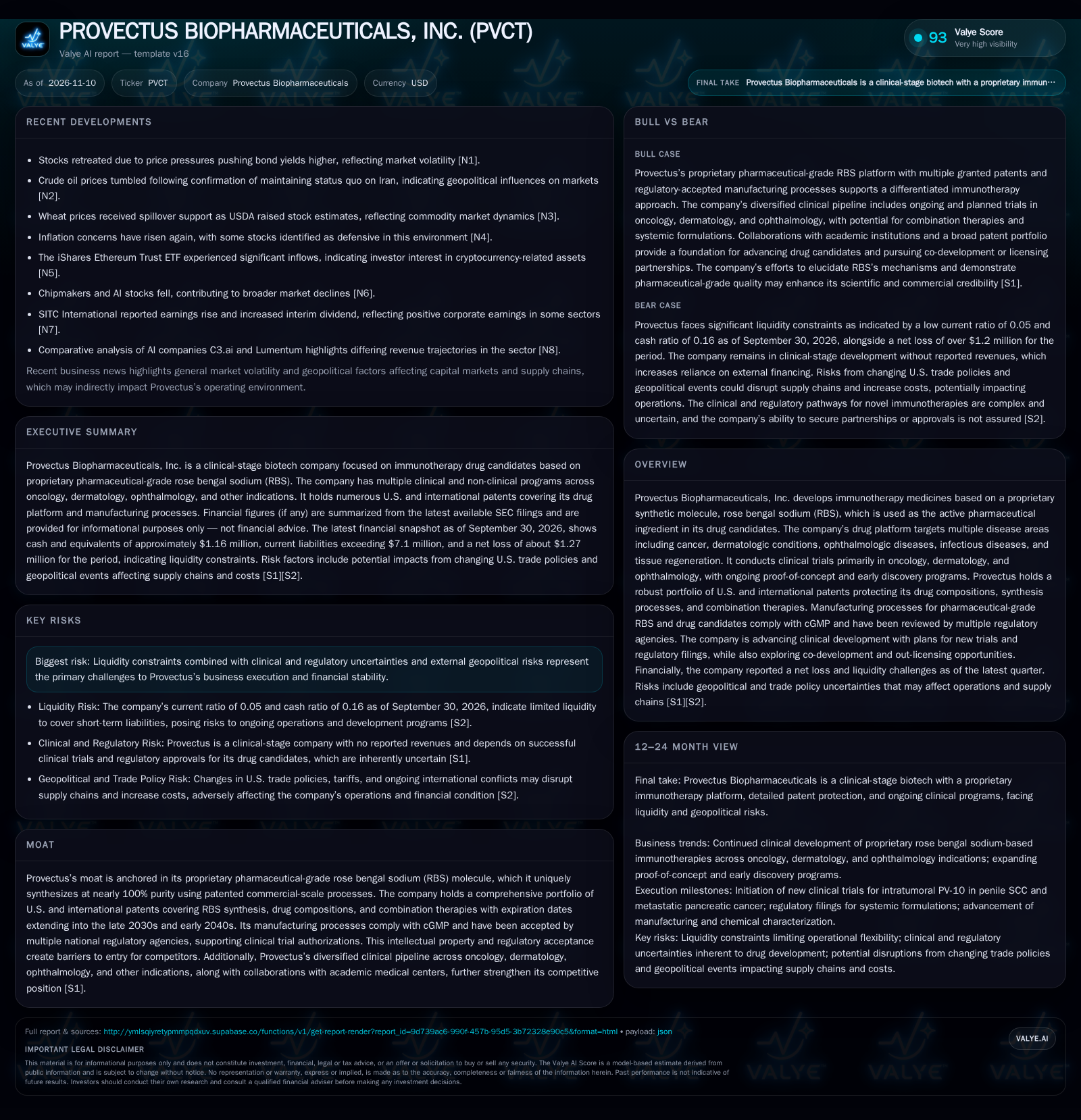
Provectus Biopharmaceuticals is a clinical-stage biotech company developing immunotherapies based on its proprietary, nearly pure rose bengal sodium molecule, with broad patent protection and ongoing clinical programs in oncology, dermatology, and ophthalmology. The near-term viability of its clinical and partnership ambitions depends on securing new capital or strategic collaborations in a challenging macro and regulatory environment. [S1] [S2]
Provectus Biopharmaceuticals stands at a strategic crossroads: its proprietary immunotherapy platform, built on pharmaceutical-grade rose bengal sodium and shielded by extensive patent protection, underpins a broad and ambitious clinical pipeline spanning oncology, dermatology, and ophthalmology. Despite regulatory validation of its manufacturing processes and unique intellectual property, the company faces a stark liquidity crunch, with cash and equivalents dwarfed by current liabilities and no revenue base. The interplay between clinical advancement, capital constraints, and external macro risks will likely determine whether Provectus can convert scientific promise into commercial or partnership success.
Acute Liquidity Constraints and a Diversified Clinical Pipeline Define the Moment
As of September 30, 2026, Provectus Biopharmaceuticals reported cash and equivalents of $1,156,915 and current assets of $375,197, set against current liabilities of $7,105,465, yielding a current ratio of just 0.05 and a cash ratio of 0.16. This severe imbalance highlights an immediate liquidity challenge: the company’s available resources are dwarfed by its short-term obligations. [S2]
Provectus remains pre-revenue and posted a net loss of $1,266,276 for the period, confirming ongoing operating losses typical of a clinical-stage biotech. [S2]
Despite these constraints, the company continues to advance a portfolio of clinical and proof-of-concept programs based on its proprietary pharmaceutical-grade rose bengal sodium (RBS), with patents covering compositions, synthesis, and combination therapies across oncology, dermatology, and ophthalmology. [S1]
Regulatory agencies—including the FDA—have reviewed and accepted Provectus’s cGMP-compliant manufacturing processes, supporting the company’s ability to produce RBS at commercial scale and purity. [S1]
Commercialization Pathways and the Economics of Proprietary Immunotherapy
Provectus’s business model is anchored in developing novel therapeutics based on RBS across multiple indications, with potential revenue streams from direct product sales, out-licensing, or co-development partnerships if clinical milestones are met. As a clinical-stage company, it currently generates no product revenue and is reliant on external funding to sustain operations and progress trials. [S2]
The ability to produce pharmaceutical-grade RBS at nearly 100% purity, protected by robust patents, positions Provectus to control the supply chain and potentially command premium pricing if its drug candidates achieve regulatory approval. However, the economics of such a platform are contingent on successful clinical outcomes and subsequent payer adoption, which are inherently uncertain.
The company’s diversified pipeline—spanning oncology, dermatology, ophthalmology, and early-stage programs in wound healing, infectious diseases, and animal health—could, in theory, provide multiple shots on goal and risk diversification. However, the capital intensity of running parallel clinical programs, especially without revenue, amplifies the risk of financial exhaustion before value inflection points are reached.
Operating leverage could become significant if any candidate advances to late-stage trials or commercial launch, as fixed R&D and manufacturing investments could support multiple indications.
Proprietary RBS Platform and Patent Protection as Barriers to Entry—But Clinical and Commercial Uncertainties Persist
Provectus’s competitive moat rests on its proprietary, pharmaceutical-grade RBS molecule, for which it is reportedly the only company to have advanced into clinical trials, and on a portfolio of patents covering synthesis, formulations, and combination therapies through at least 2041. [S1]
The company’s ability to synthesize RBS at near-total purity and at commercial scale, with cGMP-compliant processes accepted by regulatory agencies, could further deter competitors and facilitate regulatory approvals.
However, the fundamental risk in clinical-stage biotech is that intellectual property and process control provide no guarantee of clinical or commercial success. Competitors in immuno-oncology, wound healing, and dermatology—ranging from large pharmaceutical companies to emerging biotechs—may pursue alternative mechanisms, combination regimens, or delivery modalities that could bypass or outcompete RBS-based therapies depending on comparative efficacy, safety, and cost.
Switching costs and barriers to entry could be meaningful if Provectus’s therapies demonstrate unique clinical benefits or safety/tolerability advantages, especially in indications with high unmet need. However, absent late-stage clinical data or regulatory approval, the company remains exposed to rapid shifts in the competitive landscape and to the risk that larger players could develop workarounds or alternative approaches.
Breakthrough Clinical Data or Strategic Partnership Unlocks Value
A favorable scenario for Provectus would hinge on one or more of its RBS-based drug candidates delivering compelling efficacy and safety data in ongoing or planned clinical trials—particularly in high-need oncology indications such as metastatic pancreatic cancer or rare tumors like penile SCC. Positive results could validate the platform’s differentiated mechanism and trigger interest from larger pharmaceutical partners or investors.
Such an outcome might enable Provectus to secure co-development deals, out-licensing arrangements, or non-dilutive funding, providing both capital and external validation. The ability to demonstrate robust pharmaceutical-grade quality and proprietary manufacturing could further enhance the company’s negotiating position.
Evidence confirming this scenario would include the announcement of statistically significant clinical trial results, strong safety profiles, regulatory fast-track designations, or formal partnership agreements with well-capitalized industry players. Additionally, the successful initiation and enrollment of new trials in new indications would support the thesis that the platform has broad applicability and momentum.
Incremental Clinical Progress Amid Ongoing Funding and Execution Pressure
The most plausible outcome is that Provectus continues to make incremental progress in its clinical programs while contending with persistent liquidity and operational challenges. In this scenario, the company may initiate new trials or advance existing ones, but slow patient enrollment, capital constraints, or regulatory complexities could delay data readouts and push back value inflection points.
Absent a near-term partnership or a breakthrough clinical milestone, Provectus would likely need to pursue additional financing—potentially on dilutive terms—to sustain operations. The company’s ability to weather external shocks, such as supply chain disruptions or macroeconomic volatility, would remain limited by its acute cash shortfall.
Confirmation of this scenario would come from continued but measured clinical updates, announcements of small-scale financing or grants, and ongoing disclosures of liquidity challenges without major strategic deals or clinical breakthroughs.
Liquidity Exhaustion or Clinical Setback Forces Restructuring
A negative scenario would be triggered if Provectus is unable to secure new funding or a strategic partnership before exhausting its limited cash resources, forcing it to halt or significantly curtail clinical operations. [S2]
Alternatively, a material clinical or regulatory setback—such as the failure of a lead program to meet efficacy or safety endpoints, or rejection of a regulatory filing—could undermine investor confidence and choke off access to new capital.
Evidence that would confirm this scenario includes public disclosures of trial suspensions, workforce reductions, default on obligations, or a going-concern warning in future filings. A lack of new financing announcements or clinical progress updates would also be a negative signal.
Milestones and External Factors That Will Determine Provectus’s Trajectory
Progress and data readouts from ongoing and planned clinical trials in oncology, dermatology, and ophthalmology—especially for PV-10 in rare or high-value indications—would directly test the scientific and commercial thesis.
Announcements of new financing rounds, non-dilutive funding, or strategic partnerships would be critical to assess Provectus’s ability to continue operations and invest in clinical progress.
Updates on regulatory interactions—such as IND acceptances, fast-track designations, or manufacturing inspections—would help gauge the likelihood of advancing toward approval.
Any disclosure of disruptions or cost increases in the company’s supply chain, particularly as a result of trade policy changes or geopolitical events, would be material given current financial fragility.
A useful metric would be cash runway projections or explicit going-concern statements in future SEC filings, as these would clarify the timeline and urgency of funding needs.
Evidence of out-licensing, co-development, or academic collaboration agreements—if disclosed—would indicate external validation and risk-sharing.
Monitoring for the initiation and enrollment status of new clinical trials, particularly for systemic formulations or novel indications, would provide insight into operational momentum and broader pipeline potential.
Disclosure of patent challenges or the emergence of competing therapies with similar mechanisms could alter the competitive landscape and should be tracked for potential impact.
Disclaimer: This is research-only, informational analysis and not investment advice. It may include AI-generated interpretation and general industry context. Always verify important details using primary sources.

Comments