
Cadiz Inc.: Water Asset Leverage Meets Persistent Losses and Regulatory Uncertainty
Cadiz Inc. sits at the intersection of California’s water scarcity and infrastructure needs, backed by specialized water rights and delivery agreements. Yet persistent losses, modest revenue, and regulatory hurdles continue to test the viability of its capital-intensive model—even after a $21 million capital infusion and new CFO appointment.
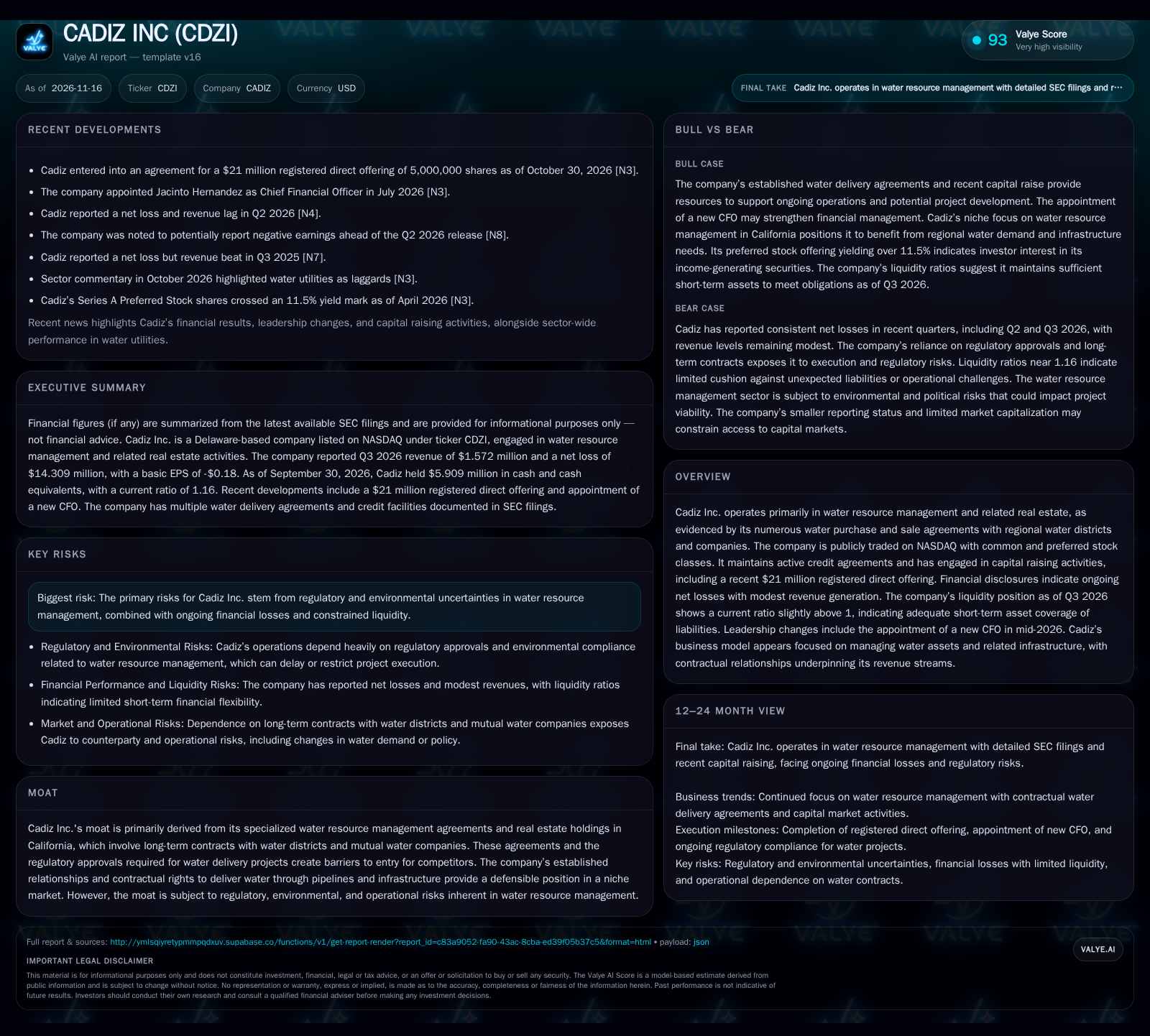
Cadiz Inc. continues to operate at a loss, with Q3 2026 revenue of $1.57 million and a net loss of $14.3 million. The company raised $21 million in a direct offering in October 2026 and maintains several water purchase/delivery agreements, but its business remains exposed to regulatory, operational, and financial risk. The ability to convert water rights and contracts into sustained, profitable cash flow remains the core challenge for the company’s future.
Cadiz Inc. operates as a niche player in California’s high-stakes water resource management sector, leveraging water rights and infrastructure agreements to address regional scarcity. Despite specialized assets and recent capital raised, the company continues to post substantial losses and faces a complex web of regulatory and execution risks. The central question for Cadiz is whether its contractual water assets and new capital can be converted into sustainable, recurring profitability—or whether persistent losses and operational headwinds will force strategic retrenchment.
Recent Capital Raise and Ongoing Losses Define Cadiz’s 2026 Backdrop
For the quarter ended September 30, 2026, Cadiz Inc. reported revenue of $1.572 million and a net loss of $14.309 million, with a basic loss per share of $0.18. As of the same date, the company’s cash and cash equivalents totaled $5.909 million, with a current ratio of 1.16, indicating short-term asset coverage only marginally above liabilities. In October 2026, Cadiz completed a $21 million registered direct offering of 5 million shares, providing a substantial, though not transformational, liquidity boost after several quarters of negative earnings. The company’s business remains anchored by water purchase, sale, and option agreements with regional water districts and companies, reflecting its focus on water resource management and related infrastructure in California. [S2] [S1]
Water Rights and Infrastructure: Capital-Intensive Model With Uneven Revenue Realization
Cadiz’s economics hinge on monetizing water rights and related infrastructure, typically through long-term agreements with water districts and mutual water companies. The potential for high-margin revenue exists if water deliveries scale, but the business is inherently capital-intensive: significant upfront investment is required for land, permitting, pipeline development, and regulatory compliance. Revenue recognition is likely lumpy and project-based, dependent on the timing of contract execution and water deliveries—rather than recurring, predictable cash flows. Variable costs may be moderate once contracts are operational, but the fixed cost base and ongoing compliance expenses create operating leverage that can amplify losses when revenue underperforms. The company reported cash and liquidity metrics for the period; these figures do not by themselves establish operating runway, investment capacity, financial flexibility, or financing capacity. However, if project ramp and regulatory approvals are delayed, ongoing losses may quickly erode the benefits of recent capital raises.
The capital-intensive nature of Cadiz’s model also implies a significant sensitivity to the timing and scale of cash flows. Delays in regulatory approvals or contract commencements can extend the period before any meaningful revenue is realized, increasing the risk of capital depletion before profitability is achieved.
Barriers and Risks in California’s Water Market
Cadiz’s competitive position is built around its portfolio of water rights, real estate, and long-term agreements—assets that are difficult to replicate due to California’s complex regulatory and environmental landscape. Entry barriers stem from the protracted permitting process, water rights litigation, and the need for infrastructure investment. However, Cadiz faces counterforces: regional water authorities, municipalities, and private utilities all compete for scarce water resources, and existing incumbents may have regulatory, political, or local relationship advantages. Substitute solutions—such as water recycling, desalination, or conservation initiatives—could impact demand for new water deliveries. Additionally, Cadiz’s reliance on a handful of large contracts exposes it to counterparty and policy risk if water demand projections shift or if regulatory approvals are delayed or denied. The company’s smaller scale and recurring losses may also limit its negotiating leverage relative to larger, better-capitalized infrastructure peers.
Another dimension influencing Cadiz’s competitive position is the evolving regulatory environment governing water rights and environmental compliance in California. Policy shifts towards sustainability and ecosystem preservation could impose stricter constraints or additional costs on water extraction and delivery, potentially limiting the volume of water that Cadiz can monetize. Conversely, increasing regulatory emphasis on drought resilience and water infrastructure modernization might create opportunities for firms with ready-to-deploy assets. The interplay between these regulatory trends and Cadiz’s strategic positioning will be critical, as the company must navigate both compliance costs and potential incentives or subsidies tied to sustainable water management.
Unlocking Water Deliveries and Regulatory Wins Could Drive Step-Change in Profitability
A favorable scenario for Cadiz would see the company successfully securing all required regulatory approvals, allowing it to execute on existing water purchase and sale agreements at scale. If water deliveries ramp as planned, fixed costs could be leveraged across higher revenue, potentially turning negative margins positive and enabling more predictable cash flow. Confirmation of this scenario would come from sequential increases in reported water delivery volumes, material revenue growth, and evidence of contract expansion or renewal with existing customers. Regulatory clarity or favorable court decisions could also unlock latent asset value and reduce investor risk perception. If Cadiz is able to access debt or non-dilutive capital based on contracted cash flows, it could further accelerate infrastructure buildout and reduce dilution risk.
Cadiz Continues in a Capital-Constrained, Project-Driven Cycle
The most plausible course is that Cadiz continues to operate in a lumpy, capital-constrained environment: periodic capital raises bridge ongoing losses, while water delivery projects advance incrementally through regulatory and contractual stages. Revenue may remain modest and volatile in the near term, with operating losses persisting until a step-change in project execution occurs. Confirmation would be ongoing modest revenue growth, recurring net losses, and further reliance on equity or preferred stock offerings to fund operations. Delays or incremental progress on regulatory approvals would reinforce this scenario, as would a lack of major new customer contracts or project milestones.
Prolonged Regulatory Delays and Cash Burn Force Strategic Retrenchment
A negative outcome could result if regulatory or legal setbacks stall key water projects, preventing Cadiz from converting water rights into operating cash flow. In this scenario, persistent losses would quickly consume the recent $21 million capital infusion, potentially forcing the company to seek additional, more dilutive financing or to sell assets at depressed valuations. Signs of this scenario would include continued revenue stagnation or decline, shrinking cash balances quarter-over-quarter, and disclosures of delayed or failed regulatory milestones. If counterparties in water delivery agreements face their own financial or policy headwinds, Cadiz’s revenue visibility could deteriorate further, heightening risk of covenant breaches or distressed asset sales.
Milestones That Will Reveal Whether Cadiz Can Convert Assets to Profitable Growth
Quarterly water delivery volumes, if disclosed, would provide direct evidence of contract execution and revenue ramp.
Progress on regulatory approvals or legal milestones tied to major water projects is critical for unlocking value.
Material changes in customer contract pipeline—such as new long-term agreements, renewals, or terminations—would signal demand and execution risk.
Evidence of operating leverage—such as narrowing operating losses as revenue grows—would confirm the model’s scalability.
Changes in the company’s ability to access non-dilutive capital (e.g., debt secured by contracts) would affect funding risk.
If disclosed, average realized price per acre-foot of water sold would help assess pricing power and margin potential.
Any updates on environmental or policy challenges in California’s water market could materially affect project timelines and risk.
Disclaimer: This is research-only, informational analysis and not investment advice. It may include AI-generated interpretation and general industry context. Always verify important details using primary sources.

Comments