
Chemed Corp’s Dual-Segment Growth: Challenges and Capital Strategies in Hospice and Home Services
Chemed balances Medicare-dependent hospice care with branded plumbing services amid regulatory and market pressures.
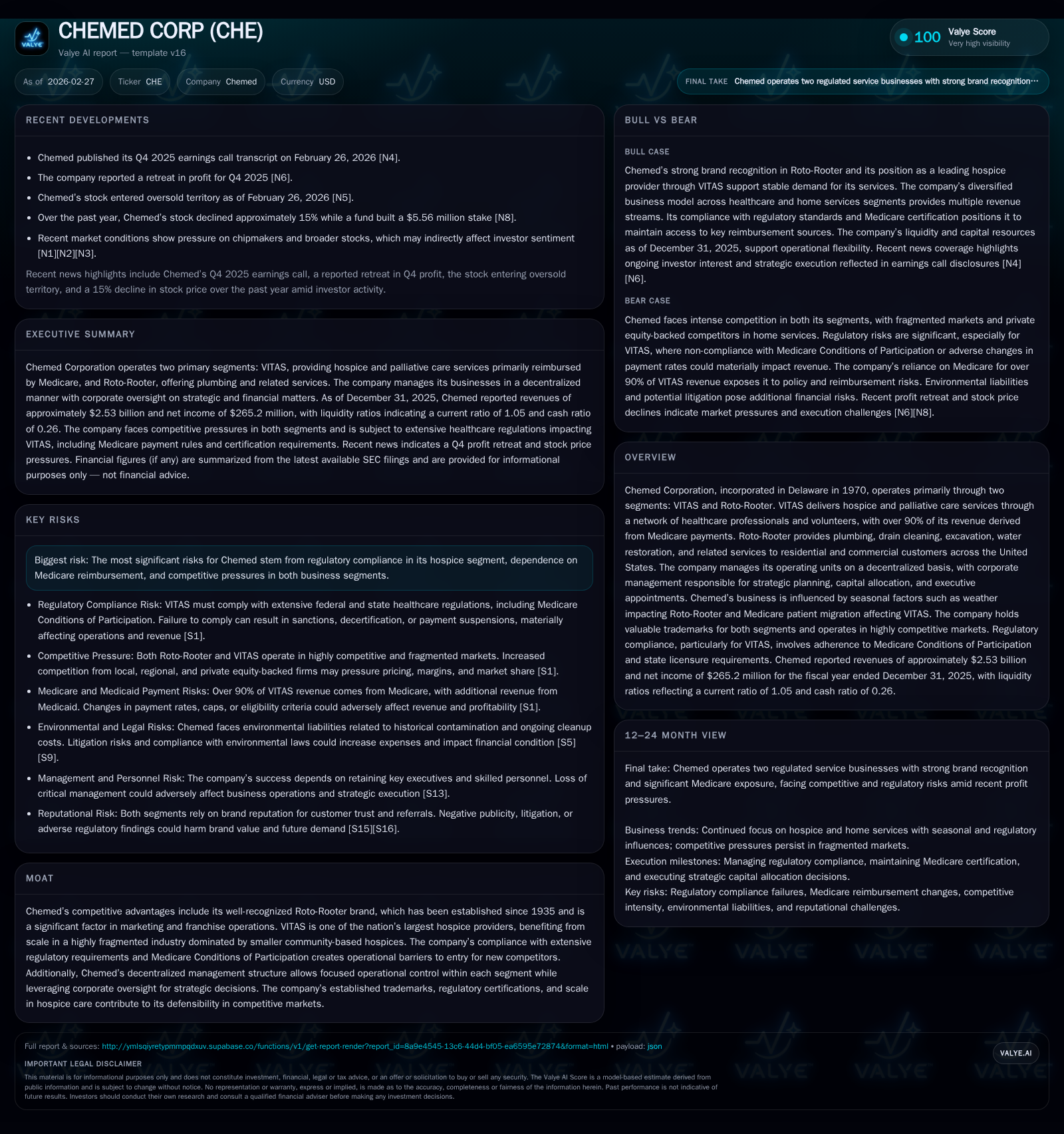
Chemed Corporation operates two distinct segments—VITAS, a leading hospice provider heavily reliant on Medicare reimbursements, and Roto-Rooter, a nationally recognized plumbing and home services brand competing in a highly fragmented market. Over the past four years, Chemed’s revenue grew steadily, driven primarily by VITAS’s top-line expansion, though operating income and net income faced pressure from regulatory cost compliance and rising expenses in both segments. Regulatory scrutiny and Medicare policy risks cloud VITAS’s growth prospects, while Roto-Rooter grapples with increased competition, marketing cost inflation, and weather-driven seasonality. Capital allocation has favored aggressive share repurchases alongside growing dividends, reflecting management’s confidence despite sector uncertainty. Key watch points include Medicare reimbursement trends and evolving competitive dynamics impacting customer acquisition costs.
Distinct Segment Overview: The Backbone of Chemed's Revenue Streams
Chemed Corporation's business model rests firmly on two operational pillars: VITAS Healthcare's hospice and palliative care services, and Roto-Rooter's residential and commercial plumbing-related offerings [S1][S7][S8]. These segments operate under a decentralized structure whereby each maintains distinct operational autonomy but aligns strategically through corporate oversight focused on capital allocation and executive appointments [S1][S8].
VITAS commands a leading position as one of the largest U.S. hospice providers—a sector heavily regulated under Medicare Conditions of Participation. With over 90% of its revenue derived from Medicare payments, including per diem reimbursement for end-of-life care, VITAS's financial health is closely tied to federal healthcare policy dynamics [S9][S16]. Moreover, certain states require Certificates of Need for hospice operations, adding layers of regional regulatory compliance that act as entry barriers [S7][S9].
Conversely, the Roto-Rooter segment capitalizes on a well-known brand established since 1935 to provide plumbing, drain cleaning, excavation, water restoration, and related services across diverse U.S. locales. This brand prominence supports a significant franchise operation subject to federal and state franchising laws including FTC regulations on franchise disclosures as well as state-specific registration requirements [S1][S7]. The segment faces notable seasonality factors driven by weather patterns affecting demand for emergency repairs or seasonal maintenance [S7][S9].
Both segments contend with rigorous regulatory environments—hospice under extensive healthcare fraud prevention statutes, while Roto-Rooter must navigate complex franchise law landscapes alongside environmental compliance [S10][S17].
Historical Performance Trends Highlighting Growth Drivers in Both Segments
Between FY2022 through FY2025, Chemed delivered consistent revenue growth at a compounded rate of approximately 4.1%, climbing from $2.13 billion in FY2022 to nearly $2.53 billion by FY2025 [F1]. This increase was largely propelled by VITAS’s steady expansions within Medicare-covered patient populations despite rising scrutiny around claims.
Operating income showed more volatility; after peaking near $366 million in FY2024 it contracted by approximately 7.7% to $338 million in FY2025 as margin headwinds intensified from cost inflation—including labor and regulatory compliance expenditures—and competitive pressures within the plumbing services business [F1]. Net income followed a similar trend with a 12.2% decline year-over-year to $265 million.
Operating cash flows remained robust but also slipped by roughly 7% YoY to $388 million due largely to working capital effects amidst higher claim administration costs [F1]. Capital expenditure outlays rose notably in FY2025 (+26.8%), reflecting investments presumably directed towards sustaining infrastructure across both segments.
Historical performance (annual)
| FY | Rev ($bn) | Net ($mm) | CFO ($mm) | OpInc ($mm) | Rev YoY | Net YoY |
|---|---|---|---|---|---|---|
| 2025 | 2.5 | 265 | 388 | 338 | +4.1% | -12.2% |
| 2024 | 2.4 | 302 | 417 | 366 | +7.4% | +10.8% |
| 2023 | 2.3 | 273 | 330 | 341 | +6.1% | +9.2% |
| 2022 | 2.1 | 250 | 310 | 343 |
Source: SEC companyfacts cache [F1].
Capital returns and efficiency (annual)
| FY | Div ($mm) | Buybacks ($mm) | FCF ($mm) |
|---|---|---|---|
| 2025 | 32 | 432 | 325 |
| 2024 | 27 | 361 | 368 |
| 2023 | 24 | 68 | 273 |
| 2022 | 22 | 115 | 253 |
Source: SEC companyfacts cache [F1].
Overall profitability measures such as ROE approximate around 27%, supported by equity levels steady near $980 million at year-end FY2025 despite share repurchases totaling $431 million in that year alone [F1]. Dividends paid have steadily increased annually but remain modest relative to buybacks.
Regulatory Landscape Balancing Hospice Compliance and Operational Risks
The most substantial legal risks for Chemed derive from VITAS’s exposure to federal False Claims Act litigation stemming from billing practices with Medicare [S4][S5][S10][S13]. A prior Corporate Integrity Agreement expired in mid-2023 following extensive federal monitoring ensuring adherence to compliance mandates; however, ongoing government probes remain an operational overhead risk.
Key regulatory frameworks impacting VITAS include the Stark Law prohibitions on physician self-referrals which may affect contracts where physicians guide patient admittance or services provided [S13][S19]. Anti-kickback statutes require vigilant structuring of relationships with suppliers and referral sources [S22]. Failure to comply can lead to large fines, civil penalties reaching treble damages per claim filed improperly, exclusion from federally funded programs including Medicare/Medicaid participation suspension or revocation—with potentially crippling financial consequences.
VITAS must also comply with HIPAA/HITECH standards concerning patient data privacy amidst increasing cybersecurity threats inherent in digital healthcare recordkeeping [S16][S21]. Medicare administrative contractors conduct regular audits via ‘‘Targeted Probe & Educate’’ programs aiming to tighten claims validation further elevating operational risk profiles [S24].
Roto-Rooter faces comprehensive franchising oversight addressing disclosure requirements prior to sale or offer of franchises along with multi-jurisdictional state-specific franchise registration demands [S1][S7]. Environmental regulations pertinent to waste disposal (septic tank pumping) and employee safety introduce additional costs given hazardous materials handling common in water restoration activities [S17].
Both units operate amid shifting regulations that can impose new reporting burdens or necessitate costly remedial actions; these compliance expenditures contribute materially to expense structures affecting margins.
Competitive Dynamics Impacting Roto-Rooter Amid Fragmented Market Structure
The plumbing, drain cleaning, excavation, and water restoration sectors serviced by Roto-Rooter remain intensely fragmented with numerous local/regional players competing alongside newer private equity-backed entrants pooling home services under common platforms [S1]. Competitive differentiators revolve around several factors including brand recognition—which favors Roto-Rooter given its longstanding national footprint dating to the mid-1930s—emergency service response times critical for urgent calls, breadth of service offerings covering both routine maintenance and complex repairs, pricing strategies sensitive within regional markets, comprehensive service guarantees enhancing customer trust as well as evolving advertising approaches reacting swiftly to shifts brought about by AI-powered search algorithms disrupting conventional marketing effectiveness [S1].
Franchise law compliance adds complexity given differing state requirements regulating franchise terminations or renewals plus inventory purchase obligations inflicted upon franchisors if franchises dissolve unexpectedly without good cause protection under law [S1]. These legal nuances necessitate continuous oversight increasing operating overhead.
Weather variability acts as an exogenous demand driver; unusually mild winters or wet/dry spells significantly influence call volumes regionally creating pronounced quarter-to-quarter results variation uncommon in less seasonally dependent industries [S7]. Cost inflation affecting vehicle upkeep—a key vector for technician mobility—and raw materials (e.g., steel cabling) also weigh on unit economics making pass-through price adjustments delicate without alienating price-sensitive customers [S20].
Capital Allocation and Returns: Navigating Shareholder Value through Dividends, Buybacks, and Investment
Chemed demonstrates a disciplined capital allocation framework balancing reinvestment into its operational base against distributions rewarding shareholders. The firm generated approximately $388 million operating cash flow last fiscal year investing $63 million into capital expenditures—a noticeable step-up reflecting investments possibly targeting IT upgrades in hospice operations alongside fleet modernization at Roto-Rooter [F1].
Free cash flow approximates $325 million after capex outlays maintaining ample liquidity at $74 million in cash & equivalents with an overall current ratio near parity (~1.05), indicating an ability to meet short-term obligations comfortably though not excessively unconstrained by working-capital buffers at this juncture [F1][S12].
Share repurchases surged dramatically in FY2025 climbing over $431 million compared with sub-$115 million levels three years ago emphasizing management’s view that buybacks represent efficient use of excess cash amid limited material acquisitions or organic capex needs currently noted by management transcripts [F1][N2]. Dividend payments have incrementally risen each year yet remain modest relative to buyback scale totaling just under $32 million last year—a strategy perhaps calibrated toward maximizing total shareholder return while preserving reinvestment headroom.
Return on equity stands around a strong ~27%, reflective of stable net income generation relative to shareholder equity despite recent margin pressures underpinning disciplined profitability focus [F1]. Leverage ratios are manageable although embedded covenants could constrain debt capacity under deteriorating earnings scenarios emphasizing prudent balance sheet stewardship incorporated into strategic planning discussions reported publicly [S12][N2].
Future Outlook: Growth Prospects and Operating Constraints across Healthcare and Home Services
Looking ahead, Chemed faces mixed growth vectors tempered by external challenges particularized uniquely within each operating segment.
VITAS anticipates growth opportunities primarily tied to demographic trends favoring hospice utilization alongside selective geographic expansion pending requisite licensing—contingent upon managing compliance rigorously especially relating to ongoing Medicare reimbursement frameworks subject to potential future modifications or moratoria constraining hospices’ certifications broadly [N2]. Medicaid policy nuances also factor into regional revenue stability given some states’ varying scope of coverage.
Margin outlook remains sensitive as increasing labor costs compounded by inflationary supply expenses may outpace any incremental rate adjustments allowed within rigid Medicare fee schedules requiring careful cost management sophistication going forward to preserve profitability thresholds set historically.
For Roto-Rooter, competitive intensity is expected to persist; private equity funded rivals continue market consolidation efforts shifting pricing power dynamics while marketing expenses rise driven by search engine algorithm complexity employing AI tools altering traditional advertising efficacy requiring heightened innovation investments [N2]. Weather unpredictability will continue exerting event-driven demand volatility complicating quarterly forecasting efforts.
Capital spending plans will likely prioritize technology initiatives enhancing scheduling efficiency plus service delivery optimization alongside incremental vehicle replacements vital for maintaining emergency response standards underpinning brand reputation criticality outlined during earnings calls [N2].
The company will need sustained attention toward human capital management amid post-pandemic labor markets exerting recruitment/retention challenges particularly for frontline technicians at Roto-Rooter and skilled nursing/care professionals across VITAS hospices requiring competitive compensation structures balanced against margin preservation objectives enforced through tight cost controls documented in recent management commentary [N2].
Analysts’ Watchlist: Key Metrics and Milestones Through 2026
Investors should closely monitor several key performance indicators emerging through ongoing filings up until full calendar year guidance emerges:
- Revenue trajectory particularly VITAS’s Medicare patient admissions growth rates corresponding with CMS policy updates or moratoria status affecting Certificates of Need licensing regimes regionally [N2].
- Margin developments tracking cost inflation pass-through success both at hospice (labor/supplies) and plumbing sides (raw materials/maintenance expenses).
- Legal/regulatory developments linked with any new False Claims Act litigations or government enforcement actions which could materially impact reserves or require additional compliance spending beyond recent cycles cited previously.[N2],[N6]
- Buyback cadence fluctuations vs dividend escalations illustrating management capital return preferences reflecting confidence levels.[N5],[N7]
- Operational milestones such as new geographic entries/losses or contraction amid competitive shifts documented during quarterly reports.[N2],[N6]
Careful attention should be given also toward interplay between macroeconomic factors influencing discretionary repair service demand versus demographic tailwinds supporting healthcare service volume growth underscoring the dual-segment narrative foundation unique within Chemed’s portfolio.
Disclaimer: This report is intended solely for informational purposes based on public domain filings and news sources without offering investment advice or recommendations. All financial data are sourced explicitly from referenced SEC filings or verified news transcripts without extrapolation beyond stated facts.
Disclaimer: This is research-only, informational analysis and not investment advice. It may include AI-generated interpretation and general industry context. Always verify important details using primary sources.

Comments