
CIENA Corp’s Q2 Surge: AI-Driven Networking Demand Fuels Growth and Profit
CIENA's latest quarterly results reflect strong growth propelled by AI-led networking demand, advancing its integrated hardware-software-services model and lifting full-year guidance.
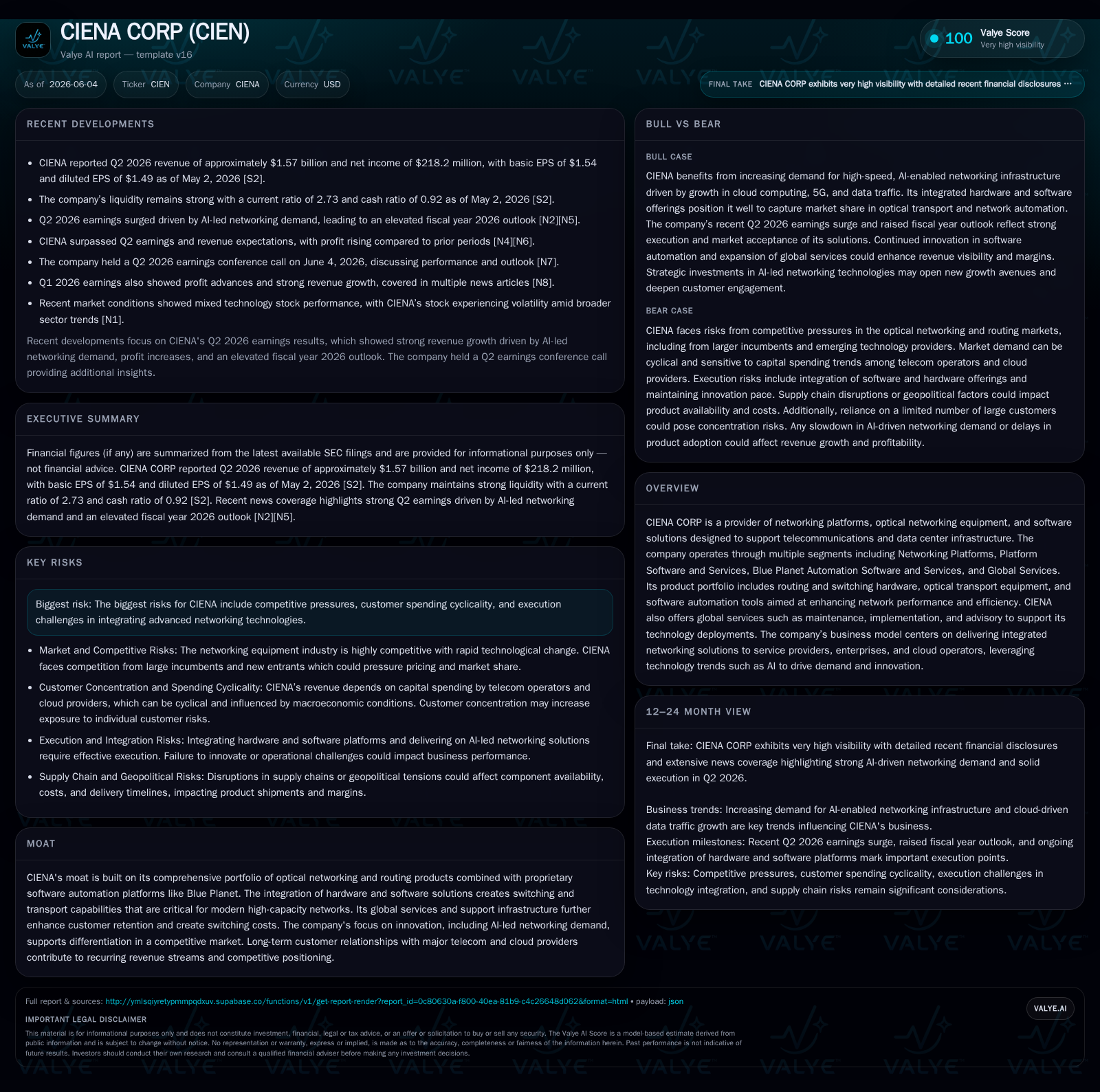
In its Q2 fiscal 2026 filing, CIENA reported a substantial revenue increase driven by heightened demand for optical networking products and expanding services, underpinned by AI-fueled network automation trends. The company’s blended business model integrating Networking Platforms, Platform Software & Services, proprietary Blue Planet automation software, and Global Services further reinforces switching costs and customer retention. Against competitive pressures and capital expenditure cyclicality risks, CIENA's sustained innovation and broad solution portfolio position it well to capitalize on structural growth in telecom and cloud infrastructure investments. Its strong balance sheet and cash flow generation support ongoing R&D investments critical to maintaining differentiation.
Latest Quarterly Performance Highlights
CIENA’s Q2 fiscal 2026 results filed June 4 demonstrate a marked acceleration in top-line growth bolstered by AI-induced network modernization demand. Total revenues reached $1.57 billion for the quarter compared to $1.13 billion year-over-year, driven predominantly by strong optical hardware sales within the Networking Platforms segment complemented by notable growth in Services revenues [S2]. This surge is more than a cyclical uptick; management explicitly links the uplift to robust adoption of AI-enabled network automation capabilities that increase customer investment confidence in CIENA's solution suite [N1]. Despite inflationary pressures on components and supply chain challenges common across tech sectors, gross margins showed resilience due to product mix improvement favoring higher-value offerings.
Profitability mirrored this trend with net income expanding dramatically over last year’s first half—from roughly $53 million to $368 million—on the back of operational leverage and disciplined expense management even amid increased R&D spend supporting innovation momentum [S2]. Cash flow from operations strengthened correspondingly, underscoring effective working capital controls despite rising inventories tied to supply chain buffering [S2]. Concurrent with earnings, CIENA raised its full-year fiscal 2026 outlook reflecting confidence that AI-driven networking demand will sustain through the remainder of the year [S3][N3].
Integrated Business Model Underpinning Product and Service Revenue Streams
CIENA operates a segmented but highly integrated business encompassing four principal lines: Networking Platforms (routing/switching/optical transport hardware), Platform Software & Services (network control systems), Blue Planet Automation Software & Services (proprietary AI-focused orchestration tools), and Global Services (maintenance, implementation, advisory) [S1]. This layered offering enables CIENA to capture value beyond point product sales by embedding into customers’ network operations via long-term service contracts. Typically sold to major telecom operators, global cloud infrastructure players, and large enterprises facing complex network performance demands, these solutions address both increasing capacity requirements as well as operational efficiency imperatives.
The hardware backbone consists of advanced optical transport equipment designed for metro, access aggregation, and core network layers—critical infrastructure where performance stakes are high given escalating traffic volumes led by cloud workloads and connectivity applications. Overlaying this is CIENA’s differentiated software capability through the Blue Planet platform that automates provisioning, fault management, and analytics using AI algorithms tailored to optimize network utilization dynamically. This integration fosters entrenched switching costs since clients depend on both specialized hardware compatibility and continuous software enhancements driving retention.
Global Services amplify this moat by delivering lifecycle management functions including installation support and predictive maintenance services that reduce downtime risk—a critical factor for service providers reliant on consistent uptime. This recurring revenue component also stabilizes overall earnings against hardware sales volatility typical in telecom capex cycles [S1][F1]
Industry and Competitive Position through an Automation and AI Lens
Within the optical networking industry landscape—historically dominated by hardware innovators—CIENA differentiates itself by marrying automated software intelligence to its product lines faster than many rivals who remain focused mainly on physical transport devices. While competitors like Ciena’s peers often offer discrete solutions or lag in holistic orchestration capabilities, CIENA’s Blue Planet suite leverages AI-driven predictive analytics that facilitate real-time network reconfiguration without manual intervention—a compelling value proposition given modern networks’ complexity.
This strategic emphasis on network automation aligns with broader market transitions toward software-defined networking (SDN) paradigms where agility enables carriers and cloud operators to manage escalating data traffic cost-effectively. Moreover, CIENA’s investment in proprietary platforms enhances its ability to negotiate multi-year contracts with large customers who increasingly view integrated HW-SW-Service bundles as essential rather than optional.
Supply chain constraints pose external risks globally; however, CIENA appears agile in managing component sourcing while investing steadily in R&D to maintain technology leadership amidst regulatory scrutiny on telecommunications infrastructure resiliency [S1][N1]. Peer benchmarking suggests that while companies like Nokia or Huawei offer competitive scale advantages or vertically integrated portfolios, CIENA’s particular blend of automation software depth combined with global service reach places it in a differentiated competitive position attractive for fulfillment of next-generation network needs.
Key Growth Drivers in Optical Networking and Software Automation
Several distinct but interrelated drivers underpin near- to medium-term growth prospects:
- Network Capacity Expansion: Rush toward upgrading metro core networks due to rising broadband traffic continues unabated. As fixed wireless access (FWA), 5G backhaul, multi-cloud architectures proliferate, demand for optical transport gear surges [S1].
- AI-Enabled Automation Demand: Customers seek intelligent orchestration tools like Blue Planet that reduce OPEX by automating service provisioning—a shift confirmed by increased Platform Software & Services bookings reported recently [N3].
- Consumption Model Evolution: Clients are adopting modular procurement approaches combining hardware purchases with subscription-based software services enabling flexible scaling aligned with usage patterns—boosting recurring revenue visibility [S1].
- Service Contract Expansion: Continued penetration of maintenance/support services broadens revenue streams beyond one-time device sales while enhancing customer stickiness.
These drivers collectively enhance key SaaS-inspired KPIs such as net retention rates within the services segment powered by regular software upgrades combined with consulting engagements [N3]
Furthermore, ASU No. 2025-05 accounting changes adopted prospectively could mildly alter credit loss estimates affecting receivables management though not materially impacting core operating metrics yet reported as a compliance note [S2]. Management must navigate these factors carefully without compromising innovation investment pace.
Upcoming Catalysts: Guidance and Demand Signals to Monitor
Investors should track several near-term developments:
- Quarterly order backlog updates indicating sustainability of momentum beyond H1 FY26,
- Margins progression reflective of improving operating leverage from higher software contribution,
- Customer adoption metrics post new product releases featured during earnings calls,
- Feedback loops from major telecom/cloud customers regarding contract renewals or expansions signaling structural relationship strength.
The company’s raised FY26 outlook sets a higher baseline that must be validated through consistent execution evidenced by upcoming earnings conferences slated after this report release date [S2][N5]. In addition, monitoring competitor moves in automated network orchestration will contextualize relative positioning advancements.
Supporting Financial Snapshot from Latest Quarter
CIENA reported approximately $1.05 billion in cash and cash equivalents at quarter-end May 2 with additional short- and long-term investments providing ample liquidity buffers against near-term operational volatility [S2][F1]. The current ratio was approximately 2.73 based on current assets of $3.57 billion and current liabilities of $1.31 billion as of the same date [S2][F1].
Operationally the company demonstrated robust cash conversion aligning with reported $368 million net income over six months despite incremental share-based compensation expenses signaling retention incentives aligned with talent criticality. Continued balanced investment across segments supports confidence that CIENA can capitalize effectively on emergent AI-driven networking market expansions while cushioning downside risks inherent in cyclical end markets.
This analysis synthesizes SEC filings up through June 4, 2026 ([S2], [S3], [S1]) alongside real-time market reporting ([N1], [N3], [N5]) providing an informed evaluation suitable for buy-side professionals monitoring CIENA CORP without investment research view implications.
Disclaimer: This is research-only, informational analysis and not investment advice. It may include AI-generated interpretation and general industry context. Always verify important details using primary sources.

Comments