
Sprinklr’s Platform Evolution: AI Integration and Customer Base Refinement Impact
Sprinklr’s recent quarterly filing highlights ongoing investments in AI-driven Unified-CXM capabilities alongside strategic customer portfolio pruning amid rising cost pressures.
In its Q1 FY2027 10-Q, Sprinklr reported a solid increase in subscription revenue driven by expanded usage within existing large enterprise clients, despite a reduction in total customer count reflecting a shift toward higher-value accounts. The company faces near-term margin compression due to escalating cloud and data costs but continues to advance its AI-native platform to deepen customer engagement and retention. Key metrics such as remaining performance obligation (RPO) and net dollar expansion rate (NDE) underscore robust underlying demand, while management emphasizes prioritizing long-term growth through innovation and selectivity in customer acquisition.
Q1 FY2027 Operating Update Highlights
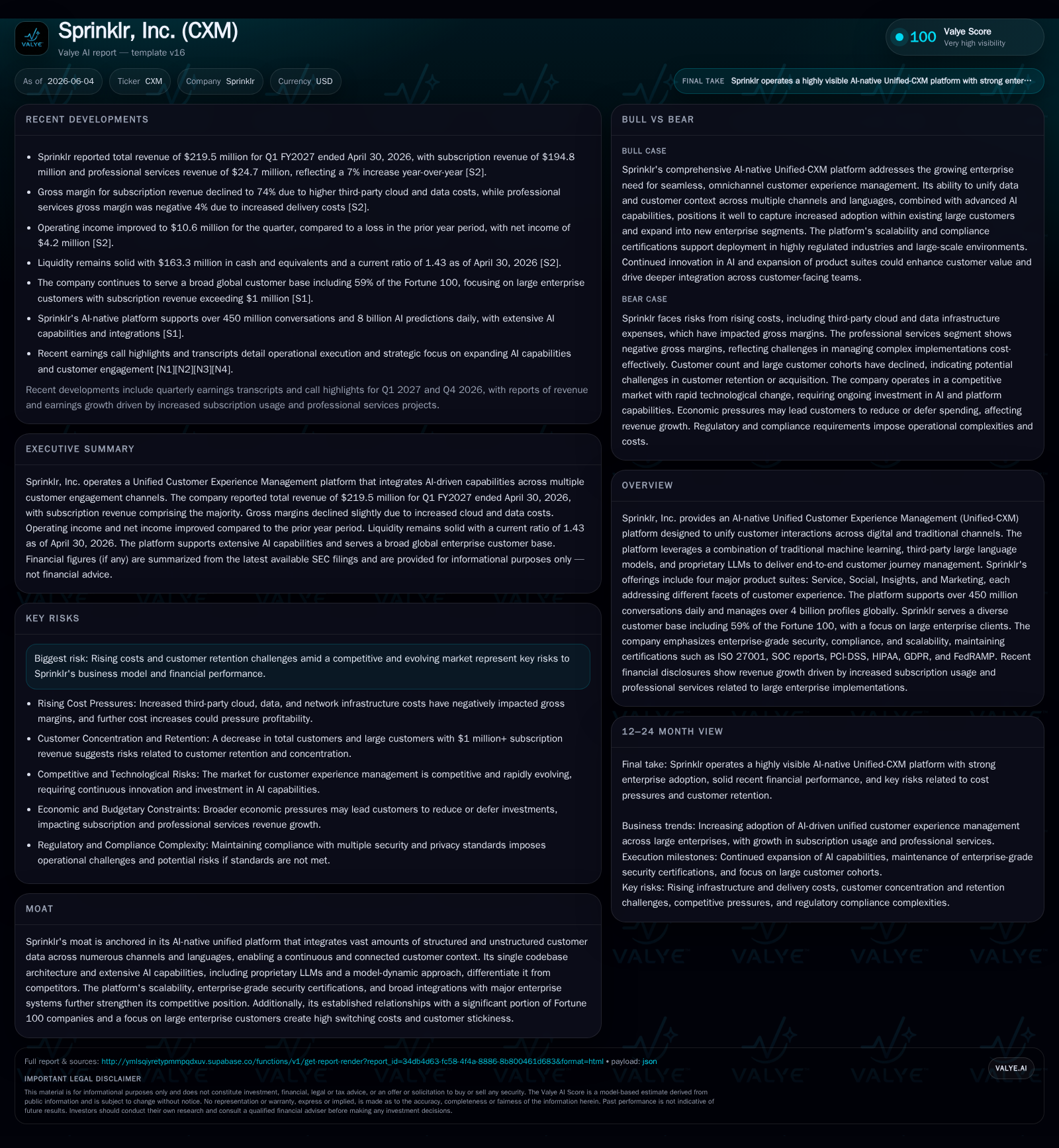
Sprinklr’s Q1 FY2027 Form 10-Q filed June 4 paints a picture of measured progress amidst a complex macro environment. The company reported Remaining Performance Obligation (RPO) of $1.038 billion with current RPO (cRPO) of $627.1 million as of April 30, signaling multi-year contract visibility for revenue recognition ahead [S2]. Subscription revenue grew by 6% year-over-year to $194.8 million driven primarily by expansion in feature utilization among existing clients rather than broad new logo acquisition.
However, the quarter revealed notable pressures on gross margins due to rising subscription-related costs—specifically a 21% increase in subscription cost of revenue reflecting elevated cloud infrastructure fees and third-party data expenses necessary to support Sprinklr's AI-intensive platform operations [S20]. This dynamic contributes to near-term margin compression even as top-line growth maintains momentum.
Management acknowledges macroeconomic uncertainties including fluctuating inflation rates, geopolitical tensions (Russia-Ukraine conflict, Middle East instability), currency fluctuations, tariffs, and U.S. government shutdown challenges as potential headwinds that could affect budgetary cycles and deal closures globally [S2]. These conditions compel a cautious approach while underpinning sustained investment into core platform innovation.
Sprinklr’s Unified-CXM Business Model and Product Differentiation
Sprinklr generates revenue primarily from subscription fees for access to its proprietary Unified Customer Experience Management (Unified-CXM) platform along with related professional services — notably onboarding and implementation support. Its offering spans four major suites: Sprinklr Social, Marketing, Insights, and Service each tailored to distinct facets of the customer journey management ecosystem powered by an AI-native architecture capable of digesting vast volumes of heterogeneous data across digital and traditional channels [S1],.
The licensing models blend per-user structured plans with volume-based tiers allowing scalability tailored to enterprise complexity. The platform is designed for enterprises demanding seamless cross-channel conversation management coupled with centralized governance protocols to reduce operational silos. This unification creates significant switching costs anchored in deeply embedded workflows spanning marketing teams, customer service units, legal/compliance functions, all leveraging proprietary insights derived from in-house large language models alongside third-party LLMs with dynamic model selection mechanisms.
Critical enterprise-grade compliance certifications including ISO 27001, SOC reports series, PCI-DSS for payment data security, HIPAA for healthcare-sensitive engagements as well as GDPR and FedRAMP elevate trustworthiness—a key gating factor for global corporations operating under stringent regulatory scrutiny.
Competitive Positioning: Moat Built on AI-Native Platform and Enterprise Focus
Sprinklr commands a distinctive niche via its AI-native foundation that fuses structured CRM data sets with broader unstructured social media streams enabling unified contextual views at unprecedented scale—supporting over 450 million daily conversations globally. By servicing approximately 59% of the Fortune 100 companies with tailored solutions adapted for global scale (150+ languages supported), Sprinklr benefits from client concentration among withdrawal-resistant enterprises that exhibit high retention fueled by ecosystem entrenchment.
Large accounts constitute a meaningful portion of sales; customers generating more than $1 million annually numbered 141 as of fiscal year-end January 31, 2026—highlighting concentrated revenue pools underpinned by multi-year subscriptions featuring built-in upsell pathways measured via net dollar expansion rates (NDE) [S1],[S2]. Such dynamics signal strong client stickiness supported by integrated workflows difficult for competitors to replicate quickly.
While Adobe Experience Cloud or Salesforce Marketing Cloud provide adjacent CXM capabilities generally focused on marketing automation or CRM-centric workflows respectively, Sprinklr positions itself uniquely through conversational AI-powered omnichannel unification that targets the entire customer experience chain including service and insights layers—not just marketing activation. Its single codebase architecture furthers agility in feature deployment compared to modular legacy stacks.
Industry Dynamics Affecting Pricing Power and Cost Structures
The SaaS sector faces growing cloud service cost pressures stemming from broader industry supply constraints in data center capacity alongside inflationary labor costs impacting operations personnel embedded in subscription delivery support functions. Sprinklr explicitly cites these rising expenses as drivers behind increased costs of subscription revenue (+21% QoQ) coupled with elevated professional services delivery costs linked to scaling large implementation projects [S20],[S1].
Subscription gross margins remain significantly higher than professional services margins but aggregate margins see variability tied to mix shifts between these streams; higher incidence of project-driven professional service activities dampens overall margin trends currently. Seasonality effects also influence revenue recognition timing given contractual concentration of purchasing activity in Q4 followed by collections cycles weighted early next fiscal year [S1],[S2].
Pricing power appears durable within core enterprise segments due to differentiated offering breadth but is partly offset near term by competitive pricing pressures deriving from evolving market maturity and expanding alternative CXM platform choices. Cost structure leverage will be critical in extending operating profitability amid external cost inflation.
Growth Catalysts: AI Innovation, Customer Base Refinement, and Market Penetration
Sprinklr’s strategic emphasis focuses on continued rollout of AI-driven enhancements such as "Social Copilot," an AI-powered assistant designed to accelerate social media insight extraction boosting marketer productivity at scale. Investments into proprietary LLM technologies combined with selective use of third-party models form the technological backbone enabling continuous feature refreshment aligned with evolving enterprise needs [S1],.
Simultaneously the customer profile has been refined deliberately; total customers declined from 1,930 to 1,677 over the fiscal year ended January 2026 reflecting intentional shedding or non-renewal among lower tier or more price-sensitive accounts while retaining or expanding larger contracts generating $1 million+ recurring revenues. This “quality over quantity” approach aims at improving lifetime value metrics driving healthier NDE figures underpinning recurring subscription growth despite headcount contractions in sales force during restructuring phases earlier in the fiscal period [S1],[S2].
Strong net dollar expansion rate serves as a key metric validating this model: Sprinklr evidences ongoing expansion within existing accounts fueled by both volume consumption growth and incremental feature adoption despite some offsetting churn from smaller contracts—a positive indicator for sustainable recurring revenue progression.
Risks and Constraints: Rising Cloud Expenses, Customer Retention Challenges, Macro Uncertainty
The operating environment reveals layered risk factors centered on pressure from escalated cloud hosting fees that compress adjusted gross margins versus historical baselines; Mcroeconomic instability ranging from inflation volatility to geopolitical headwinds inject uncertainty into enterprise IT budget cycles potentially slowing new deal velocity or driving select deferrals in spending patterns as cited around Russian-Ukrainian hostilities & Middle East conflicts along with U.S.-specific disruptions like government shutdowns affecting federal procurement timelines [S2].
Customer retention remains challenged by competitive intensity where newer entrants or incumbent strengths push slower upgrade paths or contract downsizing primarily among mid-tier segments trimmed strategically within their portfolio.
Maintaining innovation cadence will be crucial against peer offerings where alternative SaaS vendors aggressively integrate emerging generative AI capabilities potentially narrowing differentiation windows if execution lags occur.
Looking Ahead: Key Milestones, Guidance Indicators, and Execution Watchpoints
Investor focus should sharpen on renewal rates particularly among concentrated large enterprise customers key to sustaining RPO levels above $1 billion thresholds. Monitoring net dollar expansion trends will elucidate upsell health shaping forward subscription growth trajectories.
Pipeline visibility around major product upgrades such as augmented AI tools embedded within Social & Insights suites provides tangible markers for market responsiveness alongside continuous improvements targeting workflow automation gains sought by CX teams balancing productivity alongside personalization demands.
Macroeconomic developments including inflation trajectory stabilization or escalation will directly influence corporate IT budgets; tracking sales cycle duration changes across regions can signal shifting demand momentum.
Financial Profile Snapshot – Balance Sheet and Liquidity Context
As of April 30, 2026, Sprinklr held $163 million in cash and equivalents with current assets totaling approximately $745 million against current liabilities near $520 million, yielding a current ratio of about 1.43 [F1]. Historical total debt was around $80 million with net debt positioned negatively given cash buffers, indicative of a conservative leverage posture typical for SaaS growth-investing profiles [F1].
The active share repurchase authorization—headed toward full utilization via accelerated repurchase agreements plus discretionary buys—demonstrates capital return discipline balanced alongside funding operational growth priorities [S5],[S6].
This analysis is based exclusively on publicly disclosed filings providing an objective synthesis without investment research views.
Disclaimer: This is research-only, informational analysis and not investment advice. It may include AI-generated interpretation and general industry context. Always verify important details using primary sources.

Comments